Reservoir Liner Design Considerations For Large Irrigation Systems | Guide
For irrigation district engineers, water resource managers, and EPC contractors, understanding reservoir liner design considerations for large irrigation systems is essential to prevent water loss, ensure structural integrity, and optimize lifecycle costs. Unlike small farm ponds, large irrigation reservoirs (10–500 ha) are subjected to significant hydraulic heads (up to 15 m), seasonal water level fluctuations (drawdown), wave action, and freeze-thaw cycles. Proper design must address geomembrane material selection (HDPE vs LLDPE), thickness (0.75 mm to 2.0 mm) based on head pressure and subgrade conditions, slope stability (interface friction between liner and subgrade), anchor trench details, and liner protection against UV, ice, and mechanical damage. This guide provides a systematic engineering approach to each design factor, including seepage modeling, factor of safety for slope stability, and durability requirements. Procurement managers will learn how to specify liner systems that meet irrigation district standards and achieve 50-year service life.
What is Reservoir Liner Design Considerations for Large Irrigation Systems
Reservoir liner design considerations for large irrigation systems encompass the technical, hydraulic, geotechnical, and material factors that determine the performance and longevity of an impermeable lining for agricultural water storage. Unlike municipal water containment, irrigation reservoirs face unique challenges: large surface area exposed to wind and ultraviolet radiation, wide water level fluctuations (often drawn down completely each season), potential for ice damage in cold climates, and contact with agricultural chemicals including fertilizers and herbicides. Key design inputs include maximum water depth determining hydrostatic pressure, side slope angles (typically 1V:2H to 1V:4H), subgrade soil type (clay, sand, rock), and local climate parameters such as UV index, freeze-thaw cycles, and wind speed. The design process selects a liner system (single geomembrane, composite with geosynthetic clay liner, or concrete-faced) and specifies thickness, material additives including ultraviolet stabilizers and antioxidants, and protection layers such as geotextile cushion or cover soil. For engineering and procurement, a well-designed liner reduces seepage from 2-5 m³/day/ha for unlined reservoirs to less than 0.01 m³/day/ha, saving millions of cubic meters of water over the system life and preventing waterlogging of adjacent farmland.
Technical Specifications for Irrigation Reservoir Liners
Key parameters for reservoir liner design considerations for large irrigation systems are listed below. Values assume HDPE geomembrane as the primary barrier.
| Parameter | Typical Value Range | Engineering Importance |
|---|---|---|
| Maximum hydraulic head (water depth) | 5 m – 15 m for irrigation reservoirs | Determines thickness required to resist puncture and bulge. For head exceeding 10 m, specify minimum 1.5 mm HDPE. For head exceeding 15 m or severe wave action, specify 2.0 mm. |
| Geomembrane thickness for HDPE | 1.0 mm – 2.0 mm (1.5 mm typical) | Thicker liners provide higher puncture resistance from subgrade rocks and ice impact. Thinner liners at or below 1.0 mm are suitable only for buried applications or lined channels, not open reservoirs. |
| Side slope angle (horizontal : vertical) | 3:1 to 5:1 | Slopes steeper than 3:1 require textured geomembrane or increased anchor trench depth. Design slope stability factor of safety must be 1.5 or greater. Flatter slopes (5:1) reduce liner stress. |
| Interface friction angle (liner to subgrade) | Smooth HDPE on compacted clay: 20°-25°; Textured HDPE on geotextile: 30°-35° | Determines maximum slope length that can be lined without slippage. Use textured liner on slopes steeper than approximately 4.5:1 (12 degrees). |
| Tensile strength at yield for 1.5 mm HDPE | Minimum 29 kN/m in both machine and cross-machine directions | Resists tensile forces from water pressure, thermal expansion, and subgrade settlement. Low strength may lead to stress cracking under sustained load. |
| Ultraviolet stability (retained strength after 500 hours accelerated weathering) | Minimum 80 percent retention | For exposed reservoirs without floating cover, ultraviolet exposure degrades unstabilized HDPE within 2-3 years. Carbon black content of 2-3 percent is mandatory. |
| High-pressure oxidative induction time (HP-OIT) | Minimum 400 minutes for 50-year design life | Long-term antioxidant package resists thermal-oxidative degradation. Lower HP-OIT values reduce expected service life significantly. |
| Permeability of composite liner (HDPE plus compacted clay) | 1×10⁻¹⁴ m/s to 1×10⁻¹⁵ m/s | Minimizes water loss to meet irrigation district efficiency targets of 95 percent or greater storage efficiency. |
Material Structure and Composition for Irrigation Reservoirs
Understanding material composition is critical for reservoir liner design considerations for large irrigation systems. The table below shows typical layers for a composite liner system.
| Layer or Component | Material | Function and Design Impact |
|---|---|---|
| Protective cover (optional) | Sand (100-200 mm thickness) or gravel with soil | Protects geomembrane from ultraviolet radiation, ice, maintenance equipment, and animal damage. If used, reduces ultraviolet stability requirement but increases construction cost. |
| Primary geomembrane liner | HDPE (smooth or textured) or LLDPE | Primary barrier against seepage. HDPE is preferred for large systems due to high strength and chemical resistance. Thickness is based on hydraulic head and subgrade quality. |
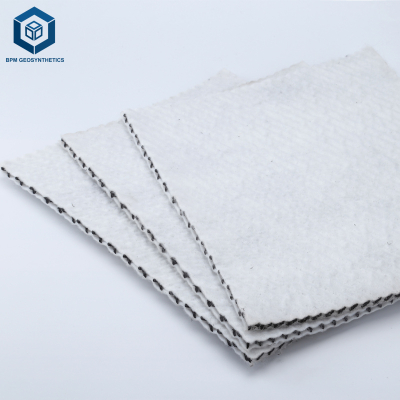
| Geotextile cushion (beneath geomembrane) | Nonwoven needle-punched fabric (200-400 grams per square meter) | Protects geomembrane from puncture by subgrade rocks or roots. Also acts as drainage layer for any leakage that reaches a secondary liner system. |
| Secondary liner (optional for critical zones) | Geosynthetic clay liner or 300 mm compacted clay | Provides redundant barrier. Used in high-consequence reservoirs such as drinking water sources or environmentally sensitive areas. Geosynthetic clay liner also self-seals small punctures. |
| Subgrade or foundation | Compacted native soil or select fill at 95 percent standard Proctor density | Provides stable base with uniform support. Remove all roots, rocks larger than 20 mm diameter, and organic matter. Slope grade toward low point for drainage. |
Manufacturing Process for Geomembranes Used in Irrigation Reservoirs
The manufacturing process influences reservoir liner design considerations for large irrigation systems. Key production steps include:
Raw material preparation: Virgin HDPE pellets are blended with carbon black at 2-3 percent concentration and antioxidant packages. For ultraviolet-exposed reservoirs, carbon black content is verified per ASTM D1603.
Extrusion using flat die method: Melt temperature is maintained at 200-230 degrees Celsius. The polymer is extruded onto a polished chill roll. Thickness is controlled by die lip gap and line speed. For textured liners required for slope stability, an embossing roll creates surface asperities with height of 0.25 mm or greater.
Cooling and winding: The sheet passes over cooling rolls, is inspected for pinholes using a high-voltage spark test, and is wound into rolls of 5-9 m width and 100-200 m length. Each roll is labeled with batch number and thickness.
Quality testing: Samples are tested for tensile strength, puncture resistance, tear resistance, carbon black content, and oxidative induction time. High-pressure oxidative induction time of 400 minutes or greater is required for 50-year irrigation reservoir design life.
Packaging: Rolls are wrapped in ultraviolet-blocking white-on-black polyethylene film to prevent premature ultraviolet exposure during storage and transportation.
Performance Comparison of Liner Materials for Irrigation Reservoirs
When evaluating reservoir liner design considerations for large irrigation systems, compare HDPE, LLDPE, and compacted clay liners.
| Material | Durability | Cost (installed per square meter) | Installation Complexity | Maintenance Requirement | Suitability for Large Irrigation Reservoirs |
|---|---|---|---|---|---|
| HDPE (1.5 mm, virgin resin, ultraviolet-stabilized) | Excellent. 50 years or more with HP-OIT of 400 minutes or greater. | 10 to 20 USD | Medium. Welding required. Textured specification needed for slopes. | Low. Annual visual inspection only. | Best for large systems. Tolerant of drawdown, agricultural chemicals, and ultraviolet exposure. |
| LLDPE (1.5 mm) | Good. More flexible than HDPE but slightly lower chemical resistance. | 8 to 16 USD | Low to medium. Easier to conform to irregular shapes. | Low. | Suitable for smaller reservoirs or shapes with curves. Lower puncture resistance than HDPE. |
| Compacted clay liner (600 mm thickness) | Fair. Cracks if not kept moist. Susceptible to root penetration. | 8 to 15 USD (if clay source is nearby) | High. Requires clay source, moisture control, and compaction equipment. | High. Requires maintenance of soil moisture to prevent cracking. | Only suitable in humid climates with local clay. Not recommended for reservoirs that undergo seasonal drawdown. |
Industrial Applications of Lined Irrigation Reservoirs
Reservoir liner design considerations for large irrigation systems apply to various agricultural and landscape scenarios:
On-farm storage for center pivot irrigation: Reservoirs ranging from 1 to 20 hectares with depth of 3 to 8 meters. Specification requires HDPE of 1.0 to 1.5 mm thickness, ultraviolet stabilized, with geotextile cushion.
District-level irrigation schemes: Reservoirs ranging from 20 to 200 hectares with depth up to 12 meters. Composite liner with HDPE plus geosynthetic clay liner or compacted clay is recommended to minimize seepage and meet water efficiency targets.
Pressurized irrigation systems including drip and micro-sprinkler: Require clean water free of sediment. Liner prevents turbidity from erosion. Specify HDPE of 1.5 mm thickness with smooth finish.
Tailwater recovery ponds: Capture runoff from irrigated fields. Liners must resist abrasion from sediment and occasional pesticide contact. LLDPE or thicker HDPE of 2.0 mm thickness is recommended.
Off-stream storage for groundwater banking: Large reservoirs exceeding 500 hectares with high hydraulic head. Double liner system with HDPE plus geosynthetic clay liner including leak detection layer. Design life targets 100 years.
Common Industry Problems and Engineering Solutions
Failure modes related to reservoir liner design considerations for large irrigation systems are often due to overlooked design factors.
Problem: Geomembrane floating or ballooning during initial reservoir filling.
Root cause: Subgrade not vented, allowing air to become trapped beneath the liner. As water level rises, trapped air pressure lifts the liner. Solution: Install subgrade venting system using perforated pipes connected to atmosphere. Alternatively, use textured liner that allows air to escape. Fill reservoir slowly while venting.Problem: Liner tears on steep slopes after drawdown when water level is lowered.
Root cause: Inadequate interface friction between liner and subgrade. Slope angle is too steep for smooth liner. As water recedes, liner slides downward causing wrinkles and tears at the toe of slope. Solution: Specify co-extruded textured geomembrane for slopes steeper than 4:1. Design anchor trenches with depth of 1.0 meter and backfill with compacted clay or concrete.Problem: Seepage beneath liner due to rodent or root penetration.
Root cause: Missing biobarrier layer. Rodents such as gophers or muskrats, or tree roots, penetrate the geomembrane. Solution: Install geotextile with rodent repellent such as capsaicin-impregnated fabric, or install granular repellent layer using broken glass or sharp gravel beneath the cushion layer. For areas with trees, create root barrier trench of 1.2 meter depth using heavy HDPE sheeting.Problem: Ice damage causing cracking of liner in winter climates.
Root cause: Ice expansion and contraction in shallow water zones of 0 to 2 meter depth. Ice sheets can puncture or tear HDPE. Solution: Maintain minimum water depth exceeding 2 meters during winter months, or install floating cover system. For reservoirs that freeze solid, use LLDPE which remains more flexible at low temperatures, or install sacrificial sand layer over the liner in freeze-prone zones.
Risk Factors and Prevention Strategies
Proactive risk management for reservoir liner design considerations for large irrigation systems includes the following strategies:
Improper subgrade compaction leading to differential settlement: Prevention: Compact subgrade to 95 percent standard Proctor density. For soft zones, over-excavate and replace with granular fill. Proof-roll the subgrade using a smooth drum roller to detect soft spots before liner placement.
Material mismatch using non-ultraviolet-stabilized liner in exposed reservoir: Prevention: Specify carbon black content of 2 to 3 percent and HP-OIT of 400 minutes or greater. For regions with high ultraviolet index, require ultraviolet testing per ASTM G154 for 1000 hours with minimum 80 percent strength retention.
Environmental exposure including wave action causing abrasion: Prevention: For reservoirs with long fetch exceeding 500 meters, wave height may exceed 0.5 meters. Use riprap wave barrier consisting of armor stone at the waterline, or increase liner thickness to 2.0 mm with additional geotextile cushion layer.
Inadequate anchor trench design leading to pullout under high water head: Prevention: Calculate anchor trench dimensions using factor of safety of 2.0 or greater against pullout. For hydraulic head of 10 meters, use trench depth of 0.8 meter, width of 0.8 meter, and backfill with compacted clay or concrete. For sloping anchor, angle the trench into the slope face.
Procurement Guide for Reservoir Liners in Irrigation Systems
For procurement managers, use this checklist for reservoir liner design considerations for large irrigation systems:
Hydraulic design inputs: Determine maximum water depth in meters, drawdown frequency expressed as full empty cycles per year, wave height based on fetch length, and number of freeze-thaw cycles per year.
Geotechnical inputs: Characterize subgrade soil type including clay, sand, or rock. Document slope angles and foundation settlement potential. Perform direct shear test to determine interface friction angle between liner and subgrade.
Liner material selection: For large reservoirs exceeding 10 hectares with water depth exceeding 5 meters, specify HDPE of 1.5 mm thickness smooth for bottom areas and 1.5 mm thickness textured for slopes steeper than 4:1.
Performance specifications: Require thickness tolerance of plus or minus 5 percent, tensile yield strength of 29 kN/m or greater for 1.5 mm material, HP-OIT of 400 minutes or greater, carbon black content of 2.0 to 3.0 percent per ASTM D1603, and ultraviolet retention exceeding 80 percent after 500 hours.
Ancillary materials: Specify geotextile cushion of nonwoven fabric at 200 to 400 grams per square meter, anchor trench details including depth, width, and backfill material, and subgrade venting system if required.
Supplier qualifications: Require ISO 9001:2015 certification and third-party laboratory accreditation. Request evidence of experience with irrigation reservoir projects including at least 10 projects each exceeding 50 hectares. Request material certificates and HP-OIT test reports for each production batch.
Warranty requirements: Seek warranty period of 25 to 50 years depending on HP-OIT value. Require that warranty covers ultraviolet degradation, seam integrity, and stress cracking resistance.
Engineering Case Study
Project type: District-level irrigation reservoir serving wheat and barley growing region.
Location: Western Australia. High ultraviolet index, hot summers, clay subgrade.
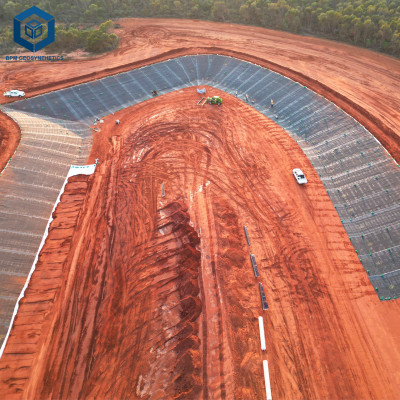
Project size: 45 hectares surface area, 10 meters maximum water depth, 1.2 million cubic meters storage capacity. Side slopes at 1V:3H ratio.
Design considerations applied: The engineering team implemented the following reservoir liner design considerations for large irrigation systems:
- Geomembrane: 1.5 mm HDPE, smooth on bottom floor, double-sided textured on side slopes with asperity height of 0.3 mm.
- Ultraviolet stability: Carbon black content of 2.5 percent, HP-OIT of 480 minutes.
- Subgrade preparation: 300 mm compacted clay layer at 95 percent Proctor density, overlaid with nonwoven geotextile cushion of 400 grams per square meter.
- Anchor trench: Perimeter trench of 0.8 meter depth by 0.8 meter width, backfilled with compacted clay.
- Freeze protection: Not required due to warm climate.
Results and benefits: The reservoir was installed in 2009. A 2024 inspection after 15 years of service showed no visible degradation, no tears, and intact welded seams. Seepage loss measured less than 0.1 mm per day, representing 99.9 percent storage efficiency. This saved approximately 2,500 megaliters per year compared to an unlined soil reservoir. Annual maintenance cost is 3,500 USD for visual inspection and patching of minor bird-related punctures. The irrigation district estimates a payback period of 8 years from water savings alone. HP-OIT retested in 2024 showed 410 minutes, still exceeding the 400 minute minimum, indicating remaining antioxidant life of 20 years or more.
FAQ Section
Q: What is the minimum thickness for an irrigation reservoir liner?
A: For water depth less than 5 meters, 0.75 mm HDPE may be used. For depth of 5 to 10 meters, specify 1.0 to 1.5 mm. For depth exceeding 10 meters or significant wave action, specify 1.5 to 2.0 mm. Always consult geotechnical review.Q: Is textured geomembrane required for side slopes?
A: For slopes steeper than 1V:4H (25 percent slope), textured liner increases interface friction and prevents slippage. For slopes of 1V:3H or steeper, textured liner is mandatory.Q: What is the expected service life of an irrigation reservoir liner?
A: With ultraviolet stabilizers and HP-OIT of 400 minutes or greater, 50 years or more is achievable. Without ultraviolet stabilizer, service life is only 2 to 5 years. Many HDPE liners in irrigation service have exceeded 30 years with proper design.Q: Can a liner be installed without a geotextile cushion?
A: Only if the subgrade is smooth, free of rocks larger than 20 mm diameter, and thoroughly compacted. However, geotextile cushion is cost-effective insurance, adding approximately 0.50 to 1.00 USD per square meter, and prevents punctures from future root growth or animal burrowing.Q: How does ice affect reservoir liners?
A: Ice can puncture HDPE in shallow zones of less than 2 meter depth due to expansion pressure. Solutions include maintaining deep water levels exceeding 2 meters during winter, installing a floating cover system, or using LLDPE which remains more flexible at low temperatures.Q: How can liner damage from cattle or wildlife be prevented?
A: Exclude animals using fencing around the reservoir perimeter. For bird damage from species such as pelicans or cormorants, use bird netting or acoustic scare devices. For rodent damage from gophers, install rodent-resistant geotextile or a broken gravel layer beneath the cushion.Q: What is the advantage of a composite liner system combining HDPE with geosynthetic clay liner?
A: The geosynthetic clay liner provides a secondary barrier and self-seals small punctures in the primary HDPE liner. This configuration is recommended for drinking water reservoirs or environmentally sensitive sites where zero seepage is mandated by regulations.Q: How are leaks tested after liner installation?
A: Conduct electrical leak location survey per ASTM D7703 for conductive geomembranes, or use water spray with dye indicator. For large reservoirs, fill slowly and monitor seepage through underdrain systems placed beneath the liner.Q: What maintenance is required for an irrigation reservoir liner?
A: Perform annual visual inspection for punctures, tears, and seam separation. Remove any sharp debris. Patch any damage using extrusion welding for HDPE or patch kit for other materials. Monitor water level changes to detect abnormal seepage rates.Q: Are there special considerations for reservoirs used with fertigation systems?
A: Yes. Fertilizers containing nitrates, phosphates, and sulfur compounds can be corrosive to some liner materials. HDPE is resistant to these chemicals. Ensure that antioxidant levels are adequate with HP-OIT of 400 minutes or greater. Rinse the liner after fertigation cycles to prevent residue buildup.
Request Technical Support or Quotation
For irrigation district engineers and EPC contractors, technical support is available to review your reservoir survey data, hydraulic head conditions, and subgrade analysis. Request a quotation for HDPE or LLDPE geomembrane with ultraviolet stabilizers, geotextile cushions, and anchor trench materials. Include HP-OIT test reports and project-specific warranty documentation.
About the Author
This guide was authored by geosynthetic and water resources engineers with over 15 years of experience in designing lined reservoirs for large-scale irrigation systems across Australia, North America, Africa, and South Asia. All recommendations follow USBR, USDA NRCS, and ICOLD guidelines for reservoir lining.