Which Geotextile GSM Is Suitable Under HDPE Liner
Which geotextile GSM is suitable under HDPE liner refers to the engineering determination of nonwoven geotextile weight (grams per square meter) required to provide puncture protection, cushioning, and filtration beneath HDPE geomembrane systems in containment, landfill, lagoon, and mining projects.
Technical Parameters and Specifications
Determining which geotextile GSM is suitable under HDPE liner depends on subgrade conditions, liner thickness, load stress, and expected service life. Common engineering ranges include:
Material: Needle-punched nonwoven polypropylene (PP) or polyester (PET)
GSM Range: 200 – 800 g/m²
Common Protection Grade: 300 g/m², 400 g/m², 500 g/m²
Tensile Strength (MD/CD): 8 – 25 kN/m
CBR Puncture Strength: 1.5 – 6.0 kN
Thickness (at 2 kPa): 2.0 – 6.5 mm
Permeability: ≥ 1 × 10⁻³ m/s
For most containment projects, the answer to which geotextile GSM is suitable under HDPE liner typically falls between 300–500 g/m². Heavier grades (≥600 g/m²) are used in mining or landfill environments with angular subgrade.
Structure and Material Composition
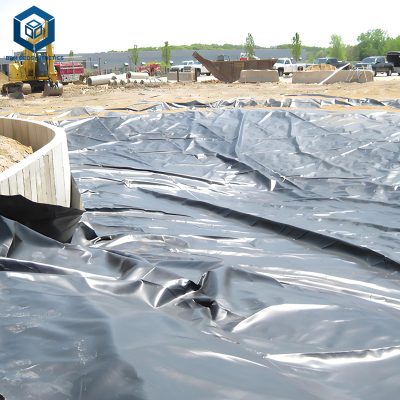
Typical liner protection system under HDPE includes:
Prepared Subgrade (Compacted soil or clay)
Nonwoven Geotextile Cushion Layer (Selected GSM)
HDPE Geomembrane Liner (1.0–2.5 mm)
Optional Upper Protection Layer (if backfilled)
Needle-punched fibers create a three-dimensional structure that absorbs stress concentrations and reduces puncture risk to the HDPE liner.
Manufacturing Process
1. Fiber Selection
Virgin PP or PET staple fibers are selected for durability and chemical resistance.
2. Carding and Web Formation
Fibers are combed and layered to achieve uniform GSM distribution.
3. Needle Punching
High-speed needle looms mechanically entangle fibers, forming structural integrity without adhesives.
4. Thermal Bonding (Optional)
Surface heat treatment improves dimensional stability and tensile performance.
5. Quality Control
Each roll tested for GSM tolerance (±5%), puncture strength, and tensile properties.
Industry Comparison
| Material | Typical GSM | Puncture Protection | Durability | Suitability Under HDPE |
|---|---|---|---|---|
| Nonwoven PP | 300–600 g/m² | High | Excellent | Highly Recommended |
| Woven Geotextile | 150–300 g/m² | Moderate | Good | Limited (Filtration Focus) |
| Recycled Fiber Nonwoven | 300–500 g/m² | Variable | Lower | Not Recommended for Critical Projects |
For critical containment structures, nonwoven virgin PP is the preferred solution when evaluating which geotextile GSM is suitable under HDPE liner systems.
Application Scenarios
Municipal solid waste landfills
Mining tailings ponds
Biogas digester lagoons
Wastewater treatment ponds
Reservoir and canal lining projects
Primary decision-makers include EPC contractors, environmental consultants, mining operators, and government procurement teams.
Core Pain Points and Solutions
1. Puncture Risk from Sharp Subgrade
Solution: Increase GSM to 400–600 g/m² based on CBR puncture analysis.
2. Uneven Settlement
Solution: Use thicker geotextile (≥500 g/m²) for improved cushioning capacity.
3. Chemical Exposure
Solution: Select virgin PP with verified chemical resistance testing.
4. Cost Optimization Pressure
Solution: Conduct stress-based calculation instead of overspecifying GSM.
Risk Warnings and Mitigation
Avoid using woven geotextile as sole cushion layer.
Do not select GSM solely based on price.
Inspect subgrade for angular stones before installation.
Require laboratory puncture compatibility testing.
Ensure overlap joints are at least 100–150 mm.
Procurement Selection Guide
Evaluate HDPE liner thickness (1.0, 1.5, 2.0 mm).
Analyze subgrade soil type and angularity.
Calculate expected vertical load and stress.
Select preliminary GSM (300–600 g/m²).
Verify CBR puncture strength requirements.
Confirm supplier production tolerance (±5%).
Request test reports (tensile, puncture, permeability).
Conduct sample roll inspection before bulk order.
Engineering Case Example
A 25,000 m² wastewater lagoon project utilized 1.5 mm HDPE liner over compacted clay. Subgrade contained minor gravel content. Engineering evaluation determined which geotextile GSM is suitable under HDPE liner by performing puncture simulation.
Final selection: 400 g/m² nonwoven PP geotextile with CBR puncture strength of 3.5 kN. Installation included full surface coverage with 150 mm overlap. After four years of service, no puncture-related failures have been reported.
FAQ
1. What is the minimum GSM under HDPE liner?
Typically 300 g/m² for smooth clay subgrade.
2. When is 500 g/m² required?
For coarse or gravelly subgrade conditions.
3. Can woven geotextile be used?
Not recommended for puncture protection.
4. Does thicker HDPE reduce GSM requirement?
Yes, but cushion layer is still required.
5. Is 800 g/m² necessary?
Only in high-stress mining or landfill projects.
6. What standard applies?
ASTM and ISO geotextile testing standards.
7. Should both sides use geotextile?
Often yes in landfill double-liner systems.
8. What overlap is required?
100–150 mm minimum.
9. Is recycled fiber acceptable?
Not for critical containment applications.
10. Does GSM affect drainage?
Higher GSM may slightly reduce permeability but improves protection.
Request Technical Support or Quotation
To determine precisely which geotextile GSM is suitable under HDPE liner for your project, provide:
Liner thickness
Subgrade description
Project load conditions
Design lifespan requirement
Our engineering team can provide technical calculation sheets, certified test reports, and sample materials for evaluation.
Authoritative Expertise (E-E-A-T)
This technical guidance is prepared by geosynthetic engineers with over 15 years of field experience in landfill, mining, wastewater, and agricultural containment projects. Our team supports EPC contractors and consultants with data-driven liner and protection system selection aligned with international engineering standards.