HDPE Geomembrane for Mining Heap Leach Pad Specification
HDPE geomembrane for mining heap leach pad specification refers to high-density polyethylene impermeable liner systems engineered for aggressive mining environments, designed to prevent solution leakage, protect groundwater, and withstand chemical, mechanical, and UV exposure during heap leaching operations.
Technical Parameters and Specification
The following technical indicators are commonly adopted in international mining projects. Values align with widely accepted standards such as GRI-GM13 for smooth liners.
| Property | 1.5 mm | 2.0 mm | Test Method |
|---|---|---|---|
| Density | ≥0.940 g/cm³ | ≥0.940 g/cm³ | ASTM D1505 |
| Tensile Strength (Yield) | ≥22 kN/m | ≥29 kN/m | ASTM D6693 |
| Elongation at Break | ≥700% | ≥700% | ASTM D6693 |
| Puncture Resistance | ≥480 N | ≥640 N | ASTM D4833 |
| Carbon Black Content | 2.0–3.0% | 2.0–3.0% | ASTM D4218 |
| Oxidative Induction Time (Std OIT) | ≥100 min | ≥100 min | ASTM D3895 |
Typical thickness range: 1.5 mm – 2.5 mm. For copper, gold, and nickel heap leach pads, 2.0 mm is widely specified.
Structure and Material Composition
Material Composition
97–98% high-density polyethylene resin
2–3% carbon black for UV resistance
Antioxidants and thermal stabilizers
Layered System in Heap Leach Pad
Compacted subgrade
Geosynthetic clay liner (optional secondary barrier)
HDPE geomembrane for mining heap leach pad specification
Geotextile cushion layer
Drainage layer (gravel or geonet)
Ore stacking zone
Manufacturing Process
1. Raw Material Preparation
Virgin polyethylene resin blended with carbon black masterbatch and antioxidants under controlled batching systems.
2. Extrusion Process
Flat die extrusion or blown film extrusion using large-scale geomembrane production lines. Melt temperature typically 200–240°C.
3. Calendering and Thickness Control
Automatic gauge control ensures ±5% thickness tolerance.
4. Cooling and Surface Treatment
Water cooling rollers stabilize structure and surface smoothness.
5. Quality Inspection
Each roll tested for tensile strength, density, OIT, carbon black dispersion, and dimensional stability.
Industry Comparison
| Material | Chemical Resistance | UV Stability | Service Life | Mining Suitability |
|---|---|---|---|---|
| HDPE Geomembrane | Excellent | Excellent | 20–50 years | Highly recommended |
| LLDPE | Very good | Good | 15–30 years | Moderate |
| PVC Liner | Moderate | Poor | 10–20 years | Not ideal for heap leach |
Application Scenarios
HDPE geomembrane for mining heap leach pad specification is primarily used in:
Gold and copper heap leach pads
Pregnant solution ponds
Evaporation ponds
Tailings storage facilities
Primary users include EPC contractors, mining developers, engineering consultants, distributors, and importers handling large-scale geosynthetics supply.
Core Pain Points and Solutions
1. Chemical Degradation Risk
Solution: Select high OIT values and verify chemical compatibility with leach solution (acidic or alkaline).
2. Puncture During Ore Loading
Solution: Install nonwoven geotextile cushion ≥800 g/m² beneath liner.
3. Weld Failure
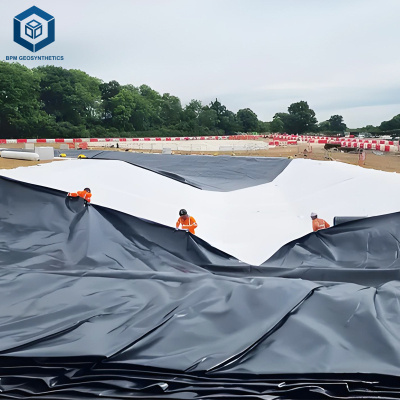
Solution: Dual-track hot wedge welding with vacuum box testing and air pressure testing.
4. UV Aging in High-Altitude Mines
Solution: Ensure carbon black dispersion category 1–2 and confirm UV stabilization package.
Risk Warnings and Mitigation
Subgrade must achieve ≥95% compaction.
Avoid installation during heavy wind conditions.
Control thermal expansion by installing during moderate temperatures.
Strictly implement CQA (Construction Quality Assurance) program.
Procurement and Selection Guide
Define heap height and load pressure.
Determine chemical exposure (pH, temperature).
Select thickness (usually 2.0 mm for primary liner).
Verify compliance with GRI-GM13.
Request third-party test reports.
Evaluate roll width to reduce welding seams.
Confirm supplier production capacity and delivery schedule.
Include onsite welding supervision requirements in contract.
Engineering Case Example
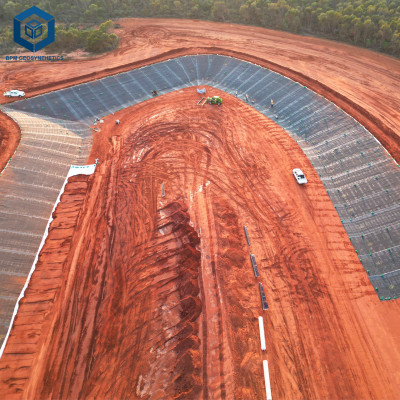
In a Southeast Asia copper heap leach project (annual ore stacking 5 million tons), a 2.0 mm hdpe geomembrane for mining heap leach pad specification was installed over 180,000 m². Dual composite liner system was adopted. After three years of operation, leakage monitoring wells reported zero contamination incidents. Weld integrity exceeded 98% first-pass acceptance rate under CQA inspection.
FAQ
1. What thickness is recommended for heap leach pads?
Typically 2.0 mm for primary liners.
2. Can HDPE resist sulfuric acid?
Yes, HDPE shows excellent resistance to acidic leach solutions.
3. Is textured surface required?
Required for slopes exceeding 3H:1V.
4. What welding method is standard?
Hot wedge dual-track welding.
5. How long is service life?
20–50 years depending on exposure conditions.
6. Does it require secondary liner?
Many regulations require double-liner systems.
7. What inspection tests are mandatory?
Air pressure test, vacuum box test, destructive shear test.
8. Can recycled resin be used?
Not recommended for primary mining liners.
9. How are rolls packaged?
Core-wound rolls wrapped in UV protective film.
10. What standards apply?
GRI-GM13 and relevant ASTM standards.
Request Technical Documentation
For detailed hdpe geomembrane for mining heap leach pad specification, project-specific thickness calculation, or EPC bidding documentation, contact our technical team to request datasheets, third-party reports, and engineering samples.
Author & Technical Authority
This article is prepared by a geosynthetics engineering team with over 15 years of mining liner system experience, supporting EPC contractors and international mining projects across Asia, Africa, and South America. All specifications referenced are aligned with internationally recognized geosynthetic standards and field engineering practice.