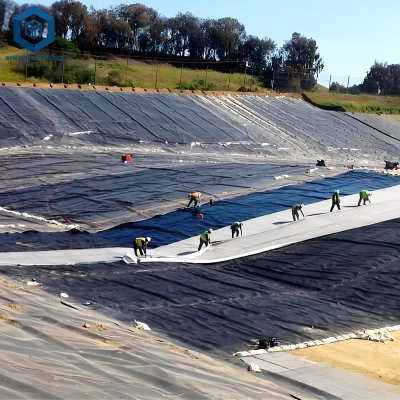
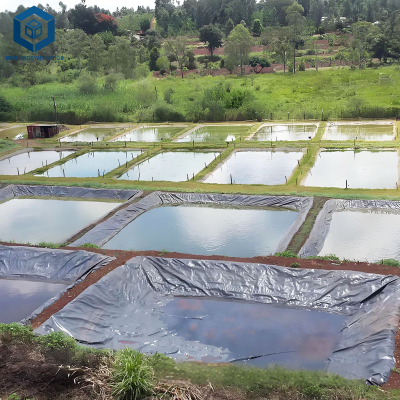
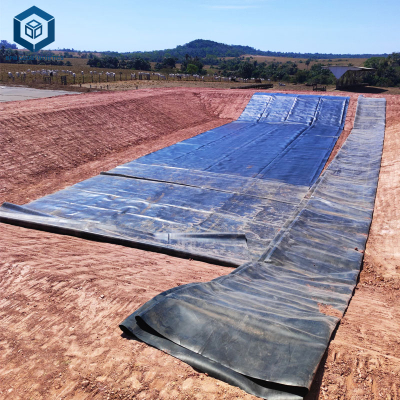
1.0mm vs 1.5mm hdpe geomembrane for fish pond
Product Definition
1.0mm vs 1.5mm HDPE geomembrane for fish pond refers to two thickness options of high-density polyethylene impermeable liners used for aquaculture pond waterproofing, seepage control, and structural containment. Thickness selection directly impacts durability, puncture resistance, service life, and total lifecycle cost in engineered fish pond systems.
Technical Parameters & Specifications
The following parameters are based on commonly adopted international standards for smooth HDPE geomembranes used in aquaculture containment systems.
| Property | 1.0mm HDPE | 1.5mm HDPE | Test Standard |
|---|---|---|---|
| Nominal Thickness | 1.0 mm | 1.5 mm | ASTM D5199 |
| Density | ≥ 0.94 g/cm³ | ASTM D1505 | |
| Tensile Strength (Yield) | ≥ 15 kN/m | ≥ 22 kN/m | ASTM D6693 |
| Puncture Resistance | ≥ 300 N | ≥ 480 N | ASTM D4833 |
| Elongation at Break | ≥ 700% | ASTM D6693 | |
| Carbon Black Content | 2.0–3.0% | ASTM D4218 | |
| Service Life (Exposed) | 8–12 years* | 12–20 years* | UV dependent |
*Service life varies depending on UV exposure, installation quality, and operational conditions.
Structure & Material Composition
The performance difference in 1.0mm vs 1.5mm HDPE geomembrane for fish pond projects is primarily driven by thickness and structural mass.
Base Polymer: High-density polyethylene resin (virgin grade preferred)
Carbon Black: 2–3% for UV resistance
Antioxidants: Thermal aging protection
Stabilizers: Long-term environmental durability
Surface Type: Smooth (typical for fish pond lining)
Thicker 1.5mm sheets provide greater structural robustness under hydrostatic pressure and subgrade irregularities.
Manufacturing Process
1. Raw Material Preparation
Virgin HDPE resin is blended with carbon black masterbatch and antioxidants using high-speed mixers.
2. Extrusion
Flat-die extrusion or blown-film extrusion equipment is used. Precise temperature control (200–230°C) ensures homogeneous melt flow.
3. Sheet Calibration
Automatic thickness monitoring systems maintain ±5% tolerance across the sheet width.
4. Cooling & Haul-Off
Chilled roller systems stabilize dimensional accuracy.
5. Quality Control
Each production batch undergoes tensile, density, and carbon black dispersion testing before packaging.
Industry Comparison
| Material | Cost Level | Durability | Puncture Resistance | Fish Pond Suitability |
|---|---|---|---|---|
| 1.0mm HDPE | Medium | Good | Moderate | Small/Medium Ponds |
| 1.5mm HDPE | Higher | Excellent | High | Commercial Aquaculture |
| 0.75mm LDPE | Low | Low | Low | Temporary Use |
| PVC Liner | Medium | Moderate | Moderate | Less UV Stable |
Application Scenarios
1.0mm vs 1.5mm HDPE geomembrane for fish pond selection depends on project scale:
Distributors: Stock 1.0mm for price-sensitive markets; 1.5mm for premium segment.
EPC Contractors: Prefer 1.5mm for long-term warranty projects.
Fish Farm Developers: 1.0mm for inland ponds; 1.5mm for high-density shrimp farming.
Importers: Choose thickness based on local regulatory and UV exposure conditions.
Core Pain Points & Solutions
1. Subgrade Puncture Risk
Solution: Use 1.5mm thickness or add nonwoven geotextile underlayment.
2. UV Degradation
Solution: Ensure adequate carbon black content and consider soil cover.
3. Welding Failure
Solution: Use dual-track hot wedge welding with air pressure testing.
4. Cost vs Durability Trade-Off
Solution: Conduct lifecycle cost analysis rather than initial material price comparison.
Risk Warnings & Mitigation
Improper subgrade preparation increases puncture risk.
Excessive thermal expansion requires anchor trench design.
Low-grade recycled resin reduces service life.
Poor seam testing leads to leakage liability.
Procurement Selection Guide
Define pond depth and hydrostatic pressure.
Assess subgrade soil condition and compaction level.
Determine expected service life (≥10 years recommended).
Specify ASTM-compliant testing certificates.
Evaluate welding method and installation team capability.
Calculate total lifecycle cost including maintenance.
Request third-party inspection reports.
Engineering Case Study
A 12-hectare commercial tilapia farm in Southeast Asia evaluated 1.0mm vs 1.5mm HDPE geomembrane for fish pond expansion. Soil conditions included compacted clay with occasional gravel. The engineering consultant recommended 1.5mm HDPE combined with 300g/m² nonwoven geotextile.
Installation included anchor trench depth of 500mm, dual hot-wedge welding, and 100% air channel testing. After three years of operation, no leakage or structural damage was reported, validating the thicker liner choice for intensive aquaculture.
FAQ
1. Is 1.0mm sufficient for small fish ponds?
Yes, for ponds under 1 hectare with smooth subgrade.
2. When is 1.5mm recommended?
For deep ponds, commercial shrimp farms, or rocky soil.
3. Does thicker mean better?
Not always; it depends on engineering requirements.
4. What welding method is preferred?
Dual-track hot wedge welding.
5. Can recycled HDPE be used?
Not recommended for long-term aquaculture projects.
6. What about UV exposure?
Carbon black content ensures UV resistance.
7. Should geotextile be used?
Yes, if subgrade contains sharp particles.
8. How to test seams?
Air pressure test or vacuum box test.
9. What is typical roll width?
5–8 meters depending on production line.
10. How to calculate material quantity?
Include slope allowance and overlap margin.
Request Technical Support
For project drawings, technical data sheets, or formal quotation regarding 1.0mm vs 1.5mm HDPE geomembrane for fish pond, please contact our engineering team with pond dimensions, soil report, and expected service life. Sample materials and welding procedure specifications are available upon request.
Author & Technical Authority
This article is prepared by a geomembrane engineering specialist with over 10 years of experience in aquaculture containment systems, landfill lining, and hydraulic infrastructure projects. Technical references align with ASTM testing standards and field installation practices adopted by EPC contractors worldwide.