Geomembrane vs Geosynthetic Clay Liner: Engineering Comparison
What is Geomembrane vs Geosynthetic Clay Liner?
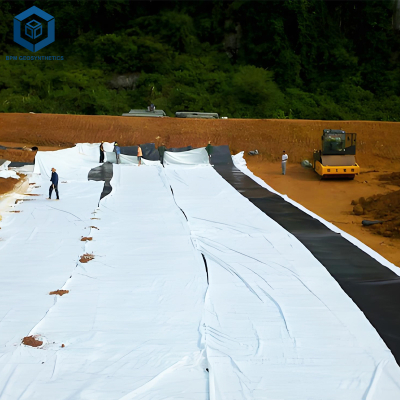
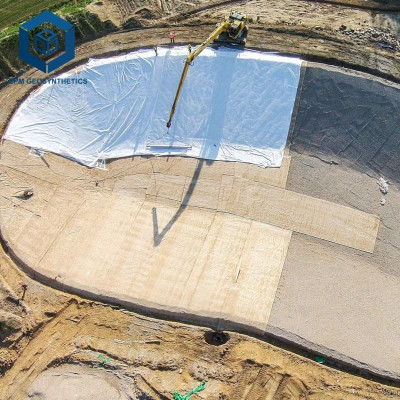
Geomembrane vs geosynthetic clay liner comparison evaluates two distinct barrier technologies: polymeric geomembranes (HDPE, LLDPE, PVC) and geosynthetic clay liners (GCLs — bentonite clay encapsulated between geotextiles). For civil engineers, EPC contractors, and procurement managers, understanding geomembrane vs geosynthetic clay liner is critical for landfill liners, secondary containment, and pond applications. HDPE geomembranes (1.5 mm) offer extremely low permeability (k = 1 × 10⁻¹⁴ m/s), excellent chemical resistance, and 50–100+ year design life, but are susceptible to puncture and require skilled welding. GCLs (typically 5–10 mm thick) have higher permeability (k = 1–5 × 10⁻¹¹ m/s when hydrated), offer self-healing properties (bentonite swells to seal small punctures), and are easier to install (overlaps, no welding), but are vulnerable to desiccation (shrinkage cracks), cation exchange (chemical degradation), and hydraulic overburden. This guide provides engineering data on geomembrane vs geosynthetic clay liner: permeability comparison, self-healing capability, installation requirements, chemical compatibility, and application-specific recommendations for landfill bottom liners, final covers, and mining applications.
Technical Specifications: Geomembrane vs Geosynthetic Clay Liner
The table below compares critical engineering parameters between HDPE geomembranes and GCLs per GRI GM13 and GRI GC8 standards.
| Parameter | HDPE Geomembrane (1.5 mm) | GCL (Geosynthetic Clay Liner) | Engineering Importance |
|---|---|---|---|
| Permeability (hydraulic conductivity, k) | ~1 × 10⁻¹⁴ m/s | 1 – 5 × 10⁻¹¹ m/s (hydrated) | HDPE is 1,000–10,000× less permeable — key difference in geomembrane vs geosynthetic clay liner comparison.}, |
| Thickness (nominal) | 1.0 – 2.5 mm | 5 – 10 mm (unhydrated); swells to 10–20 mm when hydrated | GCL is thicker but has higher permeability.}, |
| Self-Healing of Punctures | None (puncture remains open leak path) | Yes (bentonite swells to seal small punctures) | GCL can self-seal nail holes, small punctures; HDPE requires repair.}, |
| Desiccation Cracking Risk | None | High (bentonite shrinks when dried, cracks form) | GCL requires moisture maintenance or cover within 48 hours.}, |
| Chemical Compatibility | Excellent (resists pH 2–12, hydrocarbons) | Poor (bentonite degrades in high salt, low/high pH, hydrocarbon exposure) | HDPE superior for aggressive leachate or industrial chemicals.}, |
| Cation Exchange Susceptibility | None | Yes (sodium bentonite converts to calcium bentonite in hard water, reducing swell) | GCL performance degrades in high-calcium or saline environments.}, |
| Hydration Requirement | None (always impermeable) | Yes (must hydrate to achieve low permeability) | GCL installed dry; requires moisture to swell and seal.}, |
| Installation Complexity | High (thermal welding, seam testing) | Low (overlaps 150–300 mm, no welding) | GCL faster to install, less skilled labor.}, |
| Puncture Resistance | Moderate (requires geotextile cushion) | Fair (bentonite can extrude through punctures) | Both require protection from sharp subgrade.}, |
| Typical Cost (€/m² installed) | 8 – 13 | 6 – 10 | GCL generally lower installed cost.}, |
Key takeaway: Geomembrane vs geosynthetic clay liner comparison shows HDPE has far lower permeability (1,000–10,000×) and superior chemical resistance, but GCL offers self-healing and easier installation. Composite liners (HDPE + GCL) combine advantages of both.
Material Structure and Composition: Geomembrane vs Geosynthetic Clay Liner
Understanding structural differences is essential for geomembrane vs geosynthetic clay liner selection.
| Property | HDPE Geomembrane | GCL | Barrier Mechanism |
|---|---|---|---|
| Material | Polymer (polyethylene) | Sodium bentonite clay + geotextiles | HDPE: physical barrier; GCL: hydraulic barrier (swelling clay).}, |
| Structure | Homogeneous sheet | Bentonite encapsulated between woven/nonwoven geotextiles (needle-punched or adhesive-bonded) | GCL has carrier geotextile, bentonite core, cover geotextile.}, |
| Self-Healing Mechanism | None | Bentonite swells (up to 10–15× volume) to fill small holes | GCL can seal nail punctures up to ~3 mm diameter.}, |
| Failure Mode | Puncture, seam failure, stress cracking | Desiccation cracking, cation exchange, internal erosion | Each has distinct vulnerability.}, |
Engineering insight: Geomembrane vs geosynthetic clay liner comparison reveals that GCLs rely on bentonite hydration and swell for barrier function — if bentonite cannot hydrate (dry climate) or swells poorly (chemical incompatibility), barrier fails. HDPE is a true physical barrier regardless of environment.
Manufacturing Process: Geomembrane vs Geosynthetic Clay Liner Production
Production methods differ significantly between HDPE geomembranes and GCLs.
HDPE geomembrane manufacturing: Extrusion of virgin PE100 resin + carbon black + antioxidants → flat die → calendering → cooling → winding. Factory-controlled quality per GRI GM13.
GCL manufacturing:
Sodium bentonite clay mined, dried, ground to powder
Clay evenly distributed between two geotextiles (carrier and cover)
Needle-punching (fiber entanglement) or adhesive bonding to hold bentonite in place
Hydration inhibitor (optional) to prevent premature hydration during shipping
Rolled and packaged in moisture-proof packaging (critical for GCL shelf life)
Quality control differences: HDPE: factory testing per GRI GM13. GCL: bentonite swell index (ASTM D5890), fluid loss (ASTM D5891), peel strength (ASTM D6496), and hydraulic conductivity (ASTM D6766).
Performance Comparison: Geomembrane vs Geosynthetic Clay Liner vs. Composite
Comparing HDPE alone, GCL alone, and composite (HDPE + GCL) systems.
| Liner System | Effective Permeability (k) | Self-Healing | Chemical Resistance | Relative Installed Cost | Typical Applications |
|---|---|---|---|---|---|
| HDPE only (1.5 mm) | ~1 × 10⁻¹⁴ m/s | No | Excellent | 1.2x | Landfill bottom liners, mining, chemical containment}, |
| GCL only (5–10 mm) | 1–5 × 10⁻¹¹ m/s | Yes (small punctures) | Fair (pH 5–9, avoid hydrocarbons) | 1.0x (baseline) | Landfill covers, secondary containment (non-aggressive), ponds}, |
| Composite (HDPE + GCL) | ~1 × 10⁻¹⁴ m/s (HDPE governs) | GCL self-heals HDPE punctures | Excellent (HDPE protects GCL) | 1.6 – 1.8x | Landfill bottom liners (redundant barrier), high-risk containment}, |
Conclusion: Geomembrane vs geosynthetic clay liner comparison shows HDPE is superior for low permeability and chemical resistance; GCL offers self-healing and lower cost. Composite liners combine advantages for critical applications.
Industrial Applications: Geomembrane vs Geosynthetic Clay Liner Selection
Application dictates the correct choice in geomembrane vs geosynthetic clay liner selection.
Landfill bottom liners (municipal solid waste): Composite liner (HDPE + GCL) or HDPE over compacted clay. GCL alone not sufficient for primary containment.
Landfill final covers (side slopes and cap): GCL commonly used (lower cost, self-healing). HDPE used for steep slopes or gas barrier requirements.
Mining heap leach pads (acidic leachate): HDPE required. GCL not compatible with acid.
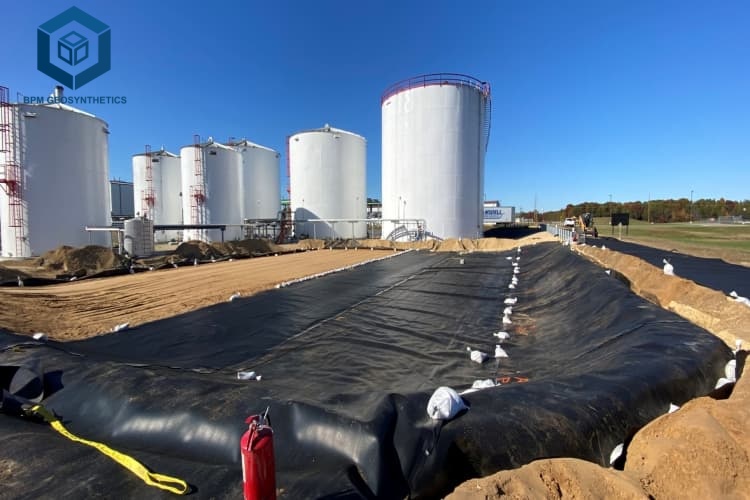
Secondary containment (tank farms, chemical plants): HDPE for aggressive chemicals; GCL for non-hazardous liquids (e.g., water, diesel).
Pond liners (water, aquaculture): GCL acceptable for low-head water (≤ 3 m). HDPE for higher head or longer life.
Remediation caps (contaminated soil containment): GCL often used due to ease of installation over irregular surfaces.
Common Industry Problems: Geomembrane vs Geosynthetic Clay Liner Failures
Real-world failures from incorrect material selection or installation.
Problem 1: GCL desiccation cracking in arid climate (no cover)
Root cause: GCL left exposed to sun before cover placement. Bentonite dried, shrank, cracked — permeability increased 1,000×. Solution: Cover GCL within 48 hours of installation. In dry climates, use HDPE instead or install moisture-retention layer.
Problem 2: HDPE puncture from subgrade stones
Root cause: 1.5 mm HDPE installed over sharp stones without adequate geotextile cushion. Solution: Use GCL as subgrade protection (GCL can self-heal small punctures) or increase geotextile to 500 g/m². Composite liner (GCL under HDPE) prevents this failure mode.
Problem 3: GCL cation exchange in saline leachate (landfill bottom liner)
Root cause: Sodium bentonite in GCL converted to calcium bentonite in high-calcium leachate. Swell index dropped from 24 mL/2g to < 10 mL/2g, permeability increased to 1 × 10⁻⁹ m/s. Solution: For aggressive leachate, specify HDPE or polymer-enhanced GCL.
Problem 4: GCL hydration before installation (premature swell)
Root cause: Moisture-proof packaging damaged during shipping. Bentonite hydrated in roll, causing expansion and roll deformation. Solution: Inspect GCL packaging upon receipt. Reject rolls with damaged or torn packaging.
Risk Factors and Prevention Strategies for Geomembrane vs Geosynthetic Clay Liner Selection
Risk: Specifying GCL for aggressive chemical environment: Bentonite degraded by acids, hydrocarbons, high salts. Mitigation: For pH < 5 or > 9, hydrocarbons, or high TDS leachate, specify HDPE instead of GCL.
Risk: GCL desiccation in arid climate: Cracks form before hydration. Mitigation: Cover GCL within 48 hours. Use moisture-retention layer (150 mm soil) or specify HDPE.
Risk: HDPE puncture from subgrade stones: No self-healing. Mitigation: Use GCL as cushion layer under HDPE (composite liner) — GCL self-heals any punctures that penetrate HDPE? Not exactly; GCL seals against HDPE puncture but hole in HDPE remains.
Risk: GCL internal erosion (hydraulic gradient): Bentonite can wash out of needle-punched GCL under high hydraulic head (> 30 m). Mitigation: For high-head applications (> 10 m), use HDPE or reinforced GCL with stronger geotextiles.
Procurement Guide: How to Choose Between Geomembrane vs Geosynthetic Clay Liner
Follow this 8-step checklist for B2B purchasing decisions.
Determine chemical exposure: Aggressive chemicals (acids, hydrocarbons, saline leachate) → HDPE. Water, mild leachate → GCL acceptable.
Assess climate and hydration potential: Arid climate, no water source for hydration → HDPE. Humid climate or water available → GCL possible.
Evaluate puncture risk: Sharp subgrade → composite liner (GCL under HDPE) or GCL alone (self-healing). HDPE alone requires geotextile cushion.
Consider installation schedule: Fast installation, limited skilled labor → GCL (overlaps, no welding). Skilled welders available → HDPE.
Determine hydraulic head (water pressure): Head > 10 m → HDPE required. Head < 3 m → GCL acceptable.
Compare cost: GCL typically lower installed cost (€6–10/m²) vs. HDPE (€8–13/m²). Composite liner (HDPE + GCL) €14–22/m².
Order samples and perform compatibility testing: For GCL, test bentonite swell index with site-specific water/leachate (ASTM D5890). For HDPE, test chemical resistance.
Review warranty and design life: HDPE: 50–100+ years. GCL: 20–50 years (depends on environment). Composite: 50–100+ years.
Engineering Case Study: Geomembrane vs Geosynthetic Clay Liner in Landfill Bottom Liner
Project type: Municipal solid waste landfill bottom liner.
Location: Midwest USA (moderate climate, clay subgrade).
Project size: 100,000 m².
Options evaluated:
- Option A: 1.5 mm HDPE geomembrane over 300 mm compacted clay.
- Option B: GCL (5 mm) over 300 mm compacted clay.
- Option C: Composite (1.5 mm HDPE over GCL) over 300 mm compacted clay.
Geomembrane vs geosynthetic clay liner comparison results:
- Permeability: Option A: 1e-14 m/s; Option B: 1e-11 m/s (higher); Option C: 1e-14 m/s (HDPE governs).
- Installed cost: Option A: €12/m²; Option B: €9/m²; Option C: €17/m².
- Regulatory: Option B (GCL alone) not accepted as primary liner by EPA. Option A and C accepted.
Decision: Option A (HDPE over clay) selected — lower cost than composite, meets regulatory requirements.
Result after 10 years: No leakage. GCL alone (Option B) would have been non-compliant and potentially failed due to leachate chemistry.
Frequently Asked Questions: Geomembrane vs Geosynthetic Clay Liner
Q1: Which has lower permeability — geomembrane or GCL?
Geomembrane. HDPE permeability is ~1 × 10⁻¹⁴ m/s vs. GCL 1–5 × 10⁻¹¹ m/s. HDPE is 1,000–10,000× less permeable — the most significant factor in geomembrane vs geosynthetic clay liner comparison.
Q2: Does GCL self-heal punctures?
Yes, for small punctures (≤ 3 mm diameter). Bentonite clay swells when hydrated, sealing nail holes, small tears. HDPE does not self-heal — any puncture is a leak path until repaired.
Q3: Can GCL be used in landfill bottom liners?
Typically not as the primary liner. EPA requires composite liner (HDPE + GCL or HDPE + clay) for MSW landfills. GCL alone may be used for landfill covers or secondary containment.
Q4: What causes GCL desiccation cracking?
When GCL dries out before hydration, bentonite shrinks, forming cracks up to 10 mm wide. Permeability increases 1,000×. Cover GCL within 48 hours of installation to prevent this.
Q5: Is GCL resistant to chemicals?
No. Sodium bentonite degrades in acidic (pH < 5), alkaline (pH > 9), high-salt, or hydrocarbon environments. HDPE is far superior for chemical resistance.
Q6: What is cation exchange in GCL?
Sodium bentonite in GCL can convert to calcium bentonite when exposed to hard water or calcium-rich leachate. Calcium bentonite swells less (10 mL/2g vs. 24 mL/2g), increasing permeability. Use polymer-enhanced GCL or HDPE in high-calcium environments.
Q7: Which is easier to install — geomembrane or GCL?
GCL is easier. Rolls are placed with overlaps (150–300 mm), no welding required. HDPE requires skilled thermal welding, seam testing, and more quality control.
Q8: What is a composite liner?
A composite liner combines HDPE geomembrane over GCL (or compacted clay). The HDPE provides extremely low permeability; the GCL self-heals small punctures and acts as a backup barrier. This is the preferred system for modern landfills.
Q9: How long does GCL last compared to HDPE?
HDPE: 50–100+ years with proper resin (PE100, PENT ≥ 500 h). GCL: 20–50 years depending on environment (desiccation, chemical attack, freeze-thaw). Composite liner achieves HDPE design life.
Q10: Can GCL be used under high hydraulic head (> 10 m)?
Not recommended. High hydraulic head can cause internal erosion (bentonite washout) in needle-punched GCLs. For head > 10 m, use HDPE or reinforced GCL with stronger geotextiles and higher bentonite mass.
Request Technical Support or Quotation for Geomembrane or GCL Systems
For project-specific liner selection, chemical compatibility testing, or composite liner design, our technical team is available.
Request a quotation – Provide application type, chemical exposure, hydraulic head, and climate conditions.
Request engineering samples – Receive HDPE geomembrane and GCL samples with permeability and swell index test reports.
Download technical specifications – GRI GM13 (geomembrane) and GRI GC8 (GCL) compliance guides, composite liner details, and selection flowchart.
Contact technical support – Liner selection consulting, chemical compatibility testing, and installation QA/QC for geomembrane or GCL projects.
About the Author
This guide on geomembrane vs geosynthetic clay liner was written by Dipl.-Ing. Hendrik Voss, a civil engineer with 19 years of experience in geosynthetics and liner systems. He has designed over 400 landfill, mining, and pond liner systems across Europe, North America, South America, and Asia, specializing in composite liner design, bentonite compatibility testing, and regulatory compliance for environmental containment. His work is referenced in GRI and ASTM D35 committee discussions on geomembrane and GCL performance standards.