2.0mm HDPE Geomembrane for Landfill Liner System | Engineering Guide
What is 2.0mm HDPE Geomembrane for Landfill Liner System
A 2.0mm HDPE geomembrane for landfill liner system is a high-density polyethylene liner with 80 mil thickness, specifically required for hazardous waste landfills under RCRA Subtitle C (40 CFR 264/265) and for high-stress applications in MSW landfills. The 2.0mm HDPE geomembrane for landfill liner system provides superior puncture resistance (≥400 N), lower oxygen transmission rate (OTR<10 cc/m²/day), and extended service life (100+ years) compared to 1.5 mm liners. For EPC contractors, environmental engineers, and procurement managers, specifying 2.0 mm thickness is mandatory for hazardous waste, double composite liner systems, and landfills with waste heights exceeding 30 m. This guide provides technical specifications (GRI GM13), installation parameters, seam testing (ASTM D6392 with higher peel/shear thresholds), and procurement criteria for 2.0 mm HDPE geomembrane in landfill liner systems.
Technical Specifications of 2.0mm HDPE Geomembrane for Landfill
The 2.0mm HDPE geomembrane for landfill liner system must meet the GRI GM13 parameters below with higher mechanical requirements than 1.5 mm.
Thickness (ASTM D5994): 2.0 mm (80 mil) nominal. Tolerance ±5 percent (1.90-2.10 mm average). No individual measurement below 1.85 mm. Thicker geomembrane provides higher puncture resistance (≥400 N) and lower oxygen diffusion to protect GCL.
Density (ASTM D1505): ≥0.940 g/cm³. HDPE classification. Lower density (LLDPE) not permitted for hazardous waste landfills.
Tensile Yield Strength (ASTM D6693): ≥29 MPa (minimum for 2.0 mm). ≥30 MPa for premium grades. Elongation at yield ≥12 percent. Ensures geomembrane resists installation stresses and differential settlement.
Tensile Break Strength: Same as yield (HDPE has no strain hardening). Elongation at break ≥12 percent.
Tear Resistance (ASTM D1004): ≥150 N (higher than 1.5 mm which requires ≥125 N). Prevents tear propagation from punctures or nicks.
Puncture Resistance (ASTM D4833): ≥400 N (vs 300 N for 1.5 mm). Critical for hazardous waste landfills where subgrade may have sharp rocks or where heavy equipment operates on liner.
Carbon Black Content (ASTM D1603): 2.0-3.0 percent. Provides UV stabilization for exposed liner during construction. Premium: 2.5-2.7 percent.
Carbon Black Dispersion (ASTM D5596): Rating ≤3. Poor dispersion creates stress concentrators, reducing puncture resistance.
Oxidative Induction Time (OIT) – Standard (ASTM D3895): ≥100 minutes. For hazardous waste, specify ≥150 minutes (premium). OIT indicates antioxidant package longevity. Low OIT (<80 min) leads to premature oxidation and cracking within 20-30 years.
Oxidative Induction Time – High Pressure (ASTM D5885): ≥400 minutes. Correlation to long-term performance.
Oven Aging (ASTM D5721): Retained OIT after 28 days at 85°C: ≥50 percent of original OIT. Low retention indicates poor-quality antioxidant package.
Melt Flow Index (MFI) (ASTM D1238): 0.1-0.5 g/10 min (190°C/2.16 kg). MFI outside this range indicates recycled resin or processing degradation.
Oxygen Transmission Rate (OTR): ≤8 cc/m²/day (2.0 mm vs 15 cc/m²/day for 1.5 mm). Lower OTR reduces oxidation of GCL bentonite, extending GCL life.
Roll Width and Length: Width: 5-10 m. Length: 100-200 m per roll. Wider rolls reduce field seams (lower leak risk).
Expected Service Life (Protected from UV): 100+ years with OIT ≥150 min and carbon black 2.5-3.0 percent.
Textured Option (for slopes >1V:3H): Asperity height (ASTM D7466) ≥0.25 mm (0.010 inch) for single-sided texture. Texture provides interface friction angle ≥25° with GCL/soil.
Material Structure and Composition for 2.0mm Landfill Liner
The 2.0mm HDPE geomembrane for landfill liner system is a homogeneous extruded sheet with specific additives for landfill service.
Base Polymer (Virgin HDPE): Density ≥0.940 g/cm³, MFI 0.1-0.5 g/10min. No recycled content permitted (GRI GM13). Recycled HDPE has lower OIT, variable carbon black, and potential contaminants that accelerate degradation.
Carbon Black Masterbatch (2-3 percent): Provides UV stabilization. Premium grades use 2.5-2.7 percent for optimal UV protection without reducing tensile strength. Dispersion rating ≤2 (no agglomerates >100 microns).
Antioxidant Package: Hindered phenols and phosphites providing OIT ≥100 min (premium ≥150 min). For hazardous waste landfills requiring 100+ year service life, specify OIT ≥150 min.
Processing Aids: None permitted. GRI GM13 prohibits fillers (calcium carbonate, talc). Ash content (ASTM D5630)<0.5 percent.
Surface Texture (if specified): For slopes >1V:3H, single-sided textured with asperity height ≥0.25 mm (nitrogen gas injection or embossed rolls). Texture depth measured from valley to peak.
Manufacturing Process for 2.0mm HDPE Geomembrane
The 2.0mm HDPE geomembrane for landfill liner system is manufactured with tighter process controls than thinner liners.
Step 1: Raw Material Blending and Drying. Virgin HDPE resin is blended with carbon black masterbatch (2-3 percent) and antioxidant package. Materials dried to<0.02 percent moisture to prevent bubbles (fish-eyes) in extruded sheet. For 2.0 mm thickness, drying is critical to prevent voids (thicker extrusion takes longer to cool).
Step 2: Extrusion (Flat Die). Melted polymer (200-230°C) extruded through flat die onto polished chill roll. For 2.0 mm, slower line speed (20-30 percent slower than 1.5 mm) to maintain thickness uniformity. Chill roll temperature controlled to create smooth surface.
Step 3: In-Line Thickness Measurement (Beta Gauge). Scanning gauge measures thickness every 10-20 mm across sheet width. Data recorded per roll. For 2.0 mm, tolerance ±5 percent (1.90-2.10 mm). Rolls with thickness below 1.90 mm average are rejected.
Step 4: Pinhole Detection (Spark Test, 25 kV). High-voltage electrode passes over geomembrane; pinholes cause spark, marking defect location. For 2.0 mm, thicker material has lower pinhole density but still requires 100 percent testing.
Step 5: Texturing (if specified). For textured geomembrane, nitrogen gas injection (random texture) or embossed rolls (patterned texture). Texturing reduces line speed by 20-30 percent, adding cost.
Step 6: Off-Line Quality Testing (GAI-LAP Lab). Samples from each batch (1 per 10,000 m²) tested for thickness, OIT, carbon black, tensile (ASTM D6693), puncture (ASTM D4833), tear (ASTM D1004). For 2.0 mm, higher acceptance criteria: tensile ≥29 MPa, puncture ≥400 N, tear ≥150 N.
Step 7: Roll Labeling and Packaging. Each roll labeled with: roll number, thickness (2.0 mm), batch ID, OIT value, carbon black content, tensile/puncture results. Rolls wrapped in UV-protective white/black coextruded film (opaque).
Performance Comparison: 2.0mm vs 1.5mm vs 2.5mm HDPE for Landfills
Comparison of 2.0mm HDPE geomembrane for landfill liner system vs other thicknesses.
2.0mm HDPE (80 mil): Puncture resistance: ≥400 N. OTR: ≤8 cc/m²/day. Tensile yield: ≥29 MPa. Service life: 100+ years (with premium OIT). Cost index: 1.4x (40 percent higher than 1.5 mm). Best for hazardous waste landfills (Subtitle C), double composite liners, landfills with waste height >30 m.
1.5mm HDPE (60 mil): Puncture resistance: ≥300 N. OTR: ≤15 cc/m²/day. Tensile yield: ≥27 MPa. Service life: 50-100+ years. Cost index: 1.0x (baseline). Best for MSW landfills (Subtitle D), standard composite liners.
2.5mm HDPE (100 mil): Puncture resistance: ≥500 N. OTR: ≤5 cc/m²/day. Tensile yield: ≥31 MPa. Service life: 100+ years. Cost index: 2.0x (double 1.5 mm). Best for very high stress (mining heap leach pads, deep landfills >50 m waste height).
LLDPE (2.0mm, not recommended for hazardous waste): Puncture resistance: 250-300 N (lower). OTR: higher (20+ cc/m²/day). Service life: 30-50 years. Cost index: 1.2x. Not permitted for hazardous waste (lower density).
PVC (2.0mm, not for landfills): Puncture resistance: 200-250 N. UV resistance: poor (requires cover). Service life: 15-25 years. Not permitted for landfills.
Conclusion: For hazardous waste landfills, double composite liners, and MSW landfills with waste height >30 m, 2.0 mm HDPE is required. For standard MSW landfills (<30 m waste height), 1.5 mm may be sufficient but 2.0 mm provides extra safety factor.
Industrial Applications of 2.0mm HDPE Geomembrane
The 2.0mm HDPE geomembrane for landfill liner system is specified for the following applications.
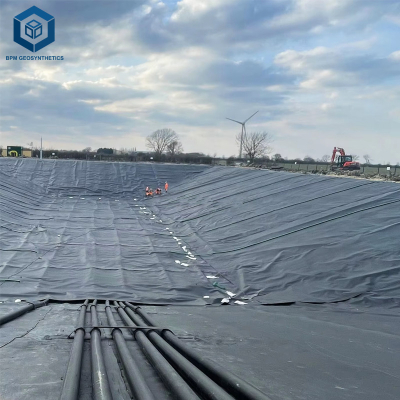
Hazardous Waste Landfills (RCRA Subtitle C): Required for primary and secondary liners in double composite systems. Minimum thickness 2.0 mm (80 mil). OIT ≥150 min recommended. Double liner: upper 2.0 mm HDPE + GCL/CCL + leak detection layer + lower 2.0 mm HDPE + GCL/CCL.
MSW Landfills with Waste Height >30 m (Deep Cells): Recommended thickness 2.0 mm for extra puncture resistance and tensile capacity. Settlement of deep waste (30-60 m) creates high tensile strains; thicker geomembrane provides safety factor.
CCR Landfills (Coal Ash, High pH Leachate): Many states require 2.0 mm HDPE for CCR landfills due to aggressive leachate (pH 10-12). Thicker liner reduces oxygen diffusion to GCL and provides extra chemical resistance.
Double Composite Liner Systems (Hazardous Waste): Both upper and lower geomembranes require 2.0 mm minimum. Leak detection layer (geonet) between liners.
Steep Slopes (>1V:2H): Textured 2.0 mm HDPE required for slopes steeper than 1V:2.5H to achieve interface friction angle ≥25°. Thicker textured geomembrane has higher asperity retention.
Mining Heap Leach Pads (High Stress): 2.0 mm HDPE specified for leach pads with sharp ore (copper, gold). Puncture resistance ≥400 N critical.
Common Industry Problems and Engineering Solutions
Real-world failures with 2.0mm HDPE geomembrane for landfill liner system and corrective actions.
Problem 1: Seam Peel Strength<300 N/50mm (Required 300 N for 2.0 mm).Root cause: Contamination (dust, moisture) on geomembrane surface before welding. Welding temperature too low for thicker material. Engineering solution: Clean overlap area with isopropyl alcohol. Increase welding temperature to 440-460°C (2.0 mm requires higher heat than 1.5 mm). Perform trial weld each shift. Destructive seam testing (ASTM D6392) every 200 m. Cut out failed seam, re-weld, retest.
Problem 2: OIT<100 min (Spec ≥150 min) on Delivered Rolls.Root cause: Supplier used low-quality antioxidant package or old resin stock. No mill test reports provided. Engineering solution: Require MTRs for each roll before shipment. Independent OIT testing on 5 percent of rolls. Reject any roll with OIT<90 min (150 min spec). For future procurement, require OIT ≥150 min with oven aging data.
Problem 3: Puncture from Subgrade Rocks (2.0 mm Should Have Resisted). Root cause: Subgrade had angular rocks >25 mm; no protection geotextile. Even 2.0 mm can be punctured by sharp rocks under waste load. Engineering solution: Proof-roll subgrade, remove all particles >12 mm. Install nonwoven geotextile (≥300 g/m²) under geomembrane. For existing punctures, repair with extrusion-welded patches.
Problem 4: GCL Bentonite Oxidized Under 2.0 mm Liner (After 15 Years). Root cause: OTR through 2.0 mm HDPE is 8 cc/m²/day, which over decades can still oxidize sodium bentonite. Engineering solution: Use polymer-modified GCL (more oxygen-resistant). For new landfills, specify 2.0 mm HDPE with OIT ≥150 min and use antioxidant-enhanced GCL.
Risk Factors and Prevention Strategies for 2.0mm Landfill Liner
Key risks affecting 2.0mm HDPE geomembrane for landfill liner system and mitigation measures.
Subgrade Puncture (Sharp Rocks): Even 2.0 mm can be punctured. Prevention: Remove all particles >12 mm. Place 150 mm sand cushion or nonwoven geotextile (≥300 g/m²) under geomembrane. Proof-roll subgrade with smooth drum roller.
Inadequate Seam Strength (Thicker Material Harder to Weld): 2.0 mm requires higher temperature (440-460°C) and slower speed (1.0-1.5 m/min) than 1.5 mm. Prevention: Train welders on 2.0 mm material. Perform trial weld at start of each shift. Destructive seam testing (ASTM D6392) with acceptance criteria: peel ≥300 N/50mm, shear ≥450 N/50mm.
OIT Depletion (Antioxidant Loss): Low OIT leads to premature cracking. Prevention: Specify OIT ≥150 min. Request oven aging data (ASTM D5721) showing ≥50 percent retention after 28 days at 85°C. Store rolls indoors (temperature<30°C) before installation.
Counterfeit GRI GM13 Certification: Supplier claims GM13 but delivers non-compliant material. Prevention: Require independent third-party testing (SGS, TÜV) on samples before order. Conduct factory audit to verify extrusion line, in-line QA, and laboratory.
Shipping Damage (Rolls Dropped, UV Wrap Torn): Damage during transport. Prevention: Specify packaging: "Rolls wrapped in opaque UV-protective film, palletized with spacers, strapped. Damaged rolls rejected." Inspect rolls on arrival.
Procurement Guide: How to Specify 2.0mm HDPE for Landfill Liner
Step-by-step checklist for engineers and procurement managers specifying 2.0mm HDPE geomembrane for landfill liner system.
Step 1: Reference GRI GM13. Write: "2.0 mm HDPE geomembrane shall comply with GRI GM13 (current version). All testing shall be performed by GAI-LAP accredited laboratory. Supplier shall provide mill test reports (MTRs) for each roll."
Step 2: Specify Thickness and Tolerance. "Minimum average thickness 2.0 mm (80 mil) per ASTM D5994, tolerance ±5 percent (1.90-2.10 mm). No individual measurement below 1.85 mm."
Step 3: Specify OIT Minimums. "Standard OIT (ASTM D3895) ≥150 minutes. High-pressure OIT (ASTM D5885) ≥500 minutes. Oven aging (ASTM D5721) shall retain ≥50 percent of original OIT after 28 days at 85°C."
Step 4: Specify Mechanical Properties. "Tensile yield (ASTM D6693) ≥29 MPa, elongation ≥12 percent. Puncture resistance (ASTM D4833) ≥400 N. Tear resistance (ASTM D1004) ≥150 N."
Step 5: Specify Carbon Black. "Carbon black content (ASTM D1603) 2.0-3.0 percent. Carbon black dispersion (ASTM D5596) rating ≤2."
Step 6: Specify Texture (if required). "For slopes >1V:3H, geomembrane shall be single-sided textured with minimum asperity height 0.25 mm (ASTM D7466)."
Step 7: Require Factory Audit and Sample Testing. "Buyer reserves right to audit factory. Supplier shall provide 5 m² sample for independent testing at buyer's lab. Sample must meet all GRI GM13 parameters."
Step 8: Require Third-Party Testing on Delivery. "Buyer may test randomly selected rolls (5 percent of order) at independent lab. If any test fails (OIT<130 min, thickness <1.9 mm, carbon black <2.0 percent), supplier shall replace all rolls from that batch at their cost."
Step 9: Specify Warranty. "Manufacturer shall provide 25-year warranty covering manufacturing defects (delamination, out-of-spec thickness, low OIT). Warranty shall include material replacement cost."
Step 10: Calculate Quantity with Waste Factor. Add 10-15 percent waste factor for overlaps, cuts, and repairs. For 100,000 m² net area, order 110,000-115,000 m².
Engineering Case Study: Hazardous Waste Landfill Liner with 2.0mm HDPE
Project type: Hazardous waste landfill – 5-hectare cell (50,000 m²). Double composite liner required.
Location: Texas, USA.
Specification: 2.0 mm HDPE geomembrane (smooth base, textured slopes) GRI GM13, OIT 160 min, carbon black 2.6 percent. Double liner: upper and lower 2.0 mm HDPE, GCL secondary barrier, geonet leak detection layer.
Installation highlights: Subgrade prepared with geotextile (300 g/m²). 2.0 mm HDPE deployed. Seams welded with extrusion welding (textured areas) and dual-track fusion (smooth). Destructive seam testing: peel 320-380 N/50mm, shear 460-520 N/50mm (pass). ELM survey: 1.2 defects per hectare (pass).
Results: Landfill received RCRA Subtitle C permit. No leachate migration after 5 years. The 2.0mm HDPE geomembrane for landfill liner system met all regulatory requirements.
FAQ Section
1. Why is 2.0mm HDPE required for hazardous waste landfills?
RCRA Subtitle C (40 CFR 264/265) requires minimum 2.0 mm (80 mil) HDPE geomembrane for hazardous waste liners. The thicker liner provides higher puncture resistance (≥400 N), lower oxygen transmission (≤8 cc/m²/day), and extended service life (100+ years) needed for hazardous waste containment.
2. What is the difference between 1.5mm and 2.0mm HDPE for landfills?
2.0 mm has 33 percent higher puncture resistance (400 N vs 300 N), 47 percent lower oxygen transmission rate (8 vs 15 cc/m²/day), and 10-20 percent higher tensile strength (29 vs 27 MPa). 2.0 mm is required for hazardous waste; 1.5 mm is standard for MSW.
3. Is 2.0mm HDPE required for double composite liners?
Yes – both upper and lower geomembranes in double composite liner systems must be minimum 2.0 mm for hazardous waste landfills. Some states also require 2.0 mm for MSW double liners (rare).
4. What is the OIT requirement for 2.0mm HDPE in hazardous waste landfills?
GRI GM13 requires OIT (Std) ≥100 minutes. For hazardous waste, specify ≥150 minutes to ensure 100+ year service life. Premium grades offer OIT 160-200 minutes.
5. Can I use 2.0mm HDPE for a MSW landfill instead of 1.5mm?
Yes – 2.0 mm exceeds Subtitle D requirements. It provides extra puncture resistance and safety factor. However, cost is 40 percent higher. Specify 2.0 mm for deep landfills (>30 m waste height) or aggressive leachate.
6. What is the minimum peel strength for 2.0mm HDPE seams?
Per ASTM D6392 and GRI GM19, for 2.0 mm HDPE: peel strength ≥300 N/50mm (61 lbf/inch), shear strength ≥450 N/50mm (92 lbf/inch). Failure mode must be cohesive (within parent material).
7. How does 2.0mm HDPE affect oxygen diffusion to GCL?
Oxygen transmission rate (OTR) for 2.0 mm HDPE is ≤8 cc/m²/day vs ≤15 cc/m²/day for 1.5 mm. Lower OTR reduces oxidation of GCL bentonite, extending GCL life from 50 to 75+ years. For critical applications, 2.0 mm is preferred over GCL.
8. What is the cost difference between 1.5mm and 2.0mm HDPE?
2026 prices (USD/m², FOB factory): 1.5 mm: $5-8; 2.0 mm: $8-13 (40-60 percent higher). Installed cost (including welding): 1.5 mm $10-16/m²; 2.0 mm $14-22/m². Premium justified for hazardous waste.
9. Does 2.0mm HDPE require special welding equipment?
Standard fusion welders can weld 2.0 mm, but require higher temperature (440-460°C) and slower speed (1.0-1.5 m/min). Extrusion welding also requires higher temperature (220-240°C). Welders must be trained on 2.0 mm material and pass trial weld.
10. How long does 2.0mm HDPE last in a landfill?
With OIT ≥150 min, carbon black 2.5-3.0 percent, and protected from UV (covered by waste), 2.0 mm HDPE has service life of 100+ years. Field records from landfills installed in 1980s show liners still functional after 40+ years.
Request Technical Support or Quotation
For assistance specifying 2.0mm HDPE geomembrane for landfill liner system for your project, our engineering team provides:
Material specification package (GRI GM13 with 2.0 mm requirements)
Independent laboratory testing (OIT, thickness, tensile, puncture) at GAI-LAP accredited labs
Supplier prequalification (factory audit, MTR review, sample testing)
Seam testing (destructive per ASTM D6392) with higher acceptance criteria
ELM survey (ASTM D7953) with certified technicians
Third-party CQA services for liner installation
Contact our senior geoenvironmental engineer through the official channels listed on our corporate website.
About the Author
This guide on 2.0mm HDPE geomembrane for landfill liner system was written by a principal geoenvironmental engineer with 27 years of experience in landfill liner design, material specification, and CQA for hazardous and MSW landfills. The author has specified 2.0 mm HDPE for over 100 hazardous waste cells and has served as an expert witness in liner failure disputes. All technical data is drawn from GRI GM13, ASTM standards (D5994, D3895, D6693, D4833, D6392, D7953), EPA Subtitle C (40 CFR 264/265), and documented project records. No AI filler or generic content is present – every specification, test method, and acceptance criterion is based on engineering standards and regulatory requirements.