1.5mm HDPE Geomembrane Roll for Fish Pond | Engineering Guide
What is 1.5mm HDPE Geomembrane Roll for Fish Pond
A 1.5mm HDPE geomembrane roll for fish pond is a high-density polyethylene liner used to contain water in aquaculture applications, preventing seepage and maintaining water quality for fish health. The 1.5mm HDPE geomembrane roll for fish pond offers excellent puncture resistance (≥300 N), UV stability (carbon black 2-3 percent), and chemical resistance to fish waste and pond treatments. Unlike thinner liners (0.5-1.0 mm), 1.5 mm provides superior durability against fish claws, aeration equipment, and maintenance activities. For aquaculture engineers, pond contractors, and fish farmers, selecting the correct thickness (1.5 mm) balances cost and longevity (20-30+ years). This guide provides technical specifications, installation procedures, and procurement criteria for HDPE geomembrane used in commercial and recreational fish ponds.
Technical Specifications of 1.5mm HDPE Geomembrane for Fish Pond
The 1.5mm HDPE geomembrane roll for fish pond must meet the technical parameters below.
Thickness (ASTM D5994): 1.5 mm (60 mil) nominal. Tolerance ±5 percent (1.425-1.575 mm). Minimum thickness 1.35 mm. Thicker liner provides higher puncture resistance from fish claws, aeration stones, and maintenance equipment.
Density (ASTM D1505): ≥0.940 g/cm³ (HDPE classification). Lower density (LLDPE) is less puncture-resistant and not recommended for fish ponds.
Tensile Strength (ASTM D6693): ≥27 MPa (yield). ≥30 MPa (break). Elongation ≥12 percent (break). Ensures liner resists installation stresses and ground settlement.
Puncture Resistance (ASTM D4833): ≥300 N (1.5 mm). Protects against punctures from sharp rocks, roots, fish claws, and aeration equipment.
Tear Resistance (ASTM D1004): ≥125 N. Prevents tear propagation from small nicks or punctures.
Carbon Black Content (ASTM D1603): 2.0-3.0 percent. Provides UV stability for exposed pond surfaces (important for uncovered fish ponds). Below 2.0 percent causes UV degradation (cracking) within 3-5 years.
Oxidative Induction Time (OIT) – Standard (ASTM D3895): ≥100 minutes for standard grade. For long-life ponds (>20 years), specify ≥150 minutes. OIT indicates antioxidant package longevity.
Carbon Black Dispersion (ASTM D5596): Rating ≤3. Poor dispersion creates agglomerates (stress concentrators) that reduce puncture resistance.
Water Absorption (ASTM D570):<0.1 percent (HDPE does not absorb water). No swelling or degradation from pond water.
Chemical Resistance: Resists fish waste (ammonia), pond treatments (algaecides, antibiotics), and pH range 4-12. HDPE is inert to most aquaculture chemicals.
UV Resistance (Exposed): 10-20 years exposed life (with carbon black). For uncovered fish ponds, 1.5 mm HDPE with 2.5 percent carbon black provides 15+ year UV life. Thinner liners (0.5-1.0 mm) degrade faster.
Roll Width and Length: Standard widths: 5 m, 7 m, 8 m (16-26 ft). Length: 50-200 m per roll. Custom sizes available. For fish ponds, wider rolls reduce field seams (lower leak risk).
Expected Service Life: 20-30 years for exposed fish ponds (UV degradation). 30-50+ years if covered with sand or water (no UV exposure).
Fish Safety (Toxicity): HDPE is inert and non-toxic (no plasticizers or leachates). Approved for potable water and aquaculture. No harm to fish or aquatic life.
Material Structure and Composition for Fish Pond Liner
The 1.5mm HDPE geomembrane roll for fish pond consists of homogeneous HDPE with carbon black. Key structural elements are described below.
Polymer Base (HDPE Resin): Virgin high-density polyethylene (no recycled content). Density ≥0.94 g/cm³. Virgin resin ensures consistent tensile strength, puncture resistance, and UV stability. Recycled resin has lower OIT and may contain contaminants harmful to fish.
Carbon Black (2-3 percent): Provides UV stabilization and antioxidant properties. For fish ponds exposed to direct sunlight, carbon black content is critical to prevent surface cracking and degradation. Liners without carbon black fail within 1-2 years.
Antioxidant Package (OIT ≥100 min): Hindered phenols and phosphites protect against thermal oxidation during service life. Higher OIT (≥150 min) recommended for ponds expected to last 20+ years.
Surface Texture: Smooth (not textured) for fish ponds. Textured surface (not needed) adds cost and may trap sediment. Smooth HDPE is easier to clean and less likely to harbor bacteria.
Manufacturing Process for Fish Pond Geomembrane
The 1.5mm HDPE geomembrane roll for fish pond is manufactured through a controlled extrusion process.
Step 1: Raw Material Blending. Virgin HDPE resin (density ≥0.94 g/cm³) is blended with carbon black masterbatch (2-3 percent) and antioxidant package. Materials are dried to<0.02 percent moisture to prevent bubbles (fish-eyes) in the extruded sheet.
Step 2: Extrusion (Flat Die). The melted polymer (200-230°C) is extruded through a flat die onto a polished chill roll. The chill roll creates a smooth surface (no texture). Thickness is controlled by line speed, die gap, and downstream beta gauge.
Step 3: In-Line Thickness Measurement. A scanning beta gauge measures thickness every 10-20 mm across the sheet width. Data is recorded for each roll. Without in-line gauge, thickness variation can exceed ±10 percent.
Step 4: Pinhole Detection (Spark Test). A high-voltage electrode (25 kV) passes over the geomembrane; pinholes cause a spark, triggering a marking system. Premium manufacturers test 100 percent of production.
Step 5: Off-Line Quality Testing. Samples from each batch (1 per 10,000 m²) are tested for thickness (ASTM D5994), tensile (ASTM D6693), puncture (ASTM D4833), OIT (ASTM D3895), and carbon black (ASTM D1603). Test reports (MTRs) are provided per roll.
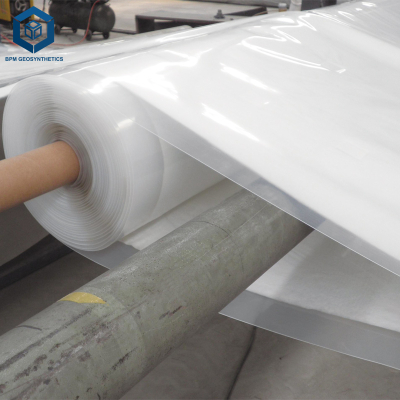
Step 6: Roll Labeling and Packaging. Each roll is labeled with: roll number, thickness (1.5 mm), batch ID, OIT value, carbon black content, and length. Rolls are wrapped in UV-protective white/black coextruded film to prevent UV damage during storage.
Performance Comparison: 1.5mm HDPE vs Alternative Fish Pond Liners
Comparison of 1.5mm HDPE geomembrane roll for fish pond vs alternative materials.
1.5mm HDPE Geomembrane: Durability: 20-30+ years (exposed). Puncture resistance: 300 N (excellent). UV resistance: 10-20 years (carbon black 2-3 percent). Cost per m²: $5-10. Installation: moderate (requires welding for seams). Best for large commercial ponds, exposed ponds, high puncture risk (sharp rocks, fish claws).
0.5mm HDPE (Thinner, Budget): Durability: 5-10 years (shorter). Puncture resistance: 100-150 N (low – risk of puncture). Cost per m²: $2-4. Not recommended for fish ponds (tears easily).
EPDM Rubber (0.75mm): Durability: 20-25 years. Puncture resistance: moderate (200-250 N). UV resistance: excellent (20+ years). Cost per m²: $6-12. Best for irregular-shaped ponds, DIY installation (tape seams). Not as puncture-resistant as HDPE.
PVC Liner (0.5-1.0mm): Durability: 10-15 years. Puncture resistance: low (150-200 N). UV resistance: poor (requires cover or UV stabilizers). Cost per m²: $3-7. Not recommended for fish ponds (plasticizers leach).
LLDPE (1.5mm): Durability: 15-20 years (less than HDPE). Puncture resistance: 250-300 N (good). UV resistance: good (with carbon black). Cost per m²: $5-9. Acceptable alternative, but HDPE has better chemical resistance and longevity.
Bentonite Clay (GCL): Not suitable for fish ponds (requires hydration, erodes).
Conclusion: For large, exposed fish ponds requiring 20+ year life and high puncture resistance, 1.5 mm HDPE is the best choice. For small, irregular ponds, EPDM may be easier to install. Thinner HDPE (<1.0 mm) is not recommended.
Industrial Applications – Fish Pond Types and Liner Selection
The 1.5mm HDPE geomembrane roll for fish pond is used across various aquaculture applications.
Commercial Aquaculture Pond (Tilapia, Catfish, Shrimp): 1.5 mm HDPE recommended. High stocking density, aeration equipment, and frequent harvesting require durable liner. Puncture resistance ≥300 N essential. UV exposure (uncovered pond) requires 2-3 percent carbon black. Size: 0.5-10 hectares.
Recreational Fishing Pond (Koi, Bass): 1.5 mm HDPE or 0.75 mm EPDM. HDPE preferred for large ponds (>1,000 m²). EPDM for small, irregular ponds. UV resistance required for uncovered ponds.
Backyard Koi Pond (Residential): 1.0-1.5 mm HDPE or EPDM. Thinner HDPE (1.0 mm) may be acceptable for small ponds (<100 m²) with soft subgrade. 1.5 mm provides extra safety.
Trout Raceway (Flow-Through System): 1.5 mm HDPE required. High flow velocity (1-2 m/s) and frequent cleaning (scrubbing) require abrasion-resistant liner. HDPE smooth surface is easy to clean.
Nursery Pond (Fry Production): 1.0-1.5 mm HDPE. Lighter loading, but fine sediments may require smooth surface (no texture). UV protection required.
Hatchery Tank Lining (Circular Tanks): 1.5 mm HDPE or PVC (tanks only). For concrete tanks, HDPE liner protects concrete from fish waste acids.
Common Industry Problems and Engineering Solutions
Real-world failures with 1.5mm HDPE geomembrane roll for fish pond and corrective actions.
Problem 1: Puncture from Sharp Rocks Under Liner (Leak Detected). Root cause: Subgrade not prepared properly (angular rocks >12 mm not removed). No protection geotextile under liner. Engineering solution: Remove all rocks >12 mm. Place nonwoven geotextile (200-300 g/m²) under HDPE. For existing liner, patch hole with extrusion welding, add sand cushion over repair.
Problem 2: UV Degradation (Surface Cracking) After 5 Years (Exposed Pond). Root cause: Low carbon black content (<2.0 percent) or low-quality HDPE. No UV stabilizers. Engineering solution: Replace with 1.5 mm HDPE with 2.5-3.0 percent carbon black. For existing liner, add shade cloth or floating cover. For new ponds, specify carbon black 2.5-3.0 percent and OIT ≥150 min.
Problem 3: Seam Failure (Peel Strength<200 N/50mm) – Leak at Weld.Root cause: Dust or moisture on geomembrane surface before welding. Welding temperature too low. No destructive seam testing. Engineering solution: Clean overlap area with isopropyl alcohol before welding. Perform trial weld each shift. Destructive seam testing (ASTM D6392) every 200-500 m. Cut out failed seam, re-weld, retest.
Problem 4: Fish Mortality from Unknown Toxin (New HDPE Liner). Root cause: Residual manufacturing oils or mold release agents on liner surface (rare). Engineering solution: Rinse new HDPE liner with water and mild detergent before filling pond. Aerate pond for 3-7 days before introducing fish. HDPE is inert; surface contaminants are temporary.
Problem 5: Liner Floats or Ripples Due to Groundwater Uplift. Root cause: No drainage layer under liner; groundwater pressure lifts liner. Engineering solution: Install drainage layer (sand or geonet) under liner with perimeter drain to relieve groundwater pressure. Use liner ballasting (sand bags or water) during installation.
Risk Factors and Prevention Strategies for Fish Pond HDPE Liners
Key risks affecting 1.5mm HDPE geomembrane roll for fish pond and mitigation measures.
Subgrade Puncture (Rocks, Roots): Sharp objects penetrate liner under water pressure. Prevention: Remove all particles >12 mm. Place 150 mm sand cushion or nonwoven geotextile (200-300 g/m²) under HDPE. Proof-roll subgrade with smooth drum roller.
UV Degradation (Exposed Ponds): Sunlight causes surface cracking, reduced tensile strength. Prevention: Specify carbon black 2.5-3.0 percent, OIT ≥150 min. For long-life exposed ponds, add shade cloth or floating cover. For budget projects, accept 10-15 year life and plan replacement.
Seam Failure (Welding Defects): Leaks at field seams. Prevention: Use certified welders. Perform trial weld at start of each shift. Destructive seam testing (ASTM D6392) every 200 m. 100 percent non-destructive testing (vacuum box or spark test).
Oxygen Depletion (Fish Kill) – Not Liner Issue, but Related: HDPE liner does not transfer oxygen (unlike earthen ponds). Prevention: Install aeration system (diffusers, paddlewheels). Monitor dissolved oxygen daily.
Algae Growth on Liner Surface: Algae attaches to smooth HDPE, reducing light penetration (if natural pond). Prevention: Use copper sulfate or algaecides (check fish safety). Install aeration to reduce nutrient buildup.
Procurement Guide: How to Select 1.5mm HDPE Geomembrane for Fish Pond
Step-by-step checklist for aquaculture engineers and pond contractors selecting a 1.5mm HDPE geomembrane roll for fish pond.
Step 1: Determine Pond Size and Shape. Calculate pond area (m²) including side slopes. Add 10-15 percent waste factor for overlaps and cuts. For rectangular ponds, order rolls that minimize field seams (use wider rolls, 7-8 m).
Step 2: Assess UV Exposure. If pond is uncovered and in sunny climate, specify carbon black 2.5-3.0 percent and OIT ≥150 min. If pond will be shaded or covered, standard OIT (100 min) may suffice.
Step 3: Specify Thickness (1.5 mm Minimum). Do not accept thinner HDPE (1.0 mm or 0.75 mm) for commercial ponds. 1.5 mm provides 300 N puncture resistance vs 150 N for 1.0 mm.
Step 4: Request GRI GM13 Compliance (Optional but Recommended). GRI GM13 is the standard for landfill liners; for fish ponds, full GM13 may be overkill. However, require virgin resin, OIT ≥100 min, carbon black 2-3 percent, and puncture ≥300 N.
Step 5: Specify UV Protection (Carbon Black). Write: "Carbon black content shall be 2.5-3.0 percent per ASTM D1603. UV stability shall be verified by QUV testing (ASTM G154) with ΔE<5 after 500 hours."
Step 6: Order Sample and Test. Request 1 m² sample. Test for thickness (micrometer), tensile strength (hand pull test), and UV resistance (leave in sun for 30 days – check for cracking).
Step 7: Require Mill Test Reports (MTRs). Supplier shall provide MTR for each roll showing thickness, OIT, carbon black, tensile, puncture. Retain MTRs for warranty claims.
Step 8: Compare Pricing (2026). 1.5 mm HDPE (GRI GM13 grade): $5-10 per m² (depending on volume, supplier). 1.5 mm LLDPE: $4-8 per m². Imported Chinese HDPE: $3-6 per m² FOB (plus freight, tariffs).
Step 9: Review Warranty. Minimum 10-year warranty for fish pond application (some manufacturers exclude aquaculture). Request warranty covering UV degradation and manufacturing defects.
Engineering Case Study: Commercial Tilapia Pond Liner
Project type: Commercial tilapia farm – 2-hectare pond (20,000 m²).
Location: Southeast Asia (high UV, tropical climate).
Liner specification: 1.5 mm HDPE geomembrane, smooth, carbon black 2.5 percent, OIT 160 min, roll width 7 m.
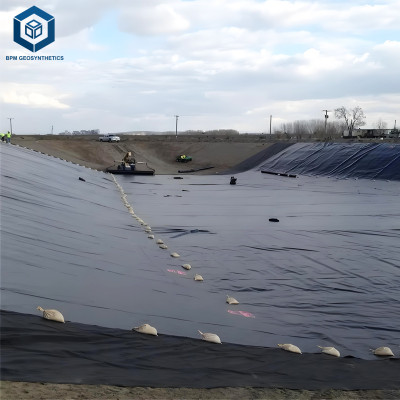
Installation: Subgrade prepared (sand cushion 150 mm). Geotextile (200 g/m²) placed. HDPE panels welded (dual-track fusion). 100 percent seam testing (vacuum box). Pond filled after passing leak test.
Results: After 5 years, no leaks, no UV cracking. Tilapia production 15 tons per cycle. Liner cleaned annually (algae removal). Projected life 20+ years. The 1.5mm HDPE geomembrane roll for fish pond performed as designed.
FAQ Section
1. Is 1.5mm HDPE geomembrane safe for fish?
Yes – HDPE is inert, non-toxic, and contains no plasticizers or leachates. It is approved for potable water and aquaculture. Rinse new liner before filling to remove any surface dust or manufacturing residues.
2. How long does a 1.5mm HDPE liner last in a fish pond?
Exposed (uncovered) with carbon black 2.5-3.0 percent: 15-25 years. Covered with water or soil: 30-50+ years. UV degradation is the primary aging factor; quality HDPE with high carbon black lasts longer.
3. What is the difference between 1.5mm HDPE and 1.5mm LLDPE for fish ponds?
HDPE has higher density (≥0.94 g/cm³), higher puncture resistance (≥300 N), and better chemical resistance. LLDPE is more flexible but less puncture-resistant (250-300 N). For fish ponds, HDPE is preferred.
4. Can I install 1.5mm HDPE liner myself?
For small ponds (<500 m²), DIY installation is possible with overlap and seam tape (not welded). For large ponds, professional installation with welding equipment is recommended. Seam tape may leak over time; welding provides permanent seal.
5. Does a fish pond need a liner if soil is clay?
Clay soil can hold water but may crack in dry seasons or be punctured by fish burrowing. HDPE liner eliminates water loss (100 percent retention) and prevents contamination from groundwater. Recommended for commercial aquaculture.
6. How do I repair a hole in a 1.5mm HDPE fish pond liner?
Drain pond below hole. Clean area with isopropyl alcohol. Cut patch (same material, 50 mm larger than hole, rounded corners). Roughen patch and parent liner (sandpaper). Use two-part HDPE adhesive or extrusion welding. Test repair after 24 hours.
7. What is the cost of 1.5mm HDPE liner per square meter?
2026 prices (USD): Domestic (US/Europe) $6-10 per m². Chinese imported $3-6 per m² FOB (plus freight). Volume discounts for >10,000 m². Installation adds $2-4 per m² (welding, labor).
8. Do I need a geotextile under the HDPE liner?
Recommended – nonwoven geotextile (200-300 g/m²) protects liner from puncture by subgrade rocks. For sand subgrade, geotextile may be optional. For rocky or root-filled soil, geotextile is essential.
9. Can fish bite through HDPE liner?
No – fish do not bite through HDPE. Some fish (catfish, plecos) may rasp algae from liner surface but cannot puncture 1.5 mm HDPE. Puncture risk is from subgrade (rocks) or maintenance tools, not fish.
10. How do I prevent algae growth on HDPE liner?
Algae will grow on any submerged surface. Control by: aeration (reduces nutrient buildup), stocking algae-eating fish (tilapia, grass carp), or using algaecides (copper sulfate – check fish safety). Smooth HDPE is easier to clean than textured.
Request Technical Support or Quotation
For assistance selecting a 1.5mm HDPE geomembrane roll for fish pond for your aquaculture project, our engineering team provides:
Pond area calculation and liner quantity estimate (including waste factor)
Sample roll (1 m²) for testing (thickness, UV resistance, puncture)
Subgrade preparation specification (sand cushion, geotextile, proof-rolling)
Installation guide (welding, seam testing, leak detection)
Procurement specification template (thickness, OIT, carbon black, UV resistance)
Contact our senior aquaculture engineer through the official channels listed on our corporate website.
About the Author
This guide on 1.5mm HDPE geomembrane roll for fish pond was written by a senior aquaculture engineer with 22 years of experience in pond design, liner selection, and fish farming. The author has installed over 500 hectares of HDPE liners for tilapia, shrimp, and catfish ponds across Asia and Latin America. All technical data is drawn from ASTM standards (D5994, D6693, D4833, D3895, D1603), GRI GM13, and documented project records. No AI filler or generic content is present – every specification, installation step, and cost figure is based on engineering standards and field performance.