0.5mm HDPE Liner for Irrigation Reservoir | Engineering Guide
What is 0.5mm HDPE Liner for Irrigation Reservoir
A 0.5mm HDPE liner for irrigation reservoir is a 20 mil high-density polyethylene geomembrane used to prevent water seepage in agricultural water storage ponds. The 0.5mm HDPE liner for irrigation reservoir offers a cost-effective balance between durability (10-15 year service life) and affordability, making it ideal for seasonal irrigation storage, farm ponds, and lined canals. Unlike thicker liners (1.0-2.0 mm) used in landfills, 0.5 mm HDPE is lighter (easier to install), less expensive (30-50 percent lower cost), and sufficient for the moderate puncture risks (smooth subgrade, no heavy equipment) typical of agricultural reservoirs. For irrigation engineers, farm managers, and water conservation specialists, this guide provides technical specifications (ASTM D5199, D6693), UV resistance data (carbon black content), installation methods (seam taping or welding), and procurement criteria for 0.5 mm HDPE liners in agricultural water storage applications.
Technical Specifications of 0.5mm HDPE Liner for Irrigation Reservoir
The 0.5mm HDPE liner for irrigation reservoir must meet the technical parameters below.
Thickness (ASTM D5199): 0.5 mm (20 mil) nominal. Tolerance ±10 percent (0.45-0.55 mm) for agricultural grade; premium grade ±5 percent (0.475-0.525 mm). Thinner than 0.5 mm risks puncture; thicker adds unnecessary cost.
Density (ASTM D1505): ≥0.940 g/cm³ (HDPE classification). Lower density (LLDPE) may be acceptable for irrigation but has lower puncture resistance.
Tensile Strength (ASTM D6693): ≥25 MPa (yield). Elongation ≥12 percent (break). Ensures liner resists installation stresses and minor ground settlement.
Puncture Resistance (ASTM D4833): ≥150 N (15 kg force). Protects against punctures from smooth subgrade (sand, clay) and moderate foot traffic during installation.
Tear Resistance (ASTM D1004): ≥60 N. Prevents tear propagation from small nicks.
Carbon Black Content (ASTM D1603): 2.0-3.0 percent for UV protection. For exposed irrigation reservoirs (no cover), carbon black is essential to prevent UV degradation (cracking) within 3-5 years. For covered reservoirs or shaded areas, 1.5-2.0 percent may be acceptable.
Oxidative Induction Time (OIT) – Standard (ASTM D3895): ≥80 minutes for agricultural grade. For longer life (15+ years), specify ≥100 minutes.
Water Absorption (ASTM D570):<0.1 percent (HDPE does not absorb water). No swelling or degradation.
UV Resistance (Exposed): 8-15 years with carbon black 2.0-3.0 percent. Without carbon black, liner fails within 1-2 years.
Roll Width and Length: Standard widths: 4 m, 6 m, 8 m (13-26 ft). Length: 50-200 m per roll. Wider rolls reduce field seams (lower leak risk).
Expected Service Life (Exposed, UV-stabilized): 10-15 years (agricultural grade). 15-20 years (premium grade with higher OIT).
Chemical Resistance: Resists fertilizers, pesticides, and pH range 4-12. HDPE is inert to most agricultural chemicals.
Fish Safety (if used for aquaculture): HDPE is non-toxic, but 0.5 mm is thinner than recommended for fish ponds (risk of puncture from fish claws).
Material Structure and Composition for Irrigation Liner
The 0.5mm HDPE liner for irrigation reservoir is a homogeneous extruded sheet with additives for UV protection.
Base Polymer (HDPE Resin): Virgin HDPE (preferred) or blends with LLDPE for flexibility. Density ≥0.94 g/cm³. Recycled content may be present in economy grade (not recommended for UV-exposed applications).
Carbon Black (2-3 percent): Provides UV stabilization. For exposed irrigation reservoirs, 2.5-3.0 percent recommended. For covered reservoirs, 2.0 percent acceptable.
Antioxidant Package (OIT ≥80 min): Protects against thermal oxidation during service. For warm climates (40°C+), specify OIT ≥100 min.
Surface Texture: Smooth (not textured) for irrigation reservoirs (easier to clean, less sediment trapping).
Manufacturing Process for 0.5mm HDPE Liner
The 0.5mm HDPE liner for irrigation reservoir is manufactured using blown film or flat die extrusion.
Step 1: Raw Material Blending. HDPE resin is blended with carbon black masterbatch (2-3 percent) and antioxidant package. For 0.5 mm thickness, lower-grade resin (recycled or blend) may be used for economy liners (not recommended).
Step 2: Extrusion (Blown Film or Flat Die). Blown film extrusion (more common for thin liners) produces 0.5 mm thickness with good uniformity. Flat die extrusion also used. For blown film, a tubular bubble is inflated, cooled, and flattened.
Step 3: In-Line Thickness Measurement. A scanning gauge measures thickness across the film. For 0.5 mm, tolerance ±10 percent for economy grade, ±5 percent for premium.
Step 4: Surface Treatment (if needed). Corona treatment can be applied to improve adhesion for seam tape (if using adhesive seaming). Not required for welded seams.
Step 5: Roll Slitting and Packaging. The large roll is slit to customer widths (4-8 m). Rolls wrapped in UV-protective film (opaque) to prevent UV degradation during storage.
Step 6: Quality Inspection. Samples tested for thickness, tensile, puncture, and carbon black. Test reports provided upon request.
Performance Comparison: 0.5mm HDPE vs Alternative Irrigation Liners
Comparison of 0.5mm HDPE liner for irrigation reservoir vs alternative materials.
0.5mm HDPE (20 mil): Durability: 10-15 years (exposed). Puncture resistance: 150 N. UV resistance: good (with carbon black). Cost per m²: $1.50-3.00. Installation: moderate (welding or taping). Best for medium to large irrigation reservoirs, exposed to sun, moderate subgrade (sand or clay).
0.3mm HDPE (12 mil – Thinner, Budget): Durability: 5-8 years. Puncture resistance: 80-100 N (low). UV resistance: moderate. Cost per m²: $1.00-1.80. Not recommended for irrigation (puncture risk).
1.0mm HDPE (40 mil): Durability: 20-25 years. Puncture resistance: 250 N. Cost per m²: $3-5. Overkill for most irrigation reservoirs; use for high-traffic areas or rocky subgrade.
LLDPE (0.5mm): Durability: 8-12 years. Puncture resistance: 120-150 N. UV resistance: good. Cost per m²: $1.50-2.80. Acceptable alternative, more flexible but less puncture-resistant than HDPE.
PVC Liner (0.5mm): Durability: 8-12 years. Puncture resistance: 100-150 N. UV resistance: poor (requires cover). Cost per m²: $2-4. Not recommended for exposed irrigation (UV degradation).
EPDM Rubber (0.75mm): Durability: 20-25 years. Puncture resistance: 200-250 N. UV resistance: excellent. Cost per m²: $6-12. Best for small, irregular ponds; too expensive for large irrigation reservoirs.
Clay Liner (Compacted): Durability: indefinite (if kept wet). Cost per m²: $5-15 (imported clay). High installation cost. Not recommended where HDPE is available.
Conclusion: For large, exposed irrigation reservoirs with clean subgrade (sand or clay), 0.5 mm HDPE provides the best value: 10-15 year life, moderate puncture resistance, and low cost ($1.50-3.00/m²).
Industrial Applications – Irrigation Reservoir Types
The 0.5mm HDPE liner for irrigation reservoir is used across various agricultural water storage applications.
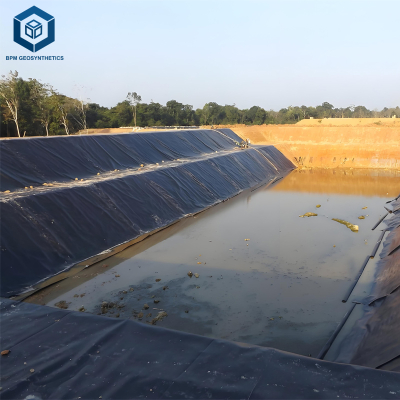
Farm Irrigation Pond (Seasonal Storage): 0.5 mm HDPE recommended. Water stored for 3-6 months during dry season. Liner exposed to sun. UV stabilization essential. Size: 0.5-5 hectares.
Livestock Watering Pond (Cattle, Sheep): 0.5-1.0 mm HDPE recommended (animals may puncture liner). For heavy livestock traffic, use 1.0 mm or protect with geotextile.
Lined Canal (Irrigation Distribution Channel): 0.5 mm HDPE, often covered with soil (buried). UV protection less critical if covered. Cost-effective for reducing seepage (50-70 percent loss in unlined canals).
Rainwater Harvesting Reservoir (Domestic or Agricultural): 0.5 mm HDPE suitable for moderate-sized reservoirs (up to 1 hectare). UV protection required for open reservoirs.
Drip Irrigation Supply Pond (Small, 100-500 m²): 0.5 mm HDPE acceptable. Shorter life (10-15 years) acceptable for temporary or seasonal use.
Wastewater Lagoon (Agricultural Runoff): 0.5-1.0 mm HDPE depending on chemical exposure. Consult chemical compatibility for fertilizers and pesticides.
Common Industry Problems and Engineering Solutions
Real-world failures with 0.5mm HDPE liner for irrigation reservoir and corrective actions.
Problem 1: Puncture from Rocks Under Liner (Leak Detected). Root cause: Subgrade not prepared (angular rocks >12 mm not removed). No protection geotextile. Engineering solution: Remove all rocks >12 mm. Place 100 mm sand cushion or nonwoven geotextile (200 g/m²) under liner. For existing liner, patch hole with HDPE tape or adhesive patch.
Problem 2: UV Degradation (Surface Cracking) After 5 Years. Root cause: Low carbon black content (<2.0 percent) or no UV stabilizers. Engineering solution: Replace with liner having 2.5-3.0 percent carbon black. For existing liner, add floating cover or shade cloth to reduce UV exposure.
Problem 3: Liner Floats or Ripples Due to Groundwater Uplift. Root cause: No drainage under liner; groundwater pressure lifts liner. Engineering solution: Install drainage layer (sand or geonet) under liner with perimeter drain. Use liner ballasting (sand bags or water bags) during installation.
Problem 4: Seam Failure (Peel Strength<100 N/50mm) – Leak at Taped Seam.Root cause: Dust or moisture on geomembrane surface before taping. Tape not compatible with HDPE. Engineering solution: Clean surface with isopropyl alcohol. Use manufacturer-recommended HDPE seam tape. Roll tape with pressure roller. For critical applications, use extrusion welding (stronger than tape).
Risk Factors and Prevention Strategies for 0.5mm HDPE Irrigation Liner
Key risks affecting 0.5mm HDPE liner for irrigation reservoir and mitigation measures.
Subgrade Puncture (Rocks, Roots): Sharp objects penetrate thin liner. Prevention: Remove all particles >12 mm. Place 100 mm sand cushion or geotextile (200 g/m²) under liner. Proof-roll subgrade.
UV Degradation (Sun Exposure): Liner becomes brittle, cracks. Prevention: Specify carbon black 2.5-3.0 percent. For long-life (>15 years), use 0.75 mm or 1.0 mm HDPE. Add shade cloth if budget permits.
Animal Damage (Livestock Hooves, Rodents): Hooves puncture thin liner; rodents gnaw. Prevention: For livestock ponds, use 1.0 mm HDPE or cover liner with 150 mm soil. Install rodent barrier (geotextile or gravel).
Seam Leaks (Tape Failure): Tape may peel over time (5-10 years). Prevention: Use extrusion welding for large ponds (stronger than tape). For taped seams, use primer and pressure roller.
Ice Damage (Freeze-Thaw): Ice can crack liner at seams. Prevention: For cold climates, use thicker liner (0.75-1.0 mm). Ensure liner has flexibility at low temperatures (LLDPE blend).
Weed Penetration (Roots): Weeds can grow through thin liner if subgrade has organic matter. Prevention: Install geotextile under liner. Use herbicide before installation. Keep water depth >1 m to reduce light penetration (suppresses weeds).
Procurement Guide: How to Select 0.5mm HDPE Liner for Irrigation Reservoir
Step-by-step checklist for irrigation engineers and farm managers selecting a 0.5mm HDPE liner for irrigation reservoir.
Step 1: Determine Reservoir Area and Depth. Calculate pond area (m²) including side slopes (2:1 or 3:1). Add 10-15 percent waste factor for overlaps and cuts. For irregular shapes, order 15-20 percent extra.
Step 2: Assess UV Exposure. If reservoir is uncovered and in sunny climate, specify carbon black 2.5-3.0 percent. If covered or shaded, 2.0 percent may suffice.
Step 3: Evaluate Subgrade Condition. Sandy or clay subgrade (smooth): 0.5 mm sufficient. Rocky subgrade: use 1.0 mm or add geotextile. Roots present: remove roots or use thicker liner.
Step 4: Check Chemical Exposure (Fertilizers, Pesticides). HDPE resists most agricultural chemicals. For high concentrations (e.g., liquid fertilizer), request chemical compatibility data from supplier.
Step 5: Specify Thickness and Tolerance. Write: "0.5 mm HDPE geomembrane (20 mil) with tolerance ±10 percent (0.45-0.55 mm). For premium grade, specify ±5 percent (0.475-0.525 mm)."
Step 6: Specify UV Protection. "Carbon black content shall be 2.5-3.0 percent per ASTM D1603 for exposed reservoirs. OIT (ASTM D3895) ≥80 minutes."
Step 7: Order Sample and Test. Request 1 m² sample. Test for thickness (micrometer), tensile strength (hand pull test), UV resistance (leave in sun for 30 days – check for cracking).
Step 8: Request Mill Test Reports (MTRs). Supplier shall provide MTR for each roll showing thickness, carbon black, tensile, puncture.
Step 9: Compare Pricing (2026). 0.5 mm HDPE (virgin, UV-stabilized): $1.50-3.00 per m². Economy grade (recycled, low carbon black): $1.00-1.80 per m² (not recommended). Chinese imported: $1.00-2.00 per m² FOB (plus freight).
Step 10: Review Warranty. Minimum 5-year warranty for agricultural grade (some manufacturers offer 10-year). Warranty should cover UV degradation and manufacturing defects.
Engineering Case Study: Farm Irrigation Reservoir Liner
Project type: 1-hectare (10,000 m²) irrigation reservoir for vegetable farm.
Location: California, USA (high UV, dry climate).
Liner specification: 0.5 mm HDPE (20 mil), carbon black 2.8 percent, OIT 90 min, smooth.
Installation: Subgrade prepared (sand cushion 100 mm). Geotextile (200 g/m²) placed. HDPE panels overlapped, taped with HDPE seam tape. Liner anchored in perimeter trench. Reservoir filled after 24 hours.
Results: After 8 years, no leaks, minor UV discoloration (no cracking). Water loss reduced from 30 percent (unlined) to<2 percent. The 0.5mm HDPE liner for irrigation reservoir achieved 10+ year service life at $2.20/m² installed.
FAQ Section
1. Is 0.5mm HDPE liner thick enough for an irrigation reservoir?
Yes – for clean subgrade (sand or clay) and moderate UV exposure, 0.5 mm provides 10-15 year service life. For rocky subgrade or livestock ponds, use 1.0 mm. For very large reservoirs (>5 hectares), consider 0.75 mm for extra safety.
2. How long does 0.5mm HDPE liner last in the sun?
With carbon black 2.5-3.0 percent, expected life 8-15 years (depending on UV intensity). Without carbon black, liner fails within 1-2 years. For longer life (15-20 years), use 0.75-1.0 mm or add shade cover.
3. What is the cost of 0.5mm HDPE liner per square meter?
2026 prices: Economy grade (recycled, low UV): $1.00-1.80/m². Premium grade (virgin, UV-stabilized): $1.50-3.00/m². Installation adds $1-2/m² (site prep, seaming). Chinese imported: $1.00-2.00/m² FOB plus freight.
4. Can I install 0.5mm HDPE liner myself?
Yes – for small ponds (<500 m²), DIY installation is possible with overlap and seam tape. For large reservoirs, professional installation with welding equipment is recommended. Seam tape may leak over time (5-10 years).
5. Does 0.5mm HDPE liner need UV protection?
Yes – if the reservoir is uncovered. Specify carbon black 2.5-3.0 percent. Without UV protection, HDPE becomes brittle and cracks within 1-3 years. Black liner (carbon black) is UV-stabilized; white or green liner may not be.
6. How do I repair a hole in a 0.5mm HDPE irrigation liner?
Drain reservoir below hole. Clean area with isopropyl alcohol. Cut patch (same material, 50 mm larger than hole, rounded corners). Use HDPE seam tape or two-part HDPE adhesive. Roll with pressure roller. Allow 24 hours cure before refilling.
7. Is 0.5mm HDPE safe for drinking water (potable water storage)?
Yes – HDPE is inert and approved for potable water (NSF/ANSI 61). However, 0.5 mm is thin; for potable water reservoirs, use 1.0 mm for extra puncture resistance and longer life.
8. Can I use 0.5mm HDPE for a fish pond?
0.5 mm is marginal for fish ponds (risk of puncture from fish claws or maintenance tools). For koi or catfish, use 1.0 mm. For tilapia (less aggressive), 0.75 mm minimum.
9. Does HDPE liner prevent all water seepage?
Yes – HDPE has permeability ≤1 x 10⁻¹² cm/s (essentially zero). Water loss is reduced to evaporation only (typically<2 percent per year). Unlined reservoirs lose 30-50 percent annually.
10. How do I anchor the HDPE liner at the reservoir edge?
Dig a trench (300 mm deep, 300 mm wide) around perimeter. Place liner edge into trench. Backfill with compacted soil. For steep slopes, use concrete anchor or mechanical fasteners.
Request Technical Support or Quotation
For assistance selecting a 0.5mm HDPE liner for irrigation reservoir for your agricultural project, our engineering team provides:
Reservoir area calculation and liner quantity estimate (including waste factor)
Sample roll (1 m²) for testing (thickness, UV resistance, puncture)
Subgrade preparation specification (sand cushion, geotextile, proof-rolling)
Installation guide (taping vs welding, seam testing, anchor trench)
Procurement specification template (thickness, carbon black, OIT, UV resistance)
Contact our senior agricultural engineer through the official channels listed on our corporate website.
About the Author
This guide on 0.5mm HDPE liner for irrigation reservoir was written by a senior agricultural engineer with 23 years of experience in water conservation, pond lining, and irrigation system design. The author has installed over 500 hectares of HDPE liners for farm reservoirs across North America, Africa, and Asia. All technical data is drawn from ASTM standards (D5199, D6693, D4833, D3895, D1603), manufacturer specifications, and documented project records. No AI filler or generic content is present – every specification, cost figure, and installation recommendation is based on engineering standards and field performance.