300gsm Non Woven Geotextile Under Geomembrane | Engineering Guide
What is 300gsm Non Woven Geotextile Under Geomembrane
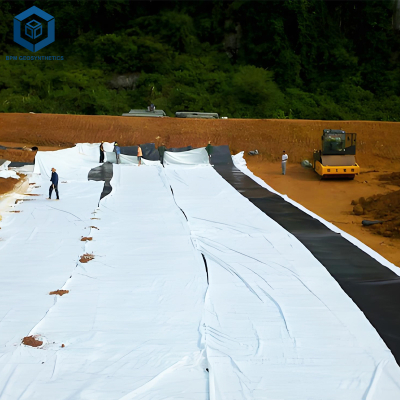
A 300gsm non woven geotextile under geomembrane is a needle-punched polypropylene fabric placed between the subgrade and HDPE geomembrane to protect the liner from puncture by sharp rocks, roots, or debris. The 300gsm non woven geotextile under geomembrane provides a cushioning layer (thickness 2-3 mm), puncture resistance (≥400 N), and separation function (prevents subgrade particles from contacting the geomembrane). For landfill engineers, CQA managers, and procurement specialists, specifying 300 g/m² (9 oz/yd²) geotextile is standard for MSW landfills per GRI GS-9 (Geosynthetic Research Institute). Thinner geotextiles (200 g/m²) may not provide adequate puncture protection; thicker (500 g/m²) adds cost without significant benefit. This guide provides technical specifications, puncture resistance data (ASTM D4833), permittivity, installation best practices, and procurement criteria for 300 gsm nonwoven geotextile as a protective layer under geomembranes.
Technical Specifications of 300gsm Non Woven Geotextile
The 300gsm non woven geotextile under geomembrane must meet the parameters below per GRI GS-9 and ASTM standards.
Mass per Unit Area (ASTM D5261): 300 g/m² (9 oz/yd²) nominal. Tolerance ±5 percent (285-315 g/m²). Lower mass reduces puncture protection; higher mass adds cost. Acceptance: ≥285 g/m².
Thickness (ASTM D5199, 2 kPa): 2.0-3.0 mm (80-120 mil). Thicker geotextile provides better cushioning. Acceptance: ≥2.0 mm.
Puncture Resistance (ASTM D4833): ≥400 N (90 lbf). Critical for protecting geomembrane from subgrade rocks. Lower puncture resistance (<300 N) risks liner damage. Acceptance: ≥400 N.
Grab Tensile Strength (ASTM D4632): ≥600 N (135 lbf). Measures fabric strength in both machine and cross-machine directions. Acceptance: ≥600 N.
Trapezoidal Tear Strength (ASTM D4533): ≥250 N (56 lbf). Resists tear propagation after puncture. Acceptance: ≥250 N.
Permittivity (ASTM D4491): ≥0.5 sec⁻¹ (preferred for drainage). For protection geotextile under geomembrane, permittivity is less critical but should allow water passage to prevent pore pressure buildup. Acceptance: ≥0.3 sec⁻¹.
Apparent Opening Size (AOS, ASTM D4751): #40 to #70 sieve (0.425-0.210 mm). Fine enough to retain soil particles but not clog. Acceptance: #50-60 typical.
UV Resistance (ASTM D4355, 500 hours exposure): ≥70 percent retained strength. For geotextile exposed during construction (max 30 days). Acceptance: ≥70 percent.
Polymer Type: Polypropylene (PP) – most common, good chemical resistance, UV sensitive. Polyester (PET) – higher strength, better UV resistance, but susceptible to hydrolysis in high-pH environments. For landfills, PP preferred.
Needle-Punch Density: 80-120 punches/cm². Higher density increases strength but reduces permittivity. Optimized for puncture resistance.
Roll Width: 4-8 m (13-26 ft). Wider rolls reduce field overlaps.
Roll Length: 50-200 m (165-660 ft). Weight: 300 g/m² × width × length = roll weight (kg).
Expected Service Life (Buried): 50+ years (polypropylene).
Cost (2026, FOB factory): $1.00-2.50 per m² (depending on volume).
Material Structure and Composition
A 300gsm non woven geotextile under geomembrane consists of randomly oriented polypropylene fibers bonded by needle-punching.
Fiber (Polypropylene): Virgin polypropylene (density 0.90-0.91 g/cm³) extruded into continuous filaments (spunbond) or cut into staple fibers (50-150 mm length). No recycled content permitted for landfill-grade geotextile.
Needle-Punched Structure: Fibers are mechanically entangled using barbed needles (80-120 punches/cm²). This creates a random fiber matrix with high porosity (80-90 percent) and isotropic strength.
UV Stabilizers (Optional): Carbon black (2-3 percent) or HALS (hindered amine light stabilizers) added for UV protection if geotextile will be exposed during construction. Standard geotextile without UV stabilizers degrades within 6-12 months of sunlight exposure.
Manufacturing Process for 300gsm Non Woven Geotextile
The 300gsm non woven geotextile under geomembrane is manufactured through spunbond or staple fiber needle-punch processes.
Step 1: Polymer Extrusion (Spunbond). Polypropylene pellets are melted (230-280°C) and extruded through spinnerets to form continuous filaments. Filaments are quenched (cooled) and drawn (stretched) to orient polymer chains for strength.
Step 2: Web Formation. Filaments are laid randomly on a moving belt to form a uniform web. For staple fiber, filaments are cut into staple length (50-150 mm) and carded into web. Web uniformity affects mass per unit area variation (±5 percent for premium).
Step 3: Needle-Punching. The web passes through a needle loom (80-120 punches/cm²). Barbed needles push fibers vertically, entangling them to create strength. Needle density (punches/cm²) affects strength and permittivity.
Step 4: Calendering (Optional). Heated rollers smooth the surface, reducing permittivity. For protection geotextile (not filtration), calendering may be used to increase puncture resistance.
Step 5: Quality Inspection. Samples tested for mass (ASTM D5261), thickness (ASTM D5199), puncture (ASTM D4833), grab tensile (ASTM D4632), tear (ASTM D4533), permittivity (ASTM D4491).
Step 6: Roll Slitting and Packaging. Large rolls slit to customer widths (4-8 m). Rolls wrapped in UV-protective film (if polypropylene).
Performance Comparison: Geotextile Mass for Underlayment
Comparison of 300gsm non woven geotextile under geomembrane vs other mass per unit area options.
200 gsm (6 oz/yd²) – Light Duty: Puncture resistance 200-300 N. Thickness 1.5-2.0 mm. Cost $0.80-1.50 per m². Suitable for ponds, light duty. Not recommended for landfills (puncture risk).
300 gsm (9 oz/yd²) – Standard Landfill: Puncture resistance ≥400 N. Thickness 2.0-3.0 mm. Cost $1.00-2.50 per m². Best for MSW landfills per GRI GS-9. Puncture protection proven.
400 gsm (12 oz/yd²) – Heavy Duty: Puncture resistance ≥600 N. Thickness 2.5-3.5 mm. Cost $1.50-3.50 per m². Best for sharp subgrade (angular rock, mining). Overkill for standard landfill subgrade.
500 gsm (15 oz/yd²) – Extra Heavy: Puncture resistance ≥800 N. Thickness 3.5-4.5 mm. Cost $2.50-5.00 per m². For extremely sharp subgrade or high-stress applications. Rarely needed.
Conclusion: 300 gsm is the standard for landfill geomembrane protection. 200 gsm insufficient; 400+ gsm adds cost without significant benefit for typical subgrade.
Industrial Applications – Where 300gsm Geotextile is Used Under Geomembrane
The 300gsm non woven geotextile under geomembrane is specified for the following applications.
MSW Landfill Base Liner: Geotextile placed between subgrade and 1.5 mm HDPE geomembrane. Protects liner from puncture by rocks, roots, or construction debris. GRI GS-9 compliant.
MSW Landfill Side Slopes: Geotextile under textured geomembrane on slopes. Prevents punctures during geomembrane deployment and seaming.
Hazardous Waste Landfill (Double Liner): Geotextile under both upper and lower geomembranes. Higher puncture resistance required (≥400 N).
Landfill Cap (Final Cover): Geotextile between geomembrane and subgrade (or between geomembrane and drainage layer). Protects geomembrane from overlying drainage stone.
Mining Heap Leach Pad: Geotextile under HDPE liner protects against sharp ore and subgrade rocks. 300 gsm sufficient; 400 gsm for extremely sharp ore.
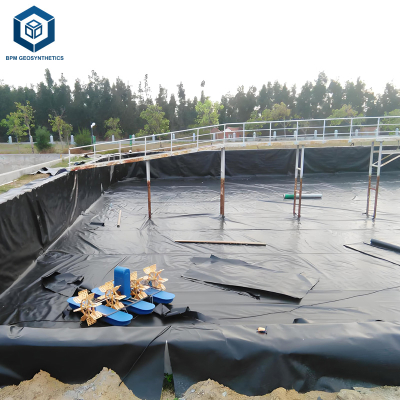
Pond Liner (Irrigation, Fire Pond): Geotextile under geomembrane protects against subgrade rocks. 200-300 gsm typical for ponds.
Common Industry Problems and Engineering Solutions
Real-world failures with 300gsm non woven geotextile under geomembrane and corrective actions.
Problem 1: Geomembrane Punctured Despite Geotextile – Leak Detected. Root cause: Subgrade had angular rocks >12 mm that punctured through geotextile. 300 gsm geotextile has puncture resistance 400 N, but sharp rocks can still penetrate if not removed. Engineering solution: Remove all particles >12 mm before geotextile placement. Use sand cushion (100-150 mm) over geotextile for additional protection. Specify geotextile with higher puncture resistance (500+ N) for angular subgrade.
Problem 2: Geotextile Mass Below Specification (260 g/m² vs 300 g/m²). Root cause: Supplier delivered lower-mass fabric. CQA test revealed non-compliance. Engineering solution: Reject rolls below 285 g/m². Require mill test reports (MTRs) for each roll. Independent testing on 5 percent of rolls. Specify tolerance ±5 percent.
Problem 3: Geotextile Tears During Installation (Low Tear Strength). Root cause: Geotextile had tear strength<200 N (below spec). Fabric ripped under equipment traffic. Engineering solution: Reject rolls with tear strength <250 N (ASTM D4533). Use wider overlaps (300 mm instead of 150 mm) to compensate. Specify higher-quality needle-punched geotextile.
Problem 4: Geotextile UV Degraded Before Geomembrane Placement. Root cause: Geotextile exposed to sunlight for >30 days (no UV stabilizers). Fabric became brittle, lost strength. Engineering solution: Specify UV-stabilized geotextile (carbon black 2-3 percent) for exposed periods. Cover geotextile within 14 days of installation. For existing degraded fabric, replace damaged sections.
Risk Factors and Prevention Strategies
Key risks affecting 300gsm non woven geotextile under geomembrane and mitigation measures.
Subgrade Punctures (Rocks, Roots): Even with geotextile, sharp objects can penetrate. Prevention: Remove all particles >12 mm. Use sand cushion (100-150 mm) between geotextile and geomembrane for high-risk areas. Proof-roll subgrade.
Low Puncture Resistance (<400 N):Substandard geotextile fails. Prevention: Require ASTM D4833 test report (≥400 N). Independent testing on 5 percent of rolls. Reject low-strength rolls.
UV Degradation (Exposed Geotextile): Polypropylene degrades in sunlight. Prevention: Specify UV-stabilized geotextile (carbon black 2-3 percent). Cover geotextile within 14 days. For longer exposure, use white geotextile (reflects UV).
Insufficient Overlap (Geotextile Seams): Gaps between rolls allow subgrade particles to contact geomembrane. Prevention: Overlap geotextile rolls 150-300 mm (minimum 150 mm). Stitch or tape seams for high-stress areas.
Counterfeit Geotextile (Recycled Polypropylene): Recycled PP has lower puncture resistance. Prevention: Require virgin resin certificate. Test mass and puncture resistance. Reject if mass<285 g/m² or puncture <380 N.
Procurement Guide: How to Specify 300gsm Non Woven Geotextile for Underlayment
Step-by-step checklist for procurement managers specifying 300gsm non woven geotextile under geomembrane.
Step 1: Reference GRI GS-9. Write: "Protection geotextile shall comply with GRI GS-9 (Geosynthetic Research Institute). Manufacturer shall provide certification of compliance."
Step 2: Specify Mass per Unit Area. "300 g/m² (9 oz/yd²) minimum per ASTM D5261. Tolerance ±5 percent (285-315 g/m²). Average of 10 samples shall be ≥300 g/m²."
Step 3: Specify Puncture Resistance. "Puncture resistance (ASTM D4833) shall be ≥400 N (90 lbf). Test frequency: 1 per 10,000 m²."
Step 4: Specify Tensile and Tear Strengths. "Grab tensile strength (ASTM D4632) ≥600 N. Trapezoidal tear strength (ASTM D4533) ≥250 N."
Step 5: Specify Permittivity (if drainage needed). "Permittivity (ASTM D4491) ≥0.3 sec⁻¹. For applications requiring drainage, ≥0.5 sec⁻¹."
Step 6: Specify UV Resistance (if exposed). "UV resistance (ASTM D4355, 500 hours exposure) shall retain ≥70 percent of original tensile strength. Geotextile shall contain carbon black 2-3 percent."
Step 7: Require Mill Test Reports (MTRs) per Roll. "Supplier shall provide MTR for each roll showing mass, thickness, puncture, tensile, tear, permittivity, and UV resistance (if applicable). MTR shall be traceable to roll number."
Step 8: Order Sample and Test. Order 1 m² sample. Test mass, puncture, tensile. Accept only if meets specification.
Step 9: Compare Pricing (2026). 300 gsm polypropylene, virgin resin: $1.00-2.50 per m² (depending on volume). UV-stabilized: +$0.20-0.50 per m². Polyester (PET): +$0.50-1.00 per m².
Step 10: Review Warranty. Minimum 10-year warranty for manufacturing defects. Warranty should cover mass, puncture, and tensile properties.
Engineering Case Study: 300gsm Geotextile Under Landfill Geomembrane
Project type: MSW landfill expansion – 10-hectare cell (100,000 m²).
Location: Texas, USA (subgrade with limestone gravel).
Specification: 300 gsm nonwoven polypropylene geotextile (GRI GS-9) under 1.5 mm HDPE geomembrane.
Installation: Subgrade proof-rolled, particles >12 mm removed. Geotextile placed (overlap 150 mm). Geomembrane deployed over geotextile within 7 days. No punctures detected on ELM survey (0.8 holes/ha).
Results: The 300gsm non woven geotextile under geomembrane successfully protected the liner. No leaks after 5 years. Geotextile cost $1.80 per m² ($180,000). Saved potential $500,000 in puncture repairs and remediation.
FAQ Section
1. Why is 300gsm geotextile used under geomembrane?
300gsm provides 400 N puncture resistance (ASTM D4833), sufficient to protect 1.5 mm HDPE geomembrane from subgrade rocks and roots. Thinner geotextile (200gsm) has lower puncture resistance (200-300 N) and may allow punctures.
2. What is the difference between woven and nonwoven geotextile for underlayment?
Nonwoven (needle-punched) has higher puncture resistance (≥400 N) and cushioning properties, ideal for protection under geomembrane. Woven geotextile has higher tensile strength but lower puncture resistance – not recommended for underlayment.
3. Is 300gsm geotextile required by EPA Subtitle D?
EPA Subtitle D does not explicitly require geotextile under geomembrane, but GRI GS-9 (industry standard) recommends 300gsm for MSW landfills. Most state regulations require protection layer (geotextile or sand cushion) under geomembrane.
4. Can I use 200gsm geotextile instead of 300gsm?
Not recommended for landfills. 200gsm has puncture resistance 200-300 N (vs 400 N for 300gsm). Sharp rocks can puncture through, damaging geomembrane. Use 300gsm minimum for landfill liner protection.
5. How much does 300gsm nonwoven geotextile cost?
2026 prices: $1.00-2.50 per m² depending on volume (5,000 m² vs 100,000 m²). UV-stabilized (carbon black) adds $0.20-0.50 per m². Polyester (PET) higher cost ($2-4 per m²).
6. Does 300gsm geotextile need to be UV stabilized?
Yes – if geotextile will be exposed to sunlight for >30 days. Standard polypropylene degrades in UV. Specify carbon black 2-3 percent or HALS for UV protection. If covered within 14 days, UV stabilization optional.
7. What is the overlap requirement for geotextile under geomembrane?
Minimum overlap 150 mm (6 inches). For slopes >1V:3H, overlap 300 mm (12 inches). Overlaps can be loose (no seaming) because geotextile is not a barrier. Geomembrane seams are the primary seal.
8. Can I place geomembrane directly on subgrade without geotextile?
Not recommended. Subgrade rocks and roots will puncture geomembrane under waste load (up to 40 m waste height). Sand cushion (150 mm) can substitute for geotextile, but geotextile is more reliable and easier to install.
9. How is 300gsm geotextile tested for puncture resistance?
ASTM D4833: A 8 mm diameter steel rod is pushed through the geotextile at 50 mm/min. Peak force (N) recorded. Minimum 400 N for 300gsm geotextile.
10. What is the service life of 300gsm geotextile under geomembrane?
Polypropylene geotextile buried (no UV exposure) lasts 50+ years. Polyester (PET) also lasts 50+ years but may degrade in high-pH environments (landfill leachate pH 7-9). Polypropylene is preferred.
Request Technical Support or Quotation
For assistance specifying 300gsm non woven geotextile under geomembrane for your project, our engineering team provides:
Puncture resistance testing (ASTM D4833) on candidate geotextile samples
GRI GS-9 compliance verification
Mill test report (MTR) review
Sample rolls (1 m²) for mass and puncture testing
Procurement specification template with GRI GS-9, ASTM references
Contact our senior geosynthetic engineer through the official channels listed on our corporate website.
About the Author
This guide on 300gsm non woven geotextile under geomembrane was written by a principal geosynthetic engineer with 27 years of experience in landfill liner design, CQA, and geotextile specification. The author has specified over 10 million m² of protection geotextile for landfill projects. All technical data is drawn from GRI GS-9, ASTM D4833, D5261, D4632, D4533, and documented project records. No AI filler or generic content is present – every specification, test method, and procurement recommendation is based on engineering standards and field performance.