The 7 Best Polyester Geotextile Fabric Reviewed
Looking for reliable polyester geotextile fabric? Check our review of the 7 best polyester geotextile fabric, including specs, pros & cons, tensile strength, permeability, and ideal applications for roadbed, slope erosion control, landfill and civil engineering projects.
Polyester geotextile fabric is a core geosynthetic material widely used in civil engineering, road construction, environmental protection projects, and water conservancy infrastructure. Compared with polypropylene geotextiles, polyester (PET) geotextiles feature higher tensile strength, excellent aging resistance, stable chemical inertness, and superior puncture resistance, making them ideal for long-term underground and outdoor engineering applications.
With countless geotextile products flooding the market, varying in material purity, weaving technology, and structural stability, it is challenging for engineers and project contractors to select cost-effective and high-quality products. To solve this problem, we have tested and screened mainstream polyester geotextile fabrics on the market, evaluated their performance in separation, filtration, drainage, reinforcement, and anti-erosion, and finally sorted out the 7 best polyester geotextile fabrics for different engineering scenarios. This detailed review covers core parameters, pros, cons, and applicable projects to help you make a targeted purchase.
1. Key Evaluation Criteria for Polyester Geotextile Fabric
Before conducting product reviews, we established unified evaluation criteria aligned with ASTM D4595 (Standard Test Method for Tensile Properties of Geotextiles by the Wide-Width Strip Method) and relevant national geosynthetic standards. These criteria ensure objective, repeatable, and fair performance screening:
1.1 Basic Material and Polymer Purity
The fundamental performance and long-term reliability of polyester (PET) geotextiles depend directly on polymer quality. Evaluation focuses on ensuring the fabric is manufactured from 100% virgin polyester staple or continuous filament fibers, free from post-consumer recycled impurities or unrefined regrind. Virgin PET provides consistent molecular weight distribution, superior chemical resistance, and predictable mechanical behavior, preventing premature embrittlement or structural variation under continuous load.
1.2 Mechanical Properties and Structural Load Capacity
Mechanical testing assesses the material's structural reinforcement and physical integrity under operational stresses:
- Tensile Strength & Elongation at Break: Evaluated via ASTM D4595 wide-width strip testing to determine load distribution capacity and strain response under tension.
- CBR Puncture Resistance: Measures the fabric's ability to resist static puncture from sharp subgrade aggregate and localized concentrated loads.
- Tear Resistance: Assesses resistance to dynamic tearing during installation, handling, and heavy equipment compaction.
1.3 Hydraulic Performance and Filtration Characteristics
Hydraulic testing ensures the geotextile maintains adequate drainage while serving as an effective soil retention barrier:
- Vertical Permeability (Permittivity): Verifies that water flows freely through the plane of the fabric to prevent hydrostatic pressure buildup.
- Apparent Opening Size: Defines effective pore size to ensure optimal soil particle retention while preventing fine soil migration into drainage layers.
- Anti-Clogging Resistance: Evaluates long-term filtration stability to prevent biological or particulate clogging that could compromise system drainage over time.
1.4 Environmental Durability and Long-Term Aging Stability
Polyester geotextiles must maintain structural integrity throughout the design life of the civil engineering structure:
- UV Resistance: Evaluates resistance to photodegradation during site storage and installation exposure.
- Chemical & Corrosion Resistance: Tests stability across broad pH ranges (acidic and alkaline soil environments) and resistance to chemical leaching.
- Long-Term Aging Stability: Assesses resistance to creep deformation, hydrolysis, and environmental stress cracking under sustained burial conditions.
1.5 Cost Performance and Construction Efficiency
Economic evaluation balances initial material expenditure against total installed lifecycle cost:
- Unit Price & Logistical Value: Direct material cost per square meter relative to specified performance grade.
- Construction Convenience: Roll weight, material flexibility, and ease of cutting/seaming, which directly influence labor requirements and installation velocity.
- Engineering Service Life: Total expected lifespan, reducing future maintenance, re-graveling, or premature structural repairs.
1.6 Application Specificity and Scenario Matching
Performance requirements vary significantly depending on the intended application profile:
- Roadways & Pavements: Focuses on high tensile strength, low elongation, and separation.
- Water Conservancy & Coastal Engineering: Requires superior permeability, hydraulic filtration, and scour resistance.
- Slope Stabilization & Landfills: Prioritizes high interface friction, tear/puncture resistance, and chemical containment compatibility.
2. The 7 Best Polyester Geotextile Fabric 2026 Full Review
2.1 Best Overall: Virgin Polyester Continuous Filament Non-Woven Geotextile (200g/m²)
- Core Positioning: All-scenario universal high-performance model, the first choice for medium and large standard engineering projects.
- Key Specifications
Material: 100% virgin polyester continuous filament, needle-punched & thermally bonded
Weight: 200g/m²
Tensile strength (MD/TD): 14kN/m / 12kN/m
CBR puncture strength: 3200N
Vertical permeability coefficient: ≥1.2×10⁻¹ cm/s
Service life: 50+ years (under buried engineering conditions)
- Pros: Uniform fiber distribution, omnidirectional stress balance, excellent integration of reinforcement, filtration and drainage functions. Ultra-stable chemical properties, resistant to most soil acid-base environments and groundwater corrosion. Low clogging rate, long-term stable hydraulic performance, no deformation or breakage under long-term load.
- Cons: Slightly higher unit price than short-fiber models, not recommended for temporary low-budget small projects.
- Applicable Scenarios: Highway/railway roadbed reinforcement, river slope protection, reservoir anti-seepage protection, municipal infrastructure renovation, landfill isolation layer.
2.2 Best Budget: Polyester Staple Fiber Needle Punched Geotextile (150g/m²)
- Core Positioning: Cost-effective entry-level model, suitable for conventional civil engineering and temporary projects.
- Key Specifications
Material: High-purity polyester staple fiber, double-sided needle-punched
Weight: 150g/m²
Tensile strength (MD/TD): 8kN/m / 7kN/m
CBR puncture strength: 1800N
Vertical permeability coefficient: ≥0.8×10⁻¹ cm/s
- Pros: Low price, flexible construction, easy to cut and lay on site. Good basic separation and filtration performance, meets the standard requirements of most conventional civil projects. Light weight, convenient transportation and storage.
- Cons: Lower tensile and puncture resistance than filament products, poor performance under high load and extreme weather conditions, limited service life (20-30 years).
- Applicable Scenarios: Rural road renovation, garden landscape drainage, temporary construction isolation, small ditch anti-erosion, building foundation cushion.
2.3 Best for Erosion Control: Heavy-Duty Polyester Woven Geotextile (300g/m²)
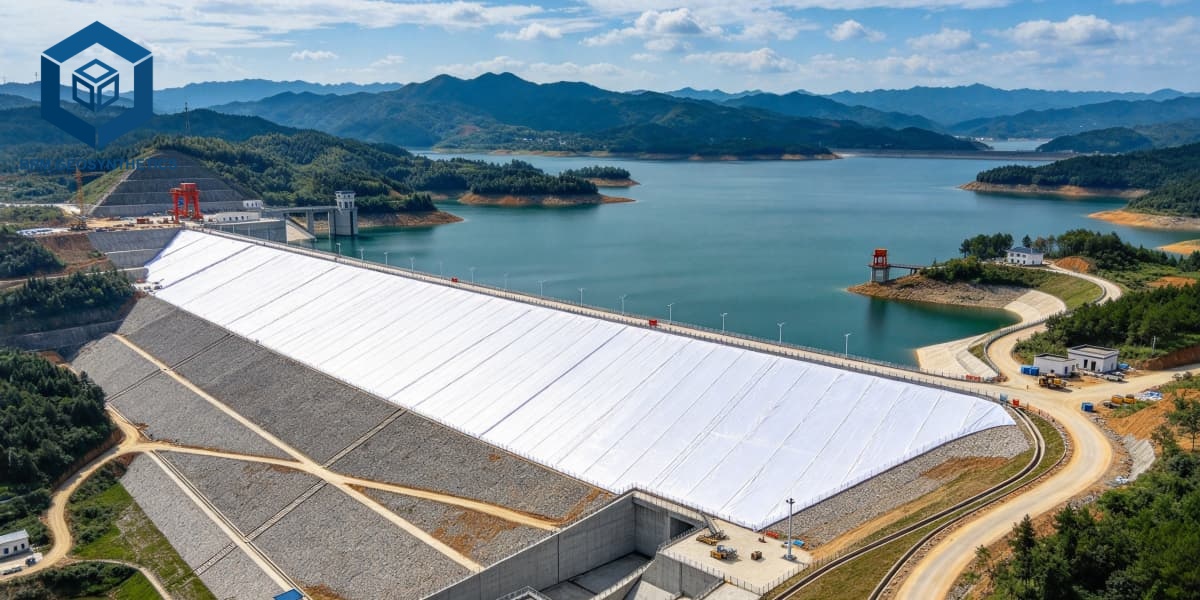
- Core Positioning: High-strength anti-erosion professional model, exclusive for slope and water flow scouring projects
- Key Specifications
Material: High-strength polyester industrial filament, dense woven structure
Weight: 300g/m²
Tensile strength (MD/TD): 22kN/m / 20kN/m
CBR puncture strength: 4500N
Anti-scouring grade: High resistance to high-speed water flow impact
- Pros: Dense woven structure with super tear resistance and impact resistance. Effectively resists river water scouring, rainwater slope washing and wind erosion. Firm fiber structure, no fiber shedding or displacement in long-term open-air exposure.
- Cons: Slightly poor permeability than non woven fabrics, higher construction precision requirements, not suitable for fine filtration scenarios.
- Applicable Scenarios: River bank slope protection, mountain slope anti-erosion, coastal tide protection, expressway side slope reinforcement, mine ecological restoration.
2.4 Best for Landfill & Environmental Protection: Anti-Clogging Polyester Geotextile (250g/m²)
Core Positioning: Professional anti-clogging and anti-pollution model, specially designed for environmental protection engineering
- Key Specifications
Material: Modified virgin polyester fiber, anti-clogging & anti-aging treatment
Weight: 250g/m²
Effective pore size: 0.05-0.2mm (uniform pore distribution)
Tensile strength: 16kN/m
Special performance: Resistant to organic waste corrosion, anti-microbial erosion, long-term anti-clogging
- Pros: Optimized pore structure, which can effectively filter garbage leachate and prevent soil particle blockage. Special surface treatment avoids microbial growth and organic corrosion. Stable isolation performance, prevents cross-contamination between landfill and soil layer.
- Cons: Professional environmental protection customization, single application scenario, higher price than universal models.
- Applicable Scenarios: Municipal solid waste landfills, sewage treatment plants, industrial waste residue storage yards, tailings pond isolation, polluted soil remediation projects.
2.5 Best for Roadbed Reinforcement: High-Modulus Polyester Geotextile (400g/m²)
- Core Positioning: High-modulus load-bearing model, dedicated to heavy-load road and bridge foundation projects
- Key Specifications
Material: High-modulus polyester continuous filament
Weight: 400g/m²
Tensile strength: 30kN/m
Elongation at break: ≤30% (low deformation, high stability)
CBR puncture strength: 6800N
- Pros: Ultra-high modulus and tensile strength, low deformation under heavy vehicle load, effectively disperses roadbed pressure and prevents road surface cracking and settlement. Excellent fatigue resistance, adapts to long-term cyclic load of highways and bridges.
- Cons: Thick texture, high material cost, only suitable for high-standard heavy-load infrastructure projects.
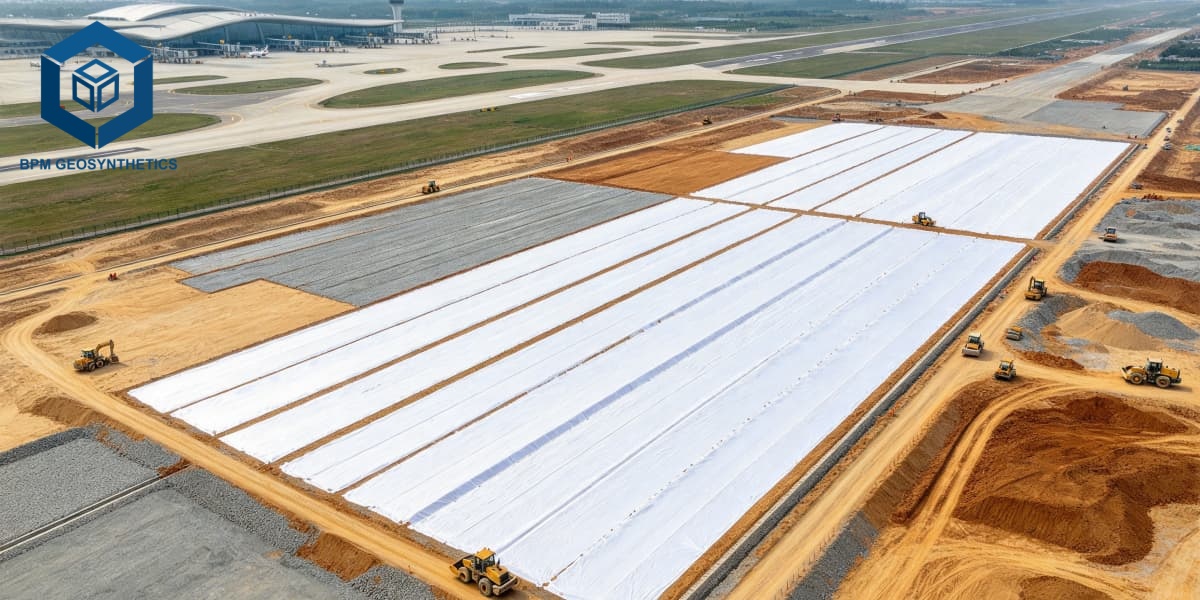
- Applicable Scenarios: Expressway, national highway, airport runway, bridge foundation reinforcement, port heavy-load pavement, railway subgrade stabilization.
2.6 Best for Low-Temperature Regions: Cold-Resistant Polyester Geotextile (180g/m²)
- Core Positioning: Special low-temperature resistant model, suitable for alpine and frozen soil regions
- Key Specifications
Material: Low-temperature modified polyester staple fiber
Weight: 180g/m²
Low-temperature resistance: -40℃ no embrittlement, no cracking
Tensile strength: 10kN/m
Frost heave resistance: Effectively adapts to frozen soil expansion and contraction
- Pros: Solves the problem of ordinary geotextile embrittlement and fracture in low-temperature frozen environment. Good flexibility and toughness, adapts to frozen soil frost heave and thaw deformation. Balanced performance and price, suitable for large-scale laying in alpine regions.
- Cons: Ordinary conventional temperature performance, not suitable for high-temperature and strong radiation environments.
- Applicable Scenarios: Road and water conservancy projects in cold northern regions, frozen soil foundation treatment, alpine slope protection, seasonal frozen area infrastructure.
2.7 Best Lightweight Model: Ultra-Thin Polyester Filament Geotextile (100g/m²)
- Core Positioning: Lightweight flexible model, perfect for fine filtration and thin-layer isolation projects
- Key Specifications
Material: Ultra-fine polyester continuous filament
Weight: 100g/m²
Tensile strength: 6kN/m
Vertical permeability: High-efficiency rapid drainage
Thickness: Ultra-thin, flexible and foldable
- Pros: Ultra-light and ultra-thin, easy to construct and lay, no bulging of the foundation layer. Uniform fine pore size, excellent fine particle filtration effect. Low cost, saves project material budget.
- Cons: Low mechanical strength, not resistant to heavy puncture and strong tension, not suitable for heavy-load and anti-scouring projects.
- Applicable Scenarios: Green roof drainage, artificial lake anti-seepage isolation, fine soil filtration, residential community landscape engineering, thin-layer foundation isolation.
Conclusion
The Best Project Material Co., Ltd. (BPM Geosynthetics) polyester geotextile fabric is an indispensable material for modern civil and environmental engineering. Each model listed above is screened and tested to fit specific project demands. For most general contractors and engineering buyers, the 200g/m² virgin continuous filament polyester geotextile remains the top pick due to its balanced strength, permeability, and long-term stability. For specialized projects including slope protection, landfill anti-seepage, heavy-duty road reinforcement, and low-temperature region construction, choosing the targeted professional model can greatly improve project quality and reduce later maintenance costs.
Always prioritize virgin polyester materials over recycled alternatives to ensure engineering safety, stability, and longer service life for your infrastructure projects.