Smooth vs textured HDPE geomembrane which one to use
Smooth and textured HDPE geomembranes are impermeable liners made from high-density polyethylene, designed for containment applications. The key difference lies in surface finish: smooth geomembranes offer low friction and ease of installation, while textured geomembranes provide enhanced interface friction for slope stability in demanding engineering environments.
Technical Parameters & Specifications
| Parameter | Smooth HDPE | Textured HDPE |
|---|---|---|
| Thickness | 0.5 – 3.0 mm | 1.0 – 3.0 mm |
| Density | ≥ 0.94 g/cm³ | ≥ 0.94 g/cm³ |
| Tensile Strength | ≥ 25 kN/m | ≥ 25 kN/m |
| Friction Angle | 10° – 14° | 18° – 30° |
| Puncture Resistance | High | Slightly Reduced (due to texture) |
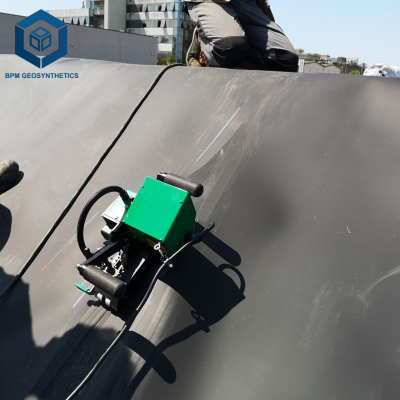
| Weldability | Excellent | Moderate (requires skilled welding) |
Structure & Material Composition
Base Material: Virgin HDPE resin (≥97.5%)
Carbon Black: 2–3% for UV resistance
Antioxidants: Thermal and oxidative protection
Surface Type:
Smooth: Flat, uniform surface
Textured: Roughened surface via gas extrusion
Optional Composite Layers:
Geotextile protection layer
Drainage layer
Manufacturing Process
Raw Material Preparation: HDPE resin blending with additives.
Extrusion: Flat die extrusion forming continuous sheet.
Texturing Process:
Smooth: Standard extrusion
Textured: Nitrogen gas injection or surface embossing
Cooling: Controlled cooling for dimensional stability.
Quality Control: Thickness, friction, and mechanical testing.
Roll Packaging: Standard widths for transport and installation.
Industry Comparison (Smooth vs Textured HDPE Geomembrane)
| Criteria | Smooth HDPE | Textured HDPE |
|---|---|---|
| Interface Friction | Low | High |
| Installation Ease | Easy | Moderate |
| Best for Flat Areas | ★★★★★ | ★★★☆☆ |
| Best for Slopes | ★★☆☆☆ | ★★★★★ |
| Cost | Lower | Slightly Higher |
| Welding Complexity | Low | Higher |
Application Scenarios
EPC Contractors: Landfills, mining, and water containment systems.
Mining Projects: Heap leach pads (textured for slopes).
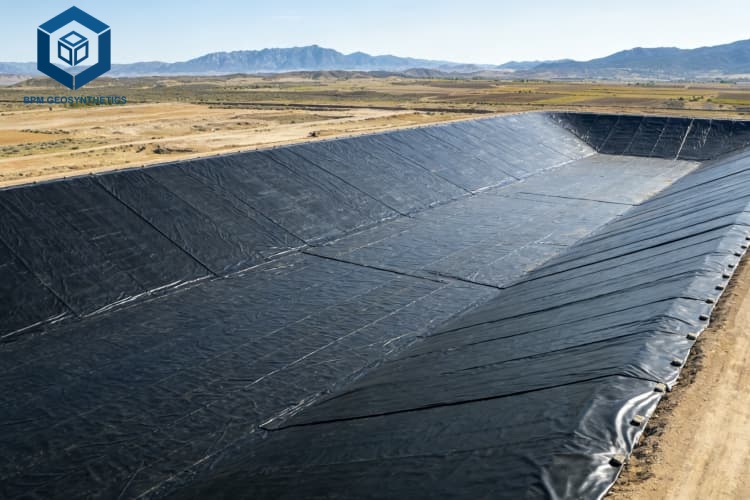
Water Reservoirs: Smooth liners for flat-bottom ponds.
Distributors: Supply of both variants for different project needs.
Core Pain Points & Solutions
Slope Instability:
Solution: Use textured HDPE geomembrane to increase friction angle.Installation Difficulty:
Solution: Use smooth HDPE for flat areas to simplify welding.Seam Failure Risk:
Solution: Employ skilled welding teams for textured surfaces.Puncture Risk:
Solution: Use geotextile protection regardless of surface type.Cost Optimization:
Solution: Combine smooth (base) and textured (slopes) in hybrid systems.
Risk Warnings & Mitigation
Incorrect material selection → Leads to slope failure or slippage.
Poor welding on textured liner → Causes leakage.
Over-specification → Increases unnecessary project cost.
Underestimating slope angle → Results in instability.
Procurement & Selection Guide
Analyze project geometry (flat vs slope areas).
Determine required friction angle.
Select smooth HDPE for flat zones.
Select textured HDPE for slopes ≥1:3 gradient.
Verify compliance with GRI GM13 standards.
Evaluate supplier experience in textured production.
Plan hybrid liner systems for cost efficiency.
Engineering Case Study
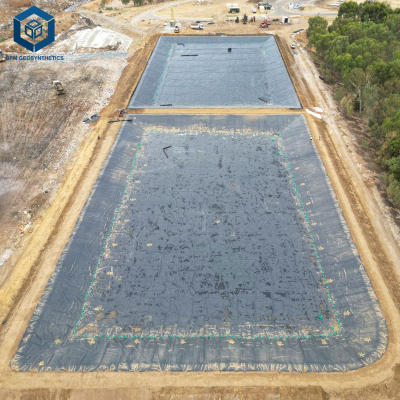
A landfill project covering 80,000 m² used a hybrid liner system: 1.5 mm smooth HDPE for the base and 1.5 mm textured HDPE for side slopes. The design improved slope stability while maintaining cost efficiency. After 5 years, inspections showed no slippage or leakage, validating the combined use strategy.
FAQ (Frequently Asked Questions)
1. What is the difference between smooth and textured HDPE?
Surface friction and application suitability.2. When should textured HDPE be used?
On slopes requiring higher friction.3. Is smooth HDPE cheaper?
Yes, generally lower cost.4. Does textured HDPE reduce puncture resistance?
Slightly, but still adequate.5. Can both types be used together?
Yes, commonly in hybrid systems.6. Is welding more difficult for textured liners?
Yes, requires experienced technicians.7. What thickness is recommended?
1.0–2.0 mm depending on project.8. What is the key selection factor?
Slope stability requirements.9. Are both UV resistant?
Yes, with carbon black stabilization.10. What standard applies?
GRI GM13.
Call to Action (CTA)
For smooth vs textured HDPE geomembrane recommendations, technical datasheets, and project-specific solutions, contact our engineering team. We provide samples, design support, and full technical assistance for your containment projects.
E-E-A-T: Authoritative Expertise
This article is prepared by geomembrane engineers with over 10 years of experience in containment system design and manufacturing. Our team supports global EPC contractors, mining companies, and environmental projects with reliable, standards-compliant geomembrane solutions.