How to test geomembrane before shipment
How to test geomembrane before shipment refers to the systematic laboratory and factory inspection procedures used to verify that geomembrane products meet engineering specifications before delivery. These tests confirm thickness accuracy, mechanical strength, impermeability, and long-term durability to ensure safe performance in containment projects such as landfills, mining ponds, and wastewater facilities.
Technical Parameters and Specifications
| Inspection Item | Typical Requirement | Test Standard |
|---|---|---|
| Thickness | 0.5 mm – 3.0 mm | ASTM D5199 |
| Density | ≥ 0.940 g/cm³ | ASTM D1505 |
| Tensile Strength | ≥ 15 kN/m | ASTM D6693 |
| Elongation at Break | ≥ 700% | ASTM D6693 |
| Puncture Resistance | ≥ 480 N | ASTM D4833 |
| Carbon Black Content | 2% – 3% | ASTM D4218 |
| Carbon Black Dispersion | Grade 1–2 | ASTM D5596 |
| Oxidative Induction Time | ≥ 100 min | ASTM D3895 |
| Hydrostatic Resistance | No leakage | ASTM D5397 |
Structure and Material Composition
Understanding the geomembrane structure helps explain why specific laboratory tests are required before shipment.
HDPE Polymer Base Layer – Provides primary impermeability and chemical resistance.
Carbon Black Stabilizer – Improves resistance to UV degradation in outdoor installations.
Antioxidant Additives – Prevent long-term polymer oxidation.
Optional Textured Surface Layer – Enhances friction in slope applications.
Uniform Extruded Sheet Structure – Ensures consistent thickness and mechanical properties.
Manufacturing Process and Pre-Shipment Testing Workflow
To understand how to test geomembrane before shipment, it is necessary to examine the quality inspection stages integrated into geomembrane manufacturing.
Step 1 – Raw Material Inspection
HDPE resin pellets and additives are tested for density, melt index, and carbon black content before production begins.
Step 2 – Polymer Mixing and Feeding
Automatic gravimetric feeding systems ensure stable polymer ratios and consistent formulation throughout the extrusion process.
Step 3 – Extrusion Sheet Production
Flat die extrusion machines produce geomembrane sheets at temperatures typically ranging from 180°C to 230°C.
Step 4 – Online Thickness Monitoring
Laser or ultrasonic thickness measurement systems continuously monitor sheet thickness across the production width.
Step 5 – Cooling and Stress Stabilization
Calender rollers and cooling systems stabilize the geomembrane sheet to eliminate residual stresses.
Step 6 – Laboratory Mechanical Testing
Samples are collected from each roll to perform tensile, puncture, and density tests according to ASTM standards.
Step 7 – Final Roll Inspection
Before shipment, each geomembrane roll undergoes visual inspection, dimensional measurement, and labeling verification.
Industry Comparison
| Material | Testing Complexity | Quality Stability | Typical Applications |
|---|---|---|---|
| HDPE Geomembrane | High | Excellent | Landfills, mining ponds |
| LLDPE Geomembrane | Moderate | Good | Agriculture reservoirs |
| PVC Membrane | Moderate | Moderate | Construction waterproofing |
| EPDM Rubber | Low | Flexible | Decorative water features |
Application Scenarios
A strict process for how to test geomembrane before shipment is essential in projects where containment reliability is critical.
Municipal landfill lining systems
Mining tailings storage facilities
Industrial wastewater treatment ponds
Oil and gas secondary containment
Agricultural irrigation reservoirs
Environmental remediation barriers
Core Pain Points and Engineering Solutions
Pain Point 1 – Inconsistent thickness across rolls
Solution: Use automated thickness scanning equipment during production.Pain Point 2 – Undetected material defects
Solution: Conduct laboratory mechanical testing for each production batch.Pain Point 3 – UV degradation during long-term exposure
Solution: Verify carbon black content and dispersion quality.Pain Point 4 – Shipment of defective rolls
Solution: Implement final inspection and roll identification tracking.
Risk Warnings and Avoidance Recommendations
Shipping geomembranes without laboratory testing may lead to installation failure.
Poor thickness control may cause weak welding seams during installation.
Low carbon black content increases the risk of UV degradation.
Improper packaging can damage geomembrane rolls during transportation.
Procurement Selection Guide
Verify compliance with ASTM and GRI geomembrane standards.
Request pre-shipment inspection reports.
Confirm laboratory testing capability within the factory.
Check extrusion line capacity and production stability.
Review engineering project references.
Evaluate roll packaging and transport protection methods.
Confirm product traceability through roll identification labels.
Engineering Case Study
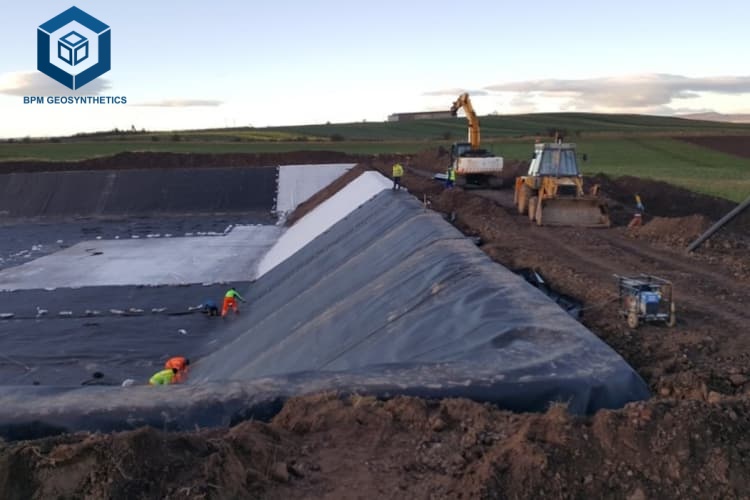
In a mining tailings containment project in South America, engineers required 1.5 mm HDPE geomembrane covering approximately 120,000 square meters. Before shipment, the manufacturer implemented a strict testing program following ASTM standards. Each production batch underwent tensile testing, density analysis, and carbon black dispersion verification.
After installation using hot wedge welding machines, seam testing confirmed excellent bonding strength. The geomembrane system successfully met environmental containment requirements and passed the final engineering inspection.
Frequently Asked Questions (FAQ)
1. Why is pre-shipment testing important for geomembranes?
It ensures the product meets engineering specifications before installation.
2. What standards apply to geomembrane testing?
ASTM and GRI GM13 standards are widely used.
3. How is geomembrane thickness measured?
Using ASTM D5199 thickness gauges or laser measurement systems.
4. What is carbon black dispersion testing?
A microscope test verifying uniform distribution of UV stabilizers.
5. How many samples should be tested?
Typically samples are taken from each production roll.
6. What mechanical tests are required?
Tensile strength, elongation, and puncture resistance tests.
7. Can defective rolls be detected visually?
Some surface defects can be detected, but laboratory testing is essential.
8. What is oxidative induction time?
A measure of resistance to thermal oxidation in polymers.
9. Are all geomembranes tested before shipment?
Reputable manufacturers perform batch testing before delivery.
10. What documents should buyers request?
Laboratory test reports, inspection certificates, and production batch records.
Request a Quote / Technical Documentation / Engineering Samples
If you require geomembrane testing reports, engineering specifications, or project samples, please contact our technical team. We provide laboratory documentation, production data, and engineering support for EPC contractors, distributors, and environmental infrastructure projects.
E-E-A-T: Author Expertise and Industry Authority
This article was prepared by professionals with extensive experience in geomembrane manufacturing, polymer materials engineering, and environmental containment systems. The technical information follows internationally recognized standards including ASTM testing procedures and GRI geomembrane specifications used in landfill, mining, and wastewater infrastructure projects worldwide.