HDPE Liner Roll Size Standard Export: Engineering Guide
What is HDPE Liner Roll Size Standard Export?
HDPE liner roll size standard export defines the dimensional specifications (width, length, roll weight, core diameter) for high-density polyethylene geomembrane rolls manufactured for international shipping and containerized transport. For procurement managers, EPC contractors, and logistics coordinators, understanding HDPE liner roll size standard export is critical for optimizing shipping costs (20 ft or 40 ft containers), minimizing field seams, and ensuring compatibility with deployment equipment. Standard export roll dimensions vary by manufacturer but typically range: width 5–10 m, length 50–200 m, roll weight 500–3,000 kg, with 3-inch or 6-inch cores. This guide provides engineering analysis of HDPE liner roll size standard export: container loading, roll dimension limits, GRI GM13 compliance, and procurement specifications for landfill, mining, and wastewater projects.
Technical Specifications of HDPE Liner Roll Size Standard Export
| Parameter | Typical Range | Maximum | Engineering Importance |
|---|---|---|---|
| Roll Width | 5 – 8 m | 10 m | Wider rolls reduce field seams. Must fit container width (2.34 m internal). |
| Roll Length | 50 – 150 m | 200 m | Longer rolls reduce shipping cost but increase weight. |
| Roll Weight | 800 – 2,000 kg | 3,000 kg | Limit 1,500 kg for forklift handling; above requires crane. |
| Core Diameter | 76 mm (3 inch) | 152 mm (6 inch) | Larger core reduces bending stress during unrolling. |
| Roll Outside Diameter | 0.8 – 1.5 m | 1.8 m | Must fit container door (2.28 m height). |
| 20 ft Container Loading | 2 – 4 rolls | 4 rolls | Optimize cube to minimize shipping cost per m². |
| 40 ft Container Loading | 4 – 8 rolls | 10 rolls | Most common for international geomembrane shipments. |
Material Structure and Composition
| Thickness (mm) | Typical Roll Length (7 m width) | Roll Weight (kg) | Shipping Cost Impact |
|---|---|---|---|
| 0.75 | 150 – 200 m | 800 – 1,100 | Lowest cost per m² |
| 1.0 | 100 – 150 m | 900 – 1,300 | Standard balance |
| 1.5 | 80 – 120 m | 1,100 – 1,700 | Moderate, heavier rolls |
| 2.0 | 60 – 100 m | 1,400 – 2,200 | Heavy, may exceed manual limit |
| 2.5 | 40 – 80 m | 1,500 – 2,800 | Highest cost per m² |
Manufacturing Process: How Roll Dimensions Are Determined
Extrusion line width: Flat die lines produce up to 10 m width; blown film lines typically 4–7 m.
Winding station capacity: Limits max roll OD and weight. Modern winders handle 1.8–2.0 m OD.
Core loading: Cardboard cores (3 or 6 inch); steel cores for rolls > 2,500 kg.
Roll slitting: Master rolls slit to customer-specified widths (e.g., 7 m from 8 m master).
Quality inspection: Roll dimensions measured; thickness tolerance ±10% across width.
Packaging: UV-resistant polyethylene wrap, edge protectors, steel strapping, labeling.
Performance Comparison: Roll Size Options by Container Type
| Roll Size (Width × Length) | Area per Roll (m²) | Rolls per 40 ft Container | Total Area per Container (m²) | Field Seams per 10,000 m² |
|---|---|---|---|---|
| 5 m × 100 m | 500 | 8 | 4,000 | 20 |
| 6 m × 100 m | 600 | 7 | 4,200 | 17 |
| 7 m × 100 m | 700 | 6 | 4,200 | 14 |
| 8 m × 100 m | 800 | 5 | 4,000 | 12 |
| 7 m × 150 m | 1,050 | 4 | 4,200 | 14 (longer seams) |
Industrial Applications
Landfill bottom liners: Prefer wide rolls (7–8 m) to reduce field seams.
Mining heap leach pads: Standard 6 m × 100 m rolls for easier handling in rough terrain.
Wastewater lagoons: 5–6 m width, shorter lengths (50–75 m) for manual handling.
Secondary containment: Narrow rolls (3–5 m) cut to fit irregular shapes.
Floating covers: Wide rolls (7–8 m) to minimize gas-leak seams.
Common Industry Problems and Engineering Solutions
Problem 1: Roll too wide for container door
Root cause: 8 m roll cannot be loaded horizontally (container width 2.34 m). Solution: Slit to ≤ 2.3 m for horizontal loading, or load vertically with racking.
Problem 2: Roll weight exceeds handling capacity
Root cause: 2.0 mm × 8 m × 150 m roll > 3,000 kg. Solution: Specify max 1,500 kg for sites without heavy equipment.
Problem 3: Roll OD too large for container door
Root cause: 200 m roll OD 1.8 m. Solution: Verify OD < 2.28 m door height.
Problem 4: Core collapse during shipping
Root cause: 3-inch core under > 1,500 kg roll. Solution: Specify 6-inch core for heavy rolls.
Risk Factors and Prevention Strategies
Underestimating shipping volume: Smaller rolls increase cost. Target 4,000–4,500 m² per 40 ft container.
Roll damage during transport: Use edge protectors, strapping, and dunnage bags.
Moisture damage during ocean transit: Use desiccant bags and moisture-barrier wrapping.
Customs delays due to missing documentation: Include detailed packing list with roll dimensions and HS code.
Procurement Guide: 8-Step Checklist
Calculate total project area to determine number of rolls.
Select optimal roll width: balance seam reduction vs handling.
Select roll length based on thickness (thicker = shorter rolls).
Specify core diameter: 3-inch for < 1,500 kg; 6-inch for > 1,500 kg.
Confirm container loading plan: 20 ft or 40 ft containers.
Request roll dimension tolerance: width ±1%, length ±1%, weight ±5%.
Specify packaging: UV wrap, edge protectors, steel strapping, labeling.
Inspect upon arrival: document any damage for claim.
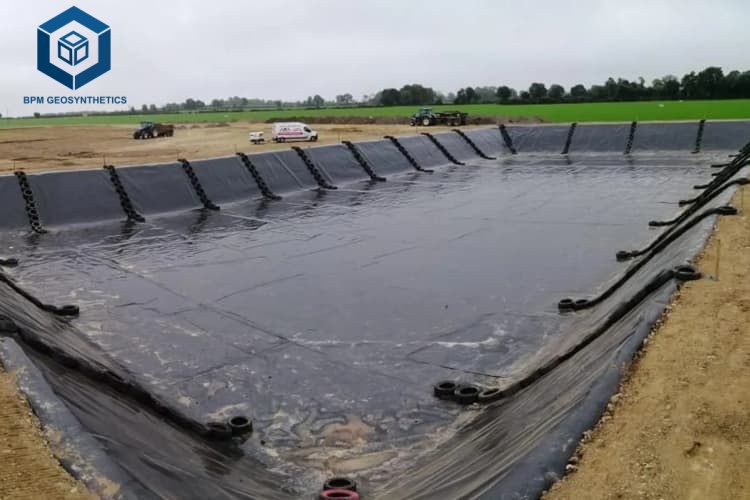
Engineering Case Study: Roll Size Optimization for Landfill Project
Project: 120,000 m² landfill bottom liner, 1.5 mm HDPE. Location: Southeast Asia. Initial specification: 5 m × 100 m rolls → 240 rolls, 30 containers, shipping €45,000. Optimized: 7 m × 120 m rolls → 143 rolls, 24 containers, shipping €36,000 (20% saving). Field seams reduced 40%. Result: €9,000 shipping saving + faster installation.
Frequently Asked Questions (FAQ)
Q1: What is the standard roll width for HDPE liner export?
5–8 m. 7 m is most common.
Q2: What is the maximum roll length?
Depends on thickness: 0.75 mm: 200 m; 1.0 mm: 150 m; 1.5 mm: 120 m; 2.0 mm: 100 m.
Q3: How many rolls fit in a 40 ft container?
4–8 rolls depending on size. Typical: 6 rolls of 7 m × 120 m (1.5 mm).
Q4: What is the maximum roll weight for forklift handling?
1,500 kg. Above that requires crane.
Q5: What core size is standard?
3-inch (76 mm) for rolls < 1,500 kg; 6-inch (152 mm) for heavier rolls.
Q6: Can rolls be loaded vertically?
Yes, but requires racking. Standard is horizontal loading.
Q7: What is the typical area per 40 ft container?
4,000–4,500 m².
Q8: How does roll width affect field seams?
Wider rolls reduce seams: 7 m rolls give 30% fewer seams than 5 m rolls.
Q9: What packaging is required for export?
UV wrap, edge protectors, steel strapping, labels, desiccant bags.
Q10: What tolerances apply?
Width ±1%, Length ±1%, Weight ±5%, Thickness ±10% per GRI GM13.
Request Technical Support or Quotation
For project-specific roll dimension optimization, container loading plans, or bulk procurement, contact our technical team.
Request a quotation – Provide thickness, total area, roll width preference, destination port.
Request engineering samples – Receive HDPE liner samples with roll dimension specifications.
Download technical specifications – GRI GM13 compliance guide, container loading calculator.
Contact technical support – Roll size optimization, logistics planning, damage inspection.
About the Author
This guide was written by Dipl.-Ing. Hendrik Voss, a civil engineer with 19 years of experience in geosynthetics and international logistics for HDPE liner systems. He has managed over 500 export shipments across Europe, Americas, Africa, and Asia, specializing in roll size optimization and logistics cost reduction for landfill, mining, and water containment projects.