HDPE vs LLDPE Geomembrane: Engineering Difference Guide
What is HDPE vs LLDPE Geomembrane Difference?
HDPE vs LLDPE geomembrane difference refers to the distinct material properties between High-Density Polyethylene and Linear Low-Density Polyethylene used in geomembrane liners for environmental containment. For civil engineers, EPC contractors, and procurement managers, understanding HDPE vs LLDPE geomembrane difference is critical for selecting the right liner for specific applications. HDPE offers higher stiffness (flexural modulus 800–1,200 MPa), superior chemical resistance, and higher tensile strength, but lower flexibility and lower stress crack resistance (PENT ≥ 500 hours). LLDPE provides greater flexibility (elongation ≥ 700%), better conformability to uneven subgrades, and higher stress crack resistance (PENT ≥ 800 hours), but lower chemical resistance and higher cost. This guide provides engineering analysis of HDPE vs LLDPE geomembrane difference: mechanical properties, installation behavior, long-term durability, and application-specific recommendations for landfill liners, mining heap leach pads, ponds, and secondary containment.
Technical Specifications: HDPE vs LLDPE Geomembrane
The table below compares critical engineering parameters per GRI GM13 (HDPE) and GRI GM17 (LLDPE).
| Parameter | HDPE (GRI GM13) | LLDPE (GRI GM17) | Engineering Importance |
|---|---|---|---|
| Density (ASTM D1505) | 0.940 – 0.960 g/cm³ | 0.925 – 0.940 g/cm³ | Higher density = stiffer, less flexible. Key differentiator in HDPE vs LLDPE geomembrane difference. |
| Flexural Modulus (ASTM D790) | 800 – 1,200 MPa | 300 – 600 MPa | HDPE is 2–3x stiffer; LLDPE conforms better to uneven subgrade. |
| Tensile Yield Strength (ASTM D6693) | ≥ 27 kN/m | ≥ 21 kN/m | HDPE has higher strength for load-bearing applications. |
| Tensile Elongation at Break | ≥ 700% | ≥ 700% | Both have excellent elongation, but LLDPE is more ductile. |
| Stress Crack Resistance (PENT, ASTM F1473) | ≥ 500 hours | ≥ 800 hours | LLDPE significantly outperforms HDPE in slow crack growth resistance. |
| Chemical Resistance (broad spectrum) | Excellent | Good (less resistant to hydrocarbons) | HDPE preferred for aggressive chemical exposure. |
| Puncture Resistance (ASTM D4833) | Good (320 N for 1.5 mm) | Better (higher elongation absorbs impact) | LLDPE absorbs point loads better due to flexibility. |
| Tear Resistance (ASTM D1004) | Good (≥ 125 N for 1.5 mm) | Higher (more ductile) | LLDPE resists tear propagation better. |
| UV Resistance (with carbon black) | Excellent (2–3% carbon black) | Excellent (2–3% carbon black) | Both require carbon black for UV protection. |
| Typical Thickness Range | 0.75 – 3.0 mm | 0.75 – 2.5 mm | Both available in standard thicknesses. |
| Cost (relative) | Baseline (1.0x) | 1.2 – 1.4x higher | LLDPE typically more expensive due to resin cost. |
Material Structure and Composition: HDPE vs LLDPE Geomembrane
The molecular structure difference drives all performance variations.
| Property | HDPE | LLDPE | Engineering Impact |
|---|---|---|---|
| Polymer Chain Branching | Low (few short branches) | High (many short branches) | LLDPE branches increase flexibility and tie molecules for crack resistance. |
| Crystallinity | 65 – 75% | 45 – 55% | Higher crystallinity = higher stiffness, lower permeability, but lower crack resistance. |
| Molecular Weight Distribution | Bimodal (PE100) preferred | Typically broad | Bimodal HDPE balances strength and processability; LLDPE naturally tougher. |
| Co-monomer Type | Hexene or octene (for SCG) | Butene, hexene, or octene | LLDPE with hexene/octene has highest crack resistance. |
| Carbon Black Dispersion | Category 1 or 2 | Category 1 or 2 | Both require good dispersion for UV protection. |
Manufacturing Process: HDPE vs LLDPE Geomembrane Production
Raw material (resin) selection: HDPE uses higher-density resin (0.94–0.96 g/cm³); LLDPE uses lower-density (0.925–0.94 g/cm³) with more co-monomer.
Compounding: Both blend carbon black (2–3%) and antioxidants. LLDPE requires different stabilizer packages due to lower crystallinity.
Extrusion: Both use flat die or blown film. LLDPE requires lower extrusion temperature (190–210°C vs. 200–220°C for HDPE).
Calendering / cooling: LLDPE cools slower due to lower crystallinity; requires longer cooling line to prevent warping.
Profiling (texturing): Both can be textured. LLDPE texturing is easier due to lower melt viscosity.
Quality inspection: Same tests (density, tensile, tear, puncture, PENT). HDPE must meet GRI GM13; LLDPE meets GRI GM17.
Performance Comparison: HDPE vs LLDPE Geomembrane vs. Other Materials
| Material | Stiffness | Flexibility | Stress Crack Resistance | Chemical Resistance | Cost | Typical Applications |
|---|---|---|---|---|---|---|
| HDPE | High | Low | Good (500+ hours) | Excellent | Baseline | Landfill liners, chemical containment, mining |
| LLDPE | Low | High | Excellent (800+ hours) | Good | +20–40% | Slopes, pond liners, flexible applications, landfill caps |
| fPP (Flexible Polypropylene) | Very Low | Very High | Excellent | Fair | High | Potable water, exposed applications |
| PVC | Low | High | N/A (different failure mode) | Fair | Medium | Canals, temporary containment |
Industrial Applications: HDPE vs LLDPE Geomembrane Selection
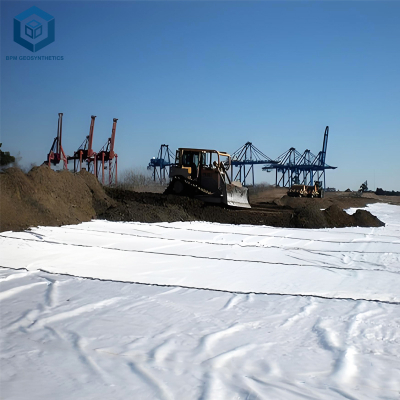
Landfill bottom liners (high load, chemical exposure): HDPE preferred for stiffness and chemical resistance.
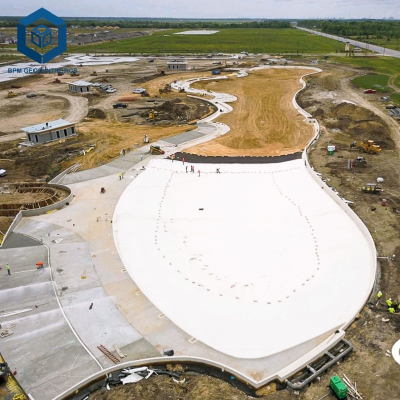
Landfill final covers (slopes, low stress): LLDPE preferred for flexibility and conformability to settlement.
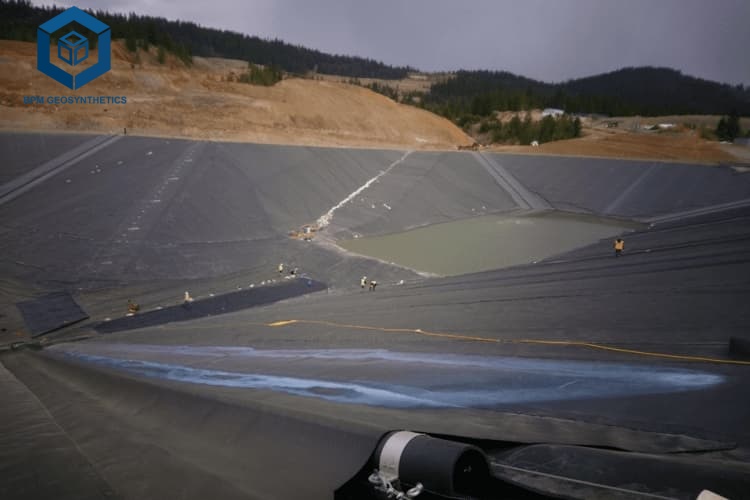
Mining heap leach pads (acidic leachate): HDPE for chemical resistance; LLDPE for flexibility over uneven ore.
Pond liners (water, aquaculture): LLDPE for flexibility and lower cost (resin cost offset by thinner gauge?).
Secondary containment (tank farms): HDPE for chemical resistance; LLDPE for corners and complex geometry.
Slope applications (> 3H:1V): LLDPE preferred — more flexible, conforms to subgrade, higher friction when textured.
Common Industry Problems: HDPE vs LLDPE Geomembrane Failures
Problem 1: HDPE stress cracking at wrinkles (landfill bottom liner)
Root cause: HDPE has lower inherent stress crack resistance than LLDPE. Wrinkles create stress concentration.
Engineering solution: For applications with unavoidable wrinkles or high tensile stress, specify LLDPE (PENT ≥ 800 hours). This is a key HDPE vs LLDPE geomembrane difference for slope applications.
Problem 2: LLDPE chemical attack in hydrocarbon service
Root cause: LLDPE has lower chemical resistance to hydrocarbons, solvents, and some acids compared to HDPE.
Solution: For chemical containment with aggressive leachate, specify HDPE. Test both materials with site-specific chemicals.
Problem 3: HDPE difficult to conform to uneven subgrade
Root cause: HDPE stiffness (flexural modulus 800–1,200 MPa) resists conforming to irregularities.
Solution: For subgrades with uneven surfaces or settlement potential, specify LLDPE (flexural modulus 300–600 MPa).
Problem 4: Higher cost of LLDPE for large projects
Root cause: LLDPE resin and additive package cost 20–40% more than HDPE.
Solution: Use HDPE for large, flat areas where flexibility is not critical. Use LLDPE only where flexibility or crack resistance is required.
Risk Factors and Prevention Strategies for HDPE vs LLDPE Geomembrane Selection
Risk: Specifying HDPE for high-settlement area: HDPE may crack under differential settlement. Mitigation: Use LLDPE for areas with expected settlement > 5%.
Risk: Specifying LLDPE for aggressive chemical exposure: LLDPE may degrade faster than HDPE. Mitigation: Review chemical compatibility data. HDPE preferred for pH < 2 or > 12, hydrocarbons.
Risk: Assuming equal weldability: LLDPE requires lower welding temperature (350–400°C vs. 400–500°C for HDPE). Mitigation: Require weld trials for LLDPE; train operators on lower temperature settings.
Risk: Higher LLDPE cost without performance justification: Over-specifying LLDPE increases project cost. Mitigation: Perform cost-benefit analysis. Use HDPE where stiffness and chemical resistance are sufficient.
Procurement Guide: How to Choose Between HDPE vs LLDPE Geomembrane
Assess chemical exposure: Aggressive chemicals (hydrocarbons, low/high pH) → HDPE. Mild chemicals (water, leachate) → either.
Evaluate subgrade and settlement: Uneven subgrade, high settlement potential → LLDPE. Stable, smooth subgrade → HDPE.
Determine stress crack risk: High tensile stress, wrinkles, or notches → LLDPE (PENT ≥ 800 hours). Low stress → HDPE (PENT ≥ 500 hours).
Consider installation conditions: Cold weather installation (< 0°C) → LLDPE more flexible, less brittle. HDPE may crack.
Compare cost: HDPE baseline. LLDPE 20–40% higher material cost. Factor in installation labor (LLDPE may install faster on uneven subgrade).
Request material certifications: HDPE: GRI GM13; LLDPE: GRI GM17. Both require resin certificates, PENT, OIT, and tensile reports.
Order samples and perform site-specific testing: Test both materials with subgrade and chemical exposure representative of field conditions.
Verify weld parameters: LLDPE requires lower temperature (350–400°C) than HDPE (400–500°C). Ensure contractor has experience with LLDPE welding.
Engineering Case Study: HDPE vs LLDPE Geomembrane for Landfill Slope
Project type: Landfill final cover side slope (3H:1V).
Location: Midwest USA.
Project size: 25,000 m².
Initial specification: 1.5 mm HDPE smooth geomembrane.
Problem: After installation, wrinkles formed due to slope settlement. Within 2 years, stress cracks appeared at wrinkle apices (PENT testing of failed material: 420 hours — borderline).
HDPE vs LLDPE geomembrane difference analysis: LLDPE offers PENT ≥ 800 hours (2x HDPE minimum) and flexural modulus 300–600 MPa (vs. 800–1,200 for HDPE). LLDPE would have conformed to settlement without wrinkling.
Remediation: Replaced failed section (8,000 m²) with 1.5 mm LLDPE textured geomembrane. No cracks after 5 years. Lesson: For slopes with settlement potential, specify LLDPE over HDPE.
Frequently Asked Questions: HDPE vs LLDPE Geomembrane Difference
Q1: What is the main difference between HDPE and LLDPE geomembrane?
HDPE has higher density (0.94–0.96 g/cm³), higher stiffness (flexural modulus 800–1,200 MPa), and better chemical resistance. LLDPE has lower density (0.925–0.94 g/cm³), higher flexibility (modulus 300–600 MPa), and superior stress crack resistance (PENT ≥ 800 vs. ≥ 500 hours).
Q2: Which is more flexible — HDPE or LLDPE?
LLDPE is significantly more flexible. This is the most practical HDPE vs LLDPE geomembrane difference for installation over uneven subgrade or on slopes.
Q3: Which has better stress crack resistance?
LLDPE. PENT (ASTM F1473) minimum is 800 hours for LLDPE vs. 500 hours for HDPE. LLDPE is preferred for applications with high tensile stress, wrinkles, or notches.
Q4: Is LLDPE more expensive than HDPE?
Yes. LLDPE typically costs 20–40% more than HDPE due to higher resin cost and different additive package.
Q5: Which has better chemical resistance?
HDPE has superior chemical resistance, especially to hydrocarbons, solvents, and extreme pH (2–12). For chemical containment, HDPE is preferred over LLDPE.
Q6: Can LLDPE be welded using the same equipment as HDPE?
Yes, but welding temperature is lower: 350–400°C for LLDPE vs. 400–500°C for HDPE. Use same dual-track thermal wedge equipment but adjust parameters.
Q7: Which is better for slope applications?
LLDPE. Its flexibility conforms to subgrade irregularities, reducing wrinkles. Textured LLDPE has high interface friction. HDPE can be used but requires careful wrinkle management.
Q8: Which has higher puncture resistance?
LLDPE has better puncture resistance due to higher elongation and ductility. HDPE is stiffer and may puncture more easily under point loads.
Q9: Which is more UV resistant?
Both are excellent when properly formulated with 2–3% carbon black. UV resistance is comparable.
Q10: How do I choose between HDPE and LLDPE for my project?
Use HDPE for: chemical containment, flat areas, high load, cost-sensitive projects. Use LLDPE for: slopes, uneven subgrade, high settlement potential, applications requiring maximum stress crack resistance. Consult GRI GM13 (HDPE) and GRI GM17 (LLDPE) standards.
Request Technical Support or Quotation for HDPE or LLDPE Geomembrane
For project-specific material selection, chemical compatibility testing, or bulk procurement, our technical team is available.
Request a quotation – Provide thickness, area, application type, chemical exposure, and subgrade conditions.
Request engineering samples – Receive both HDPE and LLDPE samples with PENT, tensile, and chemical resistance test reports.
Download technical specifications – GRI GM13 (HDPE) and GRI GM17 (LLDPE) compliance guides, selection flowchart, and chemical compatibility database.
Contact technical support – Material selection consulting, weld parameter optimization, and failure analysis for HDPE or LLDPE liners.
About the Author
This guide was written by Dipl.-Ing. Hendrik Voss, a materials engineer with 19 years of experience in polyethylene geomembrane systems. He has consulted on over 400 HDPE vs LLDPE geomembrane selection projects across Europe, North America, South America, and Asia, specializing in stress crack analysis, chemical compatibility testing, and lifecycle cost optimization for landfill, mining, and water containment applications. His work is referenced in GRI and ASTM D35 committee discussions on polyethylene geomembrane standards.