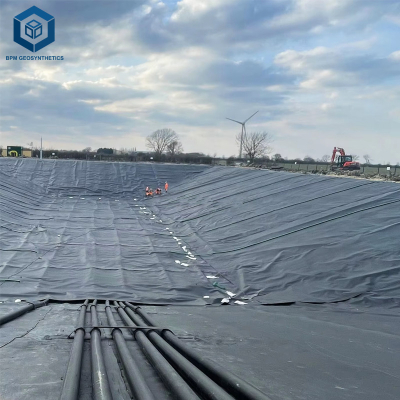
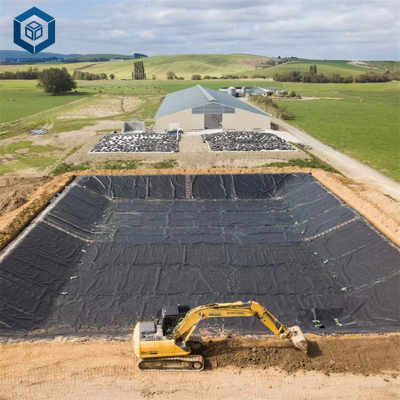
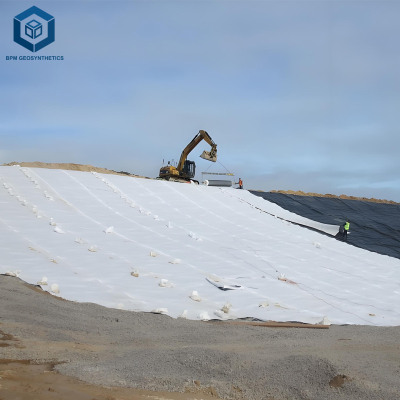
hdpe geomembrane for canal lining
HDPE geomembrane for canal lining is a high-density polyethylene impermeable barrier engineered to prevent seepage, erosion, and contamination in irrigation, drainage, and water transfer canals under long-term hydraulic and environmental loading conditions.
Technical Parameters and Specifications
For canal lining projects, HDPE geomembrane performance is defined by standardized mechanical, hydraulic, and durability parameters:
Thickness: 0.75 mm / 1.0 mm / 1.5 mm / 2.0 mm
Density: ≥ 0.94 g/cm³
Tensile Strength at Yield: ≥ 15 MPa
Elongation at Break: ≥ 700%
Hydrostatic Resistance: > 100 m water head
Carbon Black Content: 2.0–3.0%
Oxidative Induction Time (Std): ≥ 100 min
Service Temperature Range: -40°C to +60°C
Structure and Material Composition
HDPE geomembrane for canal lining typically consists of a single or multilayer polymer structure designed for hydraulic stability:
Base Polymer: Virgin HDPE resin providing impermeability and chemical resistance
Carbon Black: UV protection for long-term outdoor exposure
Antioxidant Package: Prevents thermal and oxidative degradation
Optional Textured Surface: Improves interface friction on slopes
Manufacturing Process
The engineering performance of HDPE geomembrane for canal lining is established during controlled industrial production:
Raw material selection and resin quality verification
Gravimetric dosing of HDPE, carbon black, and additives
Flat-die or blown-film extrusion under controlled temperature
Online thickness and surface inspection
Controlled cooling and stress relaxation
Roll forming, labeling, and batch traceability
Laboratory testing for tensile, OIT, and permeability
Critical equipment includes high-output extruders, automatic thickness scanners, and calibrated mechanical testing systems.
Industry Comparison
| Lining Material | Permeability | Service Life | Installation Speed | Maintenance Cost |
|---|---|---|---|---|
| HDPE Geomembrane | Very Low | 30–50 Years | Fast | Low |
| Concrete Lining | Low (Crack Risk) | 20–30 Years | Slow | High |
| Compacted Clay | Medium | 10–20 Years | Medium | Medium |
| Asphalt Lining | Low | 15–25 Years | Medium | High |
Application Scenarios
HDPE geomembrane for canal lining is widely specified in:
Irrigation canal rehabilitation and new construction
Water conveyance systems for agriculture and industry
Drainage canals in mining and infrastructure projects
Water loss control programs led by government agencies
Primary users include EPC contractors, irrigation authorities, engineering consultants, and material distributors.
Core Pain Points and Solutions
Seepage Loss: Use continuous welded HDPE geomembrane systems.
Slope Instability: Specify textured geomembranes and anchoring trenches.
UV Degradation: Ensure certified carbon black content and OIT values.
Joint Failure: Require qualified thermal welding and on-site testing.
Risk Warnings and Mitigation Advice
Poor subgrade preparation can cause puncture risk.
Improper welding may lead to long-term leakage.
Thin membranes may not withstand hydraulic uplift.
Unprotected geomembranes are vulnerable to mechanical damage.
Procurement and Selection Guide
Define canal geometry, slope angle, and hydraulic load
Select appropriate thickness based on design life
Confirm compliance with relevant ASTM or ISO standards
Evaluate textured vs smooth surface requirements
Request batch-specific quality documentation
Assess supplier welding and technical support capability
Include installation and testing procedures in contracts
Engineering Case Example
In a 12 km agricultural irrigation canal upgrade, a 1.5 mm HDPE geomembrane for canal lining replaced aging concrete. Post-installation monitoring showed seepage reduction exceeding 90%, with installation completed 35% faster than traditional lining methods.
FAQ
Q1: What thickness is typical for canal lining?
A: Commonly 1.0–1.5 mm, depending on hydraulic load.Q2: Is textured geomembrane necessary?
A: Recommended for slopes steeper than 1:3.Q3: How long does HDPE last in canals?
A: Typically 30–50 years when properly installed.Q4: Can HDPE handle flowing water?
A: Yes, with adequate anchoring and protection.Q5: Is UV resistance critical?
A: Yes, especially for exposed canal sections.Q6: How are seams tested?
A: Using vacuum box or air pressure testing.Q7: Does HDPE resist chemicals?
A: Yes, it has excellent chemical resistance.Q8: Can geomembrane be repaired?
A: Yes, via localized patch welding.Q9: Is underlayment required?
A: Often geotextile is used for puncture protection.Q10: Can it be installed in cold climates?
A: Yes, with temperature-controlled welding.
Call to Action
For canal-specific design support, technical datasheets, or project-based quotations, submit your project parameters to obtain engineered recommendations.
E-E-A-T Author Credentials
This content is prepared by a civil materials engineer with over 15 years of experience in geomembrane design, hydraulic infrastructure projects, and international EPC material specification.