1.0mm vs 1.5mm Geomembrane Cost Difference: Engineering Guide
What is 1.0mm vs 1.5mm Geomembrane Cost Difference?
1.0mm vs 1.5mm geomembrane cost difference refers to the price differential between two common HDPE liner thicknesses used in environmental containment. For procurement managers, EPC contractors, and civil engineers, understanding 1.0mm vs 1.5mm geomembrane cost difference is critical for balancing upfront material cost against long-term durability and puncture risk. A 1.0mm geomembrane contains approximately 1.0 kg of HDPE resin per m² (density 0.95 g/cm³), while 1.5mm contains 1.43 kg/m² — 43% more resin. Therefore, material cost difference is typically 40–50% (1.5mm costs €1.4–1.5x per m²). However, total installed cost difference is smaller (25–35%) because installation labor, welding, and subgrade preparation are similar regardless of thickness. This guide provides engineering analysis of 1.0mm vs 1.5mm geomembrane cost difference: mechanical properties (puncture, tear, tensile), puncture risk reduction, PENT stress crack resistance, GRI GM13 compliance, and lifecycle cost for landfill liners, mining heap leach pads, and pond applications.
Technical Specifications: 1.0mm vs 1.5mm Geomembrane
The table below compares critical engineering parameters for 1.0mm and 1.5mm HDPE geomembranes per GRI GM13 standards.
| Parameter | 1.0 mm Geomembrane | 1.5 mm Geomembrane | Engineering Importance | |
|---|---|---|---|---|
| Mass per m² (HDPE resin) | ~0.95 kg/m² | ~1.43 kg/m² | 1.5mm uses 50% more resin → directly impacts 1.0mm vs 1.5mm geomembrane cost difference.}, | |
| Puncture Resistance (ASTM D4833) | ~220 – 250 N | ~320 – 380 N | 1.5mm provides 40–50% higher puncture resistance — critical for subgrade with stones.}, | |
| Tear Resistance (ASTM D1004) | ~85 – 100 N | ~125 – 150 N | 1.5mm significantly more tear-resistant.}, | |
| Tensile Yield Strength (ASTM D6693) | ≥ 18 kN/m (typical ~22 kN/m) | ≥ 27 kN/m (typical ~32 kN/m) | 1.5mm has 45% higher strength — better for load-bearing applications.}, | |
| Tensile Elongation at Break | ≥ 700% | ≥ 700% | Both meet elongation requirement; thickness does not affect ductility.}, | |
| PENT Stress Crack Resistance (ASTM F1473) | ≥ 500 hours | ≥ 500 hours | Both can meet PENT requirement (depends on resin, not thickness).}, | |
| Subgrade Flatness Tolerance (ASTM F710) | ≤ 2 mm/2m (strict) | ≤ 3 mm/2m (more forgiving) | 1.5mm bridges small irregularities better; reduces subgrade prep cost.}, | |
| Typical Material Cost (€/m²) | 2.5 – 4.0 | 3.5 – 6.0 | 1.5mm costs 40–50% more in material alone.}, | |
| Typical Installed Cost (€/m²) | 6 – 10 | 8 – 13 | Installation cost similar; total installed difference 25–35%.}, | |
| GRI GM13 Compliance | Yes (but limited applications) | Yes (standard for landfills) | 1.5mm is minimum for landfill bottom liners per EPA guidance.}, |
Key takeaway: 1.0mm vs 1.5mm geomembrane cost difference is 40–50% in material, but installed cost difference is 25–35%. 1.5mm offers 40–50% higher puncture/tear resistance and is required for landfill bottom liners.
Material Structure and Composition: 1.0mm vs 1.5mm Geomembrane
Both thicknesses use identical resin and additive formulation — only thickness differs. The table below shows how properties scale with thickness.
| Property | 1.0 mm | 1.5 mm | Scaling Factor (1.5mm/1.0mm) |
|---|---|---|---|
| Resin Mass per m² | 1.0x (baseline) | 1.5x | 50% more material}, |
| Section Modulus (bending stiffness) | 1.0x | 3.375x | Cubic scaling (t³) → 1.5mm is 3.4x stiffer}, |
| Puncture Resistance (theoretical) | 1.0x | ~1.45x | Near-linear scaling with thickness}, |
| Tensile Strength (force per width) | 1.0x | ~1.5x | Linear with thickness}, |
| Tear Resistance | 1.0x | ~1.5x | Linear with thickness}, |
| Material Cost per m² | 1.0x | 1.5x | Directly proportional to resin mass}, |
| Installation Cost per m² | 1.0x | 1.0x (similar) | Labor same regardless of thickness}, |
Engineering insight: The 1.0mm vs 1.5mm geomembrane cost difference in material is linear with thickness (50% more), but mechanical properties scale linearly (tensile, puncture) or cubically (bending stiffness).
Manufacturing Process: How Thickness Affects 1.0mm vs 1.5mm Geomembrane Cost Difference
Production differences between 1.0mm and 1.5mm geomembranes.
Extrusion line speed: 1.0mm can be produced at higher line speed (15–20 m/min) vs. 1.5mm (10–15 m/min). Lower throughput increases cost per m² for thicker liner.
Resin consumption: 1.5mm uses 50% more resin per m² — direct cost driver for 1.0mm vs 1.5mm geomembrane cost difference.
Cooling requirements: 1.5mm requires longer cooling zone (more rolls), reducing line speed further.
Roll weight and shipping: 1.5mm rolls are heavier (fewer m² per roll, higher shipping cost per m²). A 1.5mm × 7m × 100m roll weighs ~1,500 kg vs. ~1,000 kg for 1.0mm.
Quality inspection: Same tests for both thicknesses (tensile, tear, puncture, PENT, OIT). No significant cost difference per m².
Packaging: Similar regardless of thickness.
Performance Comparison: 1.0mm vs 1.5mm Geomembrane vs. Thicker Alternatives
Comparing different thicknesses and alternative materials for containment applications.
| Geomembrane Thickness | Puncture Resistance (N) | Relative Material Cost | Relative Installed Cost | Typical Applications |
|---|---|---|---|---|
| 0.75 mm | ~150 – 180 N | 0.75x | 0.85x | Temporary covers, canals, low-risk ponds}, |
| 1.0 mm | ~220 – 250 N | 1.0x (baseline) | 1.0x (baseline) | Secondary containment, pond liners, landfill covers (some)}, |
| 1.5 mm | ~320 – 380 N | 1.45x | 1.25x | Landfill bottom liners, mining heap leach pads, primary containment}, |
| 2.0 mm | ~450 – 520 N | 1.9x | 1.5x | High-risk chemical containment, very sharp subgrade}, |
| 2.5 mm | ~550 – 650 N | 2.4x | 1.8x | Extreme puncture risk, heavy loads}, |
Conclusion: 1.0mm vs 1.5mm geomembrane cost difference is justified by 40–50% higher puncture/tear resistance. 1.5mm is the minimum for landfill bottom liners per EPA guidance.
Industrial Applications: When to Specify 1.0mm vs 1.5mm Geomembrane
Application dictates the correct thickness in 1.0mm vs 1.5mm geomembrane selection.
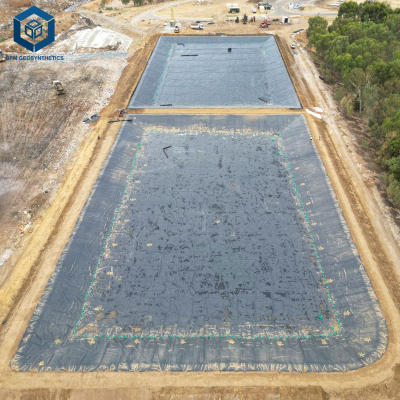
Landfill bottom liners (municipal solid waste): 1.5 mm minimum per EPA and GRI GM13. 1.0mm not permitted.
Landfill final covers (side slopes): 1.5 mm standard. 1.0mm may be used for covers over geocomposite? Not recommended.
Mining heap leach pads (acidic leachate): 1.5 mm standard. 1.0mm too thin for puncture risk from sharp ore.
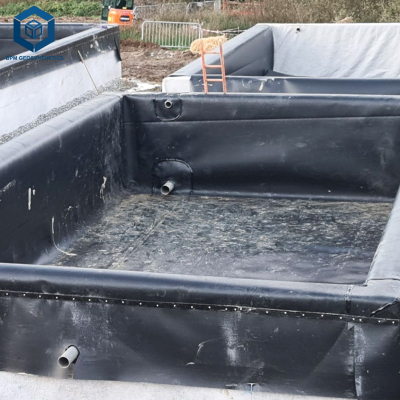
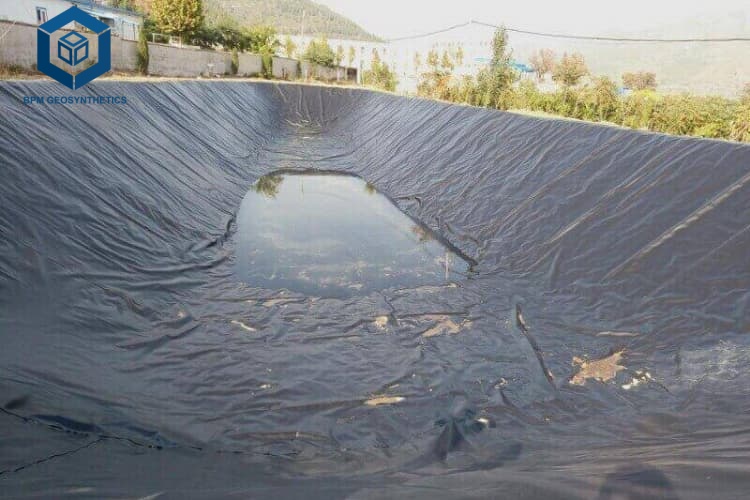
Pond liners (water, aquaculture): 1.0 mm acceptable for low-risk, flat areas. 1.5 mm for steep slopes or high puncture risk.
Secondary containment (tank farms, chemical plants): 1.5 mm for hazardous chemicals; 1.0 mm for non-hazardous.
Canals and irrigation (water conveyance): 0.75–1.0 mm typical. 1.5 mm over-specified.
Temporary covers (construction, sediment ponds): 0.75–1.0 mm acceptable for short duration.
Common Industry Problems Related to 1.0mm vs 1.5mm Geomembrane Selection
Real-world failures from incorrect thickness specification.
Problem 1: Puncture failure in 1.0mm liner on sharp subgrade
Root cause: 1.0mm geomembrane (puncture 220 N) installed over subgrade with stones > 12 mm. Insufficient geotextile cushion.
Engineering solution: In 1.0mm vs 1.5mm geomembrane for sharp subgrade, 1.5mm provides 40–50% higher puncture resistance. Upgrade to 1.5mm or improve geotextile to ≥ 500 g/m².
Problem 2: 1.0mm liner not permitted for landfill permit
Root cause: Project specified 1.0mm to save cost, but EPA/GRI GM13 requires 1.5mm minimum for landfill bottom liners.
Solution: Always verify regulatory requirements before selecting thickness. 1.0mm vs 1.5mm geomembrane cost difference is irrelevant if 1.0mm is non-compliant.
Problem 3: 1.5mm over-specified for low-risk pond (unnecessary cost)
Root cause: Engineer specified 1.5mm out of habit for a decorative pond with no puncture risk. Cost 40% higher than needed.
Solution: For low-risk applications (water, no sharp stones, gentle slopes), 1.0mm is sufficient and more cost-effective.
Problem 4: Welding difficulty with 1.0mm vs 1.5mm
Root cause: 1.0mm is more prone to welding defects (burn-through) due to lower thermal mass. Operator used 1.5mm settings.
Solution: 1.5mm is easier to weld (more forgiving). For 1.0mm, reduce welding temperature and speed. Require certified welder experience with thin geomembrane.
Risk Factors and Prevention Strategies for 1.0mm vs 1.5mm Geomembrane Selection
Risk: Specifying 1.0mm for landfill liner (non-compliant): Regulatory rejection, fines, liner replacement. Mitigation: Verify local regulations. EPA and GRI GM13 require 1.5mm minimum for landfill bottom liners.
Risk: Puncture failure in 1.0mm on rocky subgrade: 1.0mm has lower puncture resistance. Mitigation: Conduct subgrade stone survey. If stones > 12 mm present, upgrade to 1.5mm or install 500 g/m² geotextile.
Risk: Over-specifying 1.5mm for low-risk application: Unnecessary cost (40–50% premium). Mitigation: For water-only ponds, temporary covers, or canals, 1.0mm is adequate.
Risk: Welding defects in 1.0mm due to operator error: 1.0mm more susceptible to burn-through. Mitigation: Use certified welders with experience on thin geomembrane. Perform more frequent destructive testing.
Procurement Guide: How to Choose Between 1.0mm and 1.5mm Geomembrane
Follow this 8-step checklist for B2B purchasing decisions, considering 1.0mm vs 1.5mm geomembrane cost difference.
Verify regulatory requirements: Landfill bottom liners → 1.5mm minimum (EPA, GRI GM13). Mining, ponds → check local regulations.
Assess puncture risk (subgrade stones): Sharp stones > 12 mm → 1.5mm required. Smooth subgrade → 1.0mm may suffice.
Evaluate load conditions: Heavy equipment traffic, rolling loads → 1.5mm. Foot traffic only → 1.0mm acceptable.
Consider design life: Permanent containment (> 25 years) → 1.5mm provides higher safety margin. Temporary (< 10 years) → 1.0mm may be adequate.
Calculate installed cost (not just material): 1.0mm vs 1.5mm geomembrane cost difference in material is 40–50%, but installed difference is 25–35%. Get turnkey quotes.
Factor in shipping cost: 1.5mm rolls are heavier → higher freight cost per m². Compare delivered cost.
Order samples and perform puncture testing: Test both thicknesses on representative subgrade with site-specific stones.
Review warranty: Some manufacturers offer longer warranty for 1.5mm (20–25 years) vs. 1.0mm (10–15 years). Factor into lifecycle cost.
Engineering Case Study: 1.0mm vs 1.5mm Geomembrane Cost Difference in Landfill Project
Project type: Municipal solid waste landfill bottom liner.
Location: Midwest USA.
Project size: 120,000 m².
Requirement: EPA requires 1.5mm minimum for bottom liners. 1.0mm not permitted.
1.0mm vs 1.5mm geomembrane cost difference analysis (for reference):
- 1.0mm material: €2.80/m², installation €5.00/m², total €7.80/m² (not compliant)
- 1.5mm material: €4.20/m² (+50%), installation €5.50/m² (+10%), total €9.70/m²
Actual project cost (1.5mm only): €1.16M installed.
Hypothetical savings if 1.0mm allowed: €228,000 (24%) — but not permitted.
Lesson: 1.0mm vs 1.5mm geomembrane cost difference is irrelevant when 1.0mm is non-compliant. Always check regulations first.
Frequently Asked Questions: 1.0mm vs 1.5mm Geomembrane Cost Difference
Q1: How much more expensive is 1.5mm geomembrane than 1.0mm?
Material cost: 1.5mm is 40–50% more expensive (€3.5–6.0/m² vs. €2.5–4.0/m²). Installed cost difference: 25–35% (€8–13/m² vs. €6–10/m²). This is the core of 1.0mm vs 1.5mm geomembrane cost difference.
Q2: Is 1.5mm geomembrane required for landfill liners?
Yes. EPA and GRI GM13 require minimum 1.5mm thickness for landfill bottom liners. 1.0mm is not permitted for primary containment.
Q3: Does 1.5mm geomembrane have better puncture resistance than 1.0mm?
Yes. 1.5mm provides 40–50% higher puncture resistance (ASTM D4833): ~320–380 N vs. ~220–250 N for 1.0mm. This justifies the 1.0mm vs 1.5mm geomembrane cost difference for puncture-risk applications.
Q4: Can 1.0mm geomembrane be used for pond liners?
Yes, for low-risk ponds with smooth subgrade, gentle slopes (< 3H:1V), and no heavy equipment. For steep slopes or sharp subgrade, 1.5mm is recommended.
Q5: Is 1.0mm geomembrane easier to weld than 1.5mm?
No. 1.5mm is easier to weld because it has higher thermal mass, making it more forgiving of temperature variations. 1.0mm requires more precise temperature control to avoid burn-through.
Q6: How does shipping cost affect 1.0mm vs 1.5mm geomembrane cost difference?
1.5mm rolls weigh 50% more per m², so fewer m² per container. Shipping cost per m² is approximately 30–40% higher for 1.5mm. Factor this into total landed cost.
Q7: Does 1.5mm geomembrane have longer service life than 1.0mm?
Assuming same resin quality (PENT ≥ 500 hours, OIT ≥ 100 min), both have similar chemical and stress crack resistance. However, 1.5mm has higher puncture and tear resistance, reducing risk of premature failure from physical damage.
Q8: What is the minimum thickness for GRI GM13 compliance?
GRI GM13 covers thicknesses from 0.75 mm to 3.0 mm. However, for landfill bottom liners, 1.5 mm is the industry minimum per EPA guidance. 1.0mm is GM13-compliant but not accepted for primary landfill containment.
Q9: Can I use 1.0mm geomembrane for mining heap leach pads?
Not recommended. Mining subgrade is typically sharp (crushed ore), and 1.0mm puncture resistance (220 N) is insufficient. 1.5mm is standard for mining applications.
Q10: How to decide between 1.0mm and 1.5mm for my project?
Step 1: Check regulatory requirements (landfill → 1.5mm mandatory). Step 2: Assess puncture risk (sharp stones → 1.5mm). Step 3: Calculate lifecycle cost (1.5mm higher upfront but lower failure risk). Step 4: Compare 1.0mm vs 1.5mm geomembrane cost difference against project risk tolerance.
Request Technical Support or Quotation for 1.0mm or 1.5mm Geomembrane
For project-specific thickness selection, cost analysis, or bulk procurement, our technical team is available.
Request a quotation – Provide thickness (1.0 or 1.5 mm), area, application type, and subgrade conditions.
Request engineering samples – Receive 1.0mm and 1.5mm HDPE samples with puncture and tear test reports.
Download technical specifications – GRI GM13 compliance guide, thickness selection flowchart, and lifecycle cost calculator.
Contact technical support – Puncture risk assessment, regulatory compliance verification, and welding QA/QC for thin geomembrane.
About the Author
This guide on 1.0mm vs 1.5mm geomembrane cost difference was written by Dipl.-Ing. Hendrik Voss, a civil engineer with 19 years of experience in geosynthetics and liner systems. He has managed over 500 geomembrane procurement projects across Europe, North America, South America, and Asia, specializing in thickness optimization, puncture risk analysis, and lifecycle cost modeling for landfill, mining, and water containment applications. His work is referenced in GRI and ASTM D35 committee discussions on geomembrane thickness standards.