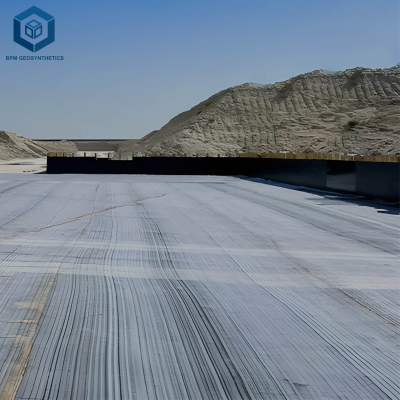
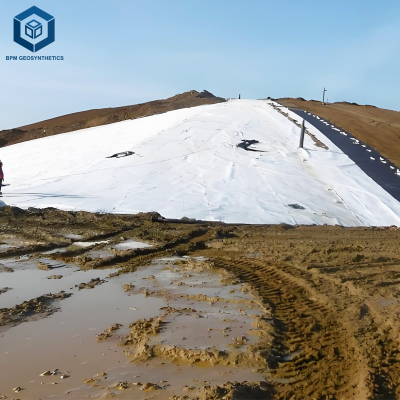
Geotextile placement before geomembrane installation
Geotextile placement before geomembrane installation refers to the engineering practice of installing a protective geotextile layer between the prepared subgrade and geomembrane liner. This layer acts as a cushion, preventing punctures, distributing loads, and improving long-term containment performance in environmental and infrastructure projects.
Technical Parameters and Specifications
| Parameter | Typical Range | Engineering Importance |
|---|---|---|
| Geotextile Mass | 200–800 g/m² | Determines cushioning and puncture resistance |
| Tensile Strength | 8–20 kN/m | Ensures durability during installation |
| Thickness | 2–8 mm | Provides protection against subgrade irregularities |
| Puncture Resistance | >1.5 kN | Prevents geomembrane damage from sharp objects |
| Overlap Width | 300–500 mm | Ensures continuous protection layer |
| Installation Slope | Up to 1V:3H | Typical slope range for liner systems |
Structure and Material Composition
Polypropylene or Polyester Fibers: Primary material providing tensile strength and durability.
Needle-Punched Structure: Mechanically bonded fibers creating a permeable cushioning layer.
Protective Cushion Layer: Reduces stress concentration under geomembrane liners.
Optional Reinforcement: High-strength fibers for heavy-duty industrial containment.
Surface Contact Layer: Ensures proper interface friction with geomembrane.
Manufacturing Process
Raw Material Preparation: Polypropylene or polyester staple fibers are selected.
Fiber Opening and Blending: Fibers are processed to ensure uniform distribution.
Web Formation: Fibers are arranged into sheets through carding equipment.
Needle Punching: Mechanical needles entangle fibers to create a strong nonwoven structure.
Thermal Stabilization: Heat treatment improves dimensional stability.
Quality Inspection: Tensile strength, thickness, and mass per unit area are tested.
Roll Packaging: Finished geotextile rolls prepared for transport and installation.
Industry Comparison
| Material | Cushion Protection | Durability | Typical Application | Cost Range (USD/m²) |
|---|---|---|---|---|
| Nonwoven Geotextile | High | Excellent | Geomembrane protection | 0.8 – 3 |
| Woven Geotextile | Moderate | High | Soil stabilization | 1 – 2.5 |
| Sand Cushion Layer | Low | Moderate | Basic liner protection | Variable |
| Concrete Protection | Very High | Very High | Industrial containment | High |
Application Scenarios
Landfill liner systems
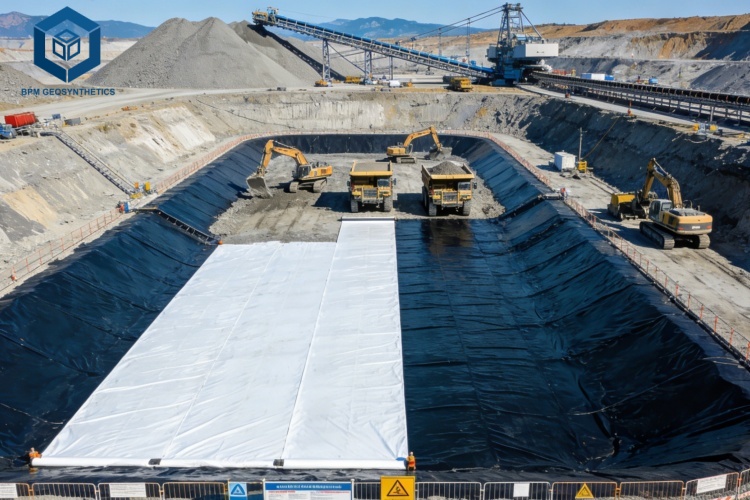
Mining tailings storage facilities
Wastewater treatment lagoons
Agricultural irrigation reservoirs
Industrial chemical containment ponds
EPC infrastructure projects involving environmental protection
Core Pain Points and Solutions
1. Geomembrane Puncture from Sharp Subgrade
Solution: Install high-density nonwoven geotextile (≥400 g/m²) before geomembrane placement.
2. Uneven Subgrade Surface
Solution: Combine subgrade grading with geotextile cushioning to distribute loads evenly.
3. Installation Damage from Equipment
Solution: Place geotextile first to reduce mechanical stress during geomembrane deployment.
4. Long-Term Stress Concentration
Solution: Use double-layer geotextile protection in high-load containment facilities.
Risk Warnings and Mitigation
Insufficient geotextile mass may fail to protect geomembrane liners.
Poor overlap between geotextile sheets can create weak points.
Subgrade preparation must remove sharp stones and debris.
Improper installation during strong wind conditions may cause wrinkles.
Contaminated surfaces can affect liner performance.
Procurement and Selection Guide
Confirm required geotextile weight based on geomembrane thickness.
Verify compliance with international geosynthetic standards.
Evaluate supplier production capacity for large infrastructure projects.
Request laboratory test reports including puncture resistance.
Inspect sample rolls before bulk procurement.
Ensure compatibility with geomembrane materials.
Plan logistics for roll transport and storage.
Engineering Case Study
Wastewater Lagoon Liner Installation Project
Project Area: 38,000 m² containment lagoon
Subgrade Type: Compacted clay soil
Protection Layer: 500 g/m² nonwoven geotextile
Liner System: 1.5 mm HDPE geomembrane
Installation Process: Geotextile placed first with 400 mm overlaps before geomembrane deployment
Outcome: No puncture incidents during installation and stable containment performance after several years of operation
FAQ – Geotextile Placement Before Geomembrane Installation
1. Why is geotextile placed before geomembrane?
It provides cushioning and protects the liner from puncture.
2. What type of geotextile is recommended?
Nonwoven needle-punched geotextiles are commonly used.
3. What weight geotextile should be used?
Typically between 300–600 g/m² depending on project conditions.
4. Is geotextile always required?
Not always, but it is strongly recommended for long-term liner protection.
5. How much overlap is required?
Usually 300–500 mm between adjacent sheets.
6. Can geotextile be installed on slopes?
Yes, provided proper anchoring and installation methods are used.
7. What happens if geotextile is omitted?
The geomembrane may be vulnerable to punctures and stress damage.
8. Does geotextile improve drainage?
Yes, it can help manage water flow and reduce hydrostatic pressure.
9. How is geotextile secured before liner placement?
Temporary ballast, pins, or anchor trenches are commonly used.
10. What equipment is needed for installation?
Excavators, spreader bars, rollers, and manual positioning tools.
Request Technical Documentation or Quotation
For distributors, EPC contractors, and engineering consultants seeking reliable geotextile placement before geomembrane installation solutions, our technical team can provide:
Geotextile and geomembrane technical datasheets
Project-specific engineering recommendations
Bulk supply quotations for infrastructure projects
Material samples for testing and evaluation
Installation guidelines for containment systems
Author Expertise (E-E-A-T)
This article is prepared by geosynthetic engineering specialists with more than 15 years of experience in geomembrane and geotextile manufacturing, environmental containment design, and large-scale infrastructure construction projects. All technical recommendations are aligned with commonly accepted engineering practices used in landfill, mining, and water management applications.