Geomembrane Price Comparison: Smooth vs Textured
Product Definition
Geomembrane is a low-permeability polymeric liner used in environmental containment systems. In geomembrane price comparison smooth vs textured analysis, the distinction lies in surface friction properties, manufacturing process, and cost impact for landfill, mining, and water containment projects.
Technical Parameters and Specifications
When conducting a geomembrane price comparison smooth vs textured, buyers must first evaluate the technical performance metrics, as pricing is directly linked to thickness, resin quality, and surface treatment.
| Property | Smooth HDPE (1.5 mm) | Textured HDPE (1.5 mm) | Test Standard |
|---|---|---|---|
| Nominal Thickness | 1.5 mm | 1.5 mm | ASTM D5199 |
| Density | ≥ 0.940 g/cm³ | ≥ 0.940 g/cm³ | ASTM D1505 |
| Tensile Strength at Yield | ≥ 22 kN/m | ≥ 22 kN/m | ASTM D6693 |
| Puncture Resistance | ≥ 480 N | ≥ 480 N | ASTM D4833 |
| Interface Friction Angle | 11°–15° | 18°–30° | ASTM D5321 |
| Carbon Black Content | 2–3% | 2–3% | ASTM D4218 |
| Price Level (Reference) | Base Price | +10% to +25% | Market Range |
In most geomembrane price comparison smooth vs textured scenarios, the cost premium for textured products is driven by additional surface processing and lower production speed.
Structure and Material Composition
Virgin HDPE Resin: High molecular weight polyethylene
Carbon Black: 2–3% for UV stabilization
Antioxidants: Improve long-term durability
Smooth Surface Layer: Standard extrusion finish
Textured Surface Layer: Nitrogen-formed asperities for friction enhancement
Both types share identical core material; surface modification differentiates performance and price.
Manufacturing Process
1. Resin Preparation
Virgin HDPE resin is blended with stabilizers in controlled proportions.
2. Extrusion
Material is melted at 200–230°C and formed through flat die extrusion.
3. Surface Treatment
For textured geomembranes, nitrogen injection or embossing creates surface roughness.
4. Cooling & Calibration
Precision rollers maintain thickness uniformity.
5. Quality Testing
Each roll undergoes tensile, OIT, thickness, and carbon black dispersion tests.
The additional texturing stage explains part of the geomembrane price comparison smooth vs textured difference.
Industry Comparison
| Criteria | Smooth Geomembrane | Textured Geomembrane | PVC Liner | EPDM |
|---|---|---|---|---|
| Cost Level | Moderate | Higher | Moderate | High |
| Slope Stability | Limited | Excellent | Moderate | Moderate |
| Durability | 25–50 yrs | 25–50 yrs | 10–20 yrs | 20–30 yrs |
| Chemical Resistance | Excellent | Excellent | Good | Good |
This geomembrane price comparison smooth vs textured highlights that textured variants are selected for engineering performance rather than basic containment.
Application Scenarios
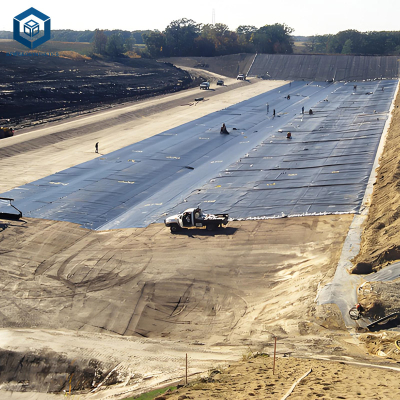
Landfill Slopes: Textured geomembrane for shear stability
Landfill Base Liners: Smooth geomembrane commonly sufficient
Mining Heap Leach Pads: Textured for enhanced friction
Reservoirs & Ponds: Smooth liner for cost efficiency
EPC Turnkey Projects: Mixed use depending on slope geometry
Core Pain Points and Solutions
1. Budget Constraints
Solution: Use smooth liner in flat zones and textured only on slopes.
2. Slope Sliding Risk
Solution: Specify textured geomembrane with verified friction angle.
3. Over-Specification
Solution: Conduct interface shear testing before final procurement.
4. Inconsistent Quality
Solution: Require certified laboratory test reports per batch.
Risk Warnings and Mitigation
Textured surfaces may reduce welding speed.
Improper subgrade preparation increases puncture risk.
Incorrect friction assumptions can cause slope instability.
Cost-focused procurement without testing may increase lifecycle expense.
Procurement and Selection Guide
Define project type (landfill, mining, water storage).
Evaluate slope ratio (e.g., 3H:1V or steeper).
Conduct stability analysis.
Request interface shear test data.
Compare price per m² including logistics.
Confirm production capacity and delivery schedule.
Specify testing standards in tender documents.
Plan CQA supervision during installation.
Effective geomembrane price comparison smooth vs textured must include lifecycle cost, not only material price.
Engineering Case Example
Project: 80,000 m² municipal landfill cell
Design: Smooth 2.0 mm HDPE for base; textured 2.0 mm HDPE for 3H:1V slopes
Cost Optimization: Hybrid selection reduced material cost by 12% compared to full textured installation
Outcome: Achieved required slope stability factor >1.5 under peak loading conditions
FAQ – Geomembrane Price Comparison Smooth vs Textured
1. Why is textured geomembrane more expensive?
Additional manufacturing processes and slower production speed.
2. How much is the price difference?
Typically 10–25% depending on thickness and market.
3. Is textured required for flat surfaces?
No, smooth is usually sufficient.
4. Does texturing affect chemical resistance?
No, base material remains HDPE.
5. Can smooth geomembrane be used on slopes?
Only if stability calculations confirm adequate safety factor.
6. Does texturing impact welding?
Yes, welding speed may be slightly reduced.
7. What thickness is common?
1.5 mm and 2.0 mm for landfill projects.
8. How is friction measured?
Using direct shear testing per ASTM D5321.
9. Are both UV stabilized?
Yes, typically 2–3% carbon black content.
10. Which is more durable?
Durability is similar; surface finish does not affect lifespan significantly.
Request Quotation or Technical Documentation
For project-specific geomembrane price comparison smooth vs textured analysis, provide project area, slope details, thickness requirement, and delivery schedule. Our technical team will supply datasheets, interface shear data, and formal commercial quotation for evaluation.
E-E-A-T Authoritative Statement
This article is prepared by environmental containment engineers with field experience in landfill and mining liner systems. Technical data references internationally recognized ASTM standards, ensuring procurement managers and EPC contractors receive engineering-based guidance for informed decision-making.