UV Resistant HDPE Liner for Exposed Pond
UV resistant HDPE liner for exposed pond is a high-density polyethylene geomembrane engineered with enhanced carbon black and antioxidant systems to withstand long-term ultraviolet radiation while maintaining impermeability, tensile strength, and environmental durability in uncovered pond applications.
Technical Parameters & Specifications
When specifying a UV resistant HDPE liner for exposed pond installations, procurement and engineering teams typically follow GRI GM13 and ASTM standards to ensure long-term weathering performance.
| Parameter | Recommended Value | Test Standard |
|---|---|---|
| Thickness | 1.0 mm – 2.0 mm | ASTM D5199 |
| Density | ≥ 0.94 g/cm³ | ASTM D1505 |
| Tensile Strength at Yield (1.5 mm) | ≥ 22 kN/m | ASTM D6693 |
| Elongation at Break | ≥ 700% | ASTM D6693 |
| Carbon Black Content | 2.0% – 3.0% | ASTM D4218 |
| Carbon Black Dispersion | Category 1–2 | ASTM D5596 |
| Standard OIT | ≥ 100 minutes | ASTM D3895 |
| High Pressure OIT | ≥ 400 minutes | ASTM D5885 |
| UV Resistance (Retained Tensile after 1600h) | ≥ 55% | ASTM D7238 |
For fully exposed ponds in high solar radiation regions, 1.5 mm or thicker UV resistant HDPE liner for exposed pond systems is generally recommended.
Structure & Material Composition
Material Components
Virgin HDPE Resin: High molecular weight polyethylene for structural integrity
Carbon Black (2–3%): Primary UV stabilizer
Antioxidants: Long-term thermal and oxidative protection
Processing Stabilizers: Control degradation during extrusion
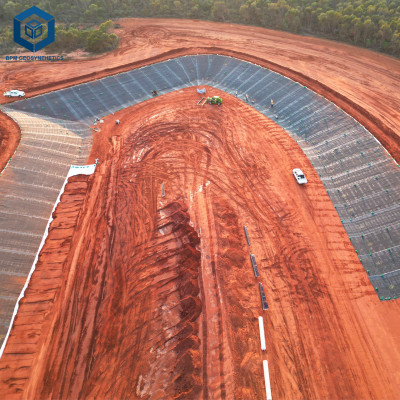
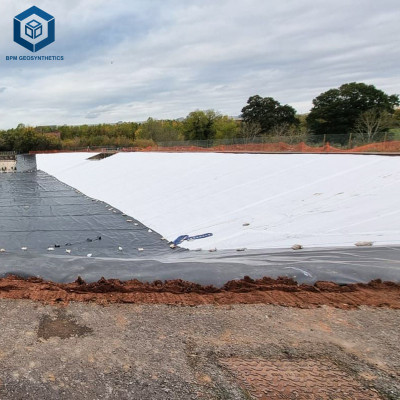
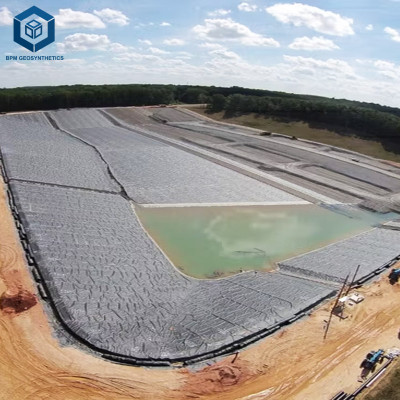
Typical Exposed Pond Configuration
Compacted soil subgrade (≥95% standard Proctor)
Optional nonwoven geotextile cushion (300–500 g/m²)
UV resistant HDPE liner for exposed pond (primary barrier)
Anchor trench perimeter system
Exposed installations demand higher UV stability compared to buried landfill liners.
Manufacturing Process
Resin Pre-Inspection: Density, melt flow index, and additive verification.
Compounding: Uniform carbon black dispersion through twin-screw mixing.
Extrusion: Blown film or flat die extrusion at 200–240°C.
Thickness Control: Online automatic gauge system.
Surface Finishing: Smooth or single-sided textured embossing.
Cooling & Winding: Controlled tension winding to prevent internal stress.
Laboratory Testing: UV aging, OIT, tensile, and dispersion validation.
Proper carbon black dispersion is critical for UV resistant HDPE liner for exposed pond performance.
Industry Comparison
| Property | HDPE | LLDPE | PVC | EPDM |
|---|---|---|---|---|
| UV Resistance | Excellent | Very Good | Moderate | Good |
| Mechanical Strength | High | Medium | Medium | Low |
| Chemical Resistance | Excellent | Very Good | Moderate | Good |
| Service Life (Exposed) | 15–25 years | 12–20 years | 8–12 years | 10–15 years |
| Welding Method | Thermal Fusion | Thermal Fusion | Solvent/Adhesive | Adhesive |
For long-term exposed water containment, UV resistant HDPE liner for exposed pond systems generally provide the most balanced performance.
Application Scenarios
Agricultural irrigation ponds
Industrial wastewater ponds
Mining evaporation ponds
Aquaculture ponds
Stormwater retention basins
Typical buyers include EPC contractors, agricultural developers, environmental engineers, and geosynthetics distributors.
Core Pain Points & Engineering Solutions
1. UV Degradation & Brittleness
Solution: Specify 2–3% carbon black and verified UV aging test results.
2. Thermal Expansion Stress
Solution: Provide adequate slack during installation and use proper anchor trenches.
3. Seam Weakness
Solution: Dual-track hot wedge welding with air pressure testing.
4. Puncture from Subgrade
Solution: Install nonwoven geotextile cushion layer.
5. Oxidative Aging
Solution: Verify OIT and HP-OIT laboratory certification.
Risk Warnings & Mitigation
Using recycled resin may reduce UV resistance.
Improper carbon black dispersion accelerates cracking.
Insufficient anchor trench depth may cause wind uplift.
Failure to conduct seam testing increases leakage risk.
Ignoring thermal expansion allowance may lead to stress fractures.
Exposed systems must undergo strict QA/QC and third-party inspection where required.
Procurement & Selection Guide
Define exposure duration and UV index of project location.
Select minimum thickness (≥1.5 mm for long-term exposure).
Confirm compliance with GRI GM13 standard.
Verify carbon black content and dispersion certification.
Review UV aging and OIT laboratory reports.
Assess manufacturer production capability and references.
Request sample roll for testing and welding trials.
Include installation supervision and seam testing plan.
A structured approach ensures correct selection of UV resistant HDPE liner for exposed pond projects.
Engineering Case Study
Project: Agricultural Irrigation Pond
Location: High solar radiation region
Area: 8,500 m²
Specification: 1.5 mm UV resistant HDPE liner for exposed pond
Installation: Smooth liner with anchor trench system, dual-track welding
Testing: Air channel testing + destructive seam sampling
Performance: 6 years exposed service with no visible cracking or leakage.
FAQ
1. What thickness is recommended for exposed ponds?
Minimum 1.5 mm for long-term exposure.
2. Is carbon black mandatory?
Yes, 2–3% is required for UV protection.
3. Can exposed liner last 20 years?
Yes, if properly specified and installed.
4. Is textured surface required?
Only for slope stability applications.
5. What welding method is best?
Hot wedge dual-track welding.
6. Is OIT testing important?
Yes, it indicates long-term oxidative resistance.
7. Can liner be directly exposed without cover soil?
Yes, if UV stabilized and properly anchored.
8. Does climate affect liner life?
Yes, high UV index regions require stricter specification.
9. Is recycled material acceptable?
Not recommended for critical exposed installations.
10. Should third-party inspection be used?
Recommended for large or regulated projects.
Request Quotation or Technical Documentation
For project-specific UV resistant HDPE liner for exposed pond specifications, laboratory test reports, welding guidelines, or engineering samples, please submit your project drawings and environmental data for technical evaluation and formal quotation.
Author & Technical Authority
This technical guide is prepared by a geosynthetics engineering specialist with over 15 years of field experience in exposed pond containment systems, agricultural water infrastructure, and environmental protection projects. All specifications align with recognized ASTM and GRI standards to support engineering procurement decisions.