Textured HDPE Geomembrane for Slope Stabilization | Engineering Guide
What is Textured HDPE Geomembrane for Slope Stabilization
A textured HDPE geomembrane for slope stabilization is a high-density polyethylene liner with a roughened surface (asperities) designed to increase interface friction between the geomembrane and adjacent soil, GCL, or geotextile, preventing sliding on slopes. The textured HDPE geomembrane for slope stabilization achieves interface friction angles of 25-32° (compared to 18-22° for smooth HDPE), allowing steeper slopes (1V:1.5H to 1V:3H) without liner failure. For geotechnical engineers, landfill designers, and mining consultants, specifying textured HDPE is mandatory for slopes >1V:3H (18.4°) to achieve factor of safety (FS) ≥1.5 against sliding. This guide provides interface friction data (ASTM D5321), asperity height requirements (≥0.25mm), slope stability calculations, textured manufacturing methods (nitrogen gas injection, embossed rolls), and procurement specifications for slope stabilization applications in landfills, dams, and mining heap leach pads.
Technical Specifications of Textured HDPE Geomembrane for Slope Stabilization
A textured HDPE geomembrane for slope stabilization must meet GRI GM13 parameters below plus texture-specific requirements.
Base Thickness (ASTM D5994, valley-to-valley): 1.5 mm (60 mil) for MSW landfill slopes. 2.0 mm (80 mil) for hazardous waste or steep slopes (>1V:2H). Tolerance ±5 percent. Base thickness excludes asperity height.
Asperity Height (Texture Depth, ASTM D7466): Minimum 0.25 mm (0.010 inch) for single-sided texture. Premium: 0.4-0.6 mm. Higher asperity = higher interface friction angle.
Total Thickness (peak-to-valley): Base thickness + asperity height = 1.75-2.5mm for 1.5mm base. Not specified; base thickness is the specification.
Density (ASTM D1505): ≥0.940 g/cm³.
Tensile Yield Strength (ASTM D6693): 1.5mm base: ≥27 MPa; 2.0mm base: ≥29 MPa. Texture may reduce tensile strength by 5-10 percent (account in design).
Elongation at Yield (ASTM D6693): ≥12 percent.
Puncture Resistance (ASTM D4833): 1.5mm base: ≥300 N; 2.0mm base: ≥400 N. Texture does not significantly affect puncture.
Interface Friction Angle with Clay (ASTM D5321, peak): Smooth HDPE: 18-22°; Textured HDPE: 25-32° (8-12° increase). Normal stress range: 25-200 kPa.
Interface Friction Angle with GCL (ASTM D5321, peak): Smooth HDPE: 16-20°; Textured HDPE: 23-30°.
Interface Friction Angle with Geotextile (ASTM D5321, peak): Smooth HDPE: 14-18°; Textured HDPE: 22-28°.
Residual Friction Angle (Post-peak, ASTM D5321): Smooth: 14-16° (large drop); Textured: 23-26° (moderate drop). Textured maintains higher residual strength.
Carbon Black Content (ASTM D1603): 2.0-3.0 percent.
Oxidative Induction Time (OIT) – Standard (ASTM D3895): ≥100 minutes (≥150 min for long-life).
Texture Type: Nitrogen gas injection (random, sandpaper-like) or embossed rolls (patterned pyramids or nodules).
Texture Pattern (Embossed): Pyramid, nodule, or linear groove. Pyramid patterns have higher friction than nodules.
Texture Uniformity (ASTM D7466): Asperity height variation ≤0.1 mm across roll width. Bald spots (no texture) not permitted.
Roll Width: Textured rolls typically 5-7 m (narrower than smooth due to texturing equipment).
Roll Length: 100-150 m for 1.5mm textured; shorter than smooth due to slower production.
Cost Premium (Textured vs Smooth): Textured costs 20-40 percent more than smooth of same thickness.
Expected Service Life (Under cover soil): 100+ years.
Material Structure and Composition – Texture Mechanisms
A textured HDPE geomembrane for slope stabilization achieves higher friction through surface asperities.
Base Polymer (Virgin HDPE): Same as smooth geomembrane – density ≥0.94 g/cm³, MFI 0.1-0.5 g/10min.
Texture Formation (Nitrogen Gas Injection): Nitrogen gas injected into molten HDPE before die exit. Gas bubbles expand and rupture at surface, creating random, sandpaper-like texture. Asperities are irregular but effective. Used for double-sided texture.
Texture Formation (Embossed Rolls): Extruded sheet passes between embossed rolls (patterned with pyramids, nodules, or linear grooves). Roll pattern imprints onto surface. Produces uniform, repeatable texture. Used for single-sided texture.
Carbon Black (2-3 percent): Same as smooth; provides UV protection.
Antioxidant Package: Same as smooth; OIT ≥100 min.
Manufacturing Process for Textured HDPE Geomembrane
Textured HDPE geomembrane for slope stabilization requires additional processing steps.
Step 1: Raw Material Blending. Same as smooth geomembrane.
Step 2: Extrusion (Flat Die). Melted HDPE extruded through flat die onto chill roll or through texturing system.
Step 3: Texturing – Nitrogen Gas Injection Method. Nitrogen gas injected into melt before die exit. Gas bubbles expand and rupture at surface, creating random texture. Chill roll temperature controls texture depth (200-230°C for deeper texture). Produces double-sided texture (both sides rough).
Step 4: Texturing – Embossed Roll Method. Extruded sheet passes between embossed steel rolls (patterned). Rolls imprint pattern onto sheet surface. Produces single-sided texture (smooth back, textured top). Uniform pattern (pyramids or nodules).
Step 5: In-Line Thickness Measurement. Beta gauge measures base thickness (valley-to-valley). Asperity height not measured in-line.
Step 6: Asperity Height Verification (Off-Line). Samples measured per ASTM D7466 using laser profilometer. Minimum 0.25 mm average asperity height. Reject rolls with average<0.20 mm.
Step 7: Quality Inspection. Tensile, puncture, OIT, carbon black tested. Interface friction angle tested per ASTM D5321 (sample frequency 1 per 100,000 m²).
Step 8: Packaging. Rolls wrapped in UV-protective film. Textured rolls require spacers between layers to prevent asperity flattening during storage.
Performance Comparison: Textured vs Smooth HDPE for Slopes
Comparison of textured HDPE geomembrane for slope stabilization vs smooth HDPE.
Interface Friction Angle (Clay): Textured: 25-32°, Smooth: 18-22°. Textured provides 8-12° higher friction – allows steeper slopes.
Maximum Slope Angle (FS=1.5, Clay interface): Textured: up to 1V:1.5H (33.7°). Smooth: maximum 1V:3H (18.4°).
Residual Friction (Post-peak): Textured: 23-26°, Smooth: 14-16°. Textured maintains higher strength after initial slip.
Cost Premium: Textured: 20-40 percent higher than smooth. For 1.5mm: smooth $5-8/m², textured $6.50-11/m².
Welding Method: Textured requires extrusion welding (slower, $6-10/m²). Smooth can use fusion welding (faster, $4-6/m²).
Installation Speed: Textured slower (extrusion welding).
Best Applications: Textured: landfill side slopes (>1V:3H), dam faces, heap leach pad slopes. Smooth: base liners, gentle slopes (<1V:5H).
Conclusion: Textured HDPE is required for slopes >1V:3H. For slopes<1V:5H, smooth HDPE may be sufficient.
Industrial Applications – Slope Stabilization with Textured HDPE
Textured HDPE geomembrane for slope stabilization is used in the following applications.
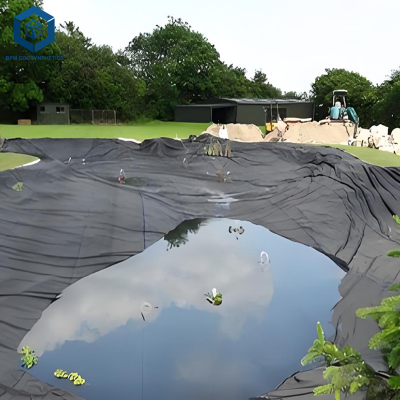
Landfill Side Slopes (MSW and Hazardous Waste): Textured HDPE (1.5-2.0mm) on slopes 1V:3H to 1V:2H. Increases friction with GCL or compacted clay, preventing liner sliding under waste load.
Landfill Final Cover (Cap) Slopes: Textured HDPE on cap slopes (1V:3H to 1V:2H) prevents cover soil from sliding. Smooth HDPE would require geotextile reinforcement.
Dam Face Liner (Upstream Dam Face): Textured HDPE on dam slope (1V:2H to 1V:1.5H). High friction with underlying geotextile or clay.
Mining Heap Leach Pad Slopes: Textured HDPE on pad perimeter slopes. Prevents liner sliding under ore load.
Reservoir Bank Slopes: Textured HDPE on steep reservoir slopes (wave action area). Increases stability under water level fluctuations.
Canal Lining (Steep Banks): Textured HDPE on canal banks (1V:1.5H). Prevents liner from sliding into canal.
Common Industry Problems and Engineering Solutions
Real-world failures with textured HDPE geomembrane for slope stabilization and corrective actions.
Problem 1: Textured HDPE Slid on Slope (Interface Friction<20°).Root cause: Asperity height<0.20 mm (bald spots). Manufacturer failed texture specification. Engineering solution: Reject rolls with asperity <0.25 mm.="" specify="" minimum="" asperity="" 0.3="" mm="" for="" steep="" slopes="">1V:2.5H). Before installation, measure texture depth with portable laser profilometer.
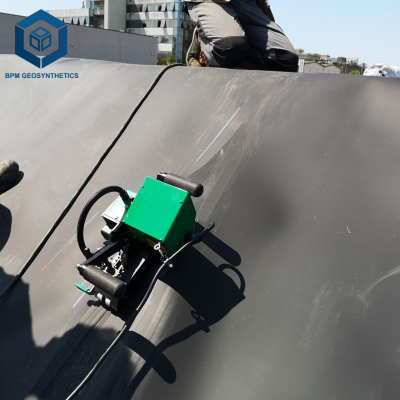
Problem 2: Extrusion Weld Failure on Textured Geomembrane (Peel<200 N/50mm).Root cause: Texture not ground flat before welding. Fusion welder cannot achieve contact on textured surface. Engineering solution: For seams on textured geomembrane, grind a 50mm wide smooth zone (remove asperities) before extrusion welding. Use extrusion welding (not fusion welding). Destructive seam testing every 200 m.
Problem 3: Interface Friction Angle Lower Than Design (23° vs Required 28°). Root cause: GCL bentonite lubricated interface (reduced friction). Smooth side of textured geomembrane installed facing GCL (texture up). Engineering solution: Install textured side facing GCL (texture down on slopes). Specify double-sided textured geomembrane for critical slopes.
Problem 4: Asperity Flattening Under High Normal Stress (Deep Landfill >50m). Root cause: Under 500 kPa normal stress, asperities compressed, reducing friction to 22° (vs 28° at low stress). Engineering solution: Use high-density texture (asperity ≥0.5 mm) or structured geomembrane with higher crush resistance. Perform interface shear testing at high normal stresses (200-500 kPa).
Risk Factors and Prevention Strategies
Key risks affecting textured HDPE geomembrane for slope stabilization and mitigation measures.
Low Asperity Height (<0.25 mm):Insufficient friction, slope failure. Prevention: Specify minimum 0.25 mm asperity (ASTM D7466). For steep slopes (>1V:2.5H), specify ≥0.3 mm. Measure on 5 percent of rolls.
Bald Spots (No Texture on Roll): Localized low friction. Prevention: Require laser profilometer measurement across roll width. Reject rolls with bald spots >10 cm².
Incorrect Installation Orientation (Texture Up on Slope): Texture facing cover soil (instead of GCL/clay) may have lower friction. Prevention: Mark rolls "TEXTURE SIDE – PLACE DOWN ON GCL/CLAY". Train installers. Use double-sided textured for critical slopes.
High Cost (20-40 percent premium over smooth): Over-specifying textured for gentle slopes. Prevention: Use smooth HDPE for slopes<1V:5H (11.3°). For slopes 1V:3H to 1V:5H, evaluate if textured required based on FS calculation.
Welding Difficulty (Extrusion welding slower): Installation cost higher. Prevention: Grind smooth zone (50mm) at seam locations before welding. Use extrusion welding with trained operators.
Asperity Flattening (High Stress, Deep Landfills): Loss of friction over time. Prevention: Specify high-density texture (asperity ≥0.5 mm). Perform interface shear testing at high normal stresses (200-500 kPa). Use LLDPE or textured GCL in combination.
Procurement Guide: How to Specify Textured HDPE for Slope Stabilization
Step-by-step checklist for procurement managers specifying a textured HDPE geomembrane for slope stabilization.
Step 1: Determine Slope Angle and Required Friction. Slope<1v:5h :="" smooth="" hdpe="" may="" suffice.="" slope="" 1v:5h="" to="" 1v:3h="" evaluate="" textured="" be="" required.="">1V:3H (18.4°): textured HDPE mandatory.
Step 2: Specify Base Thickness. 1.5 mm for MSW landfill slopes. 2.0 mm for hazardous waste or deep landfills (>30m waste height).
Step 3: Specify Asperity Height. "Textured geomembrane shall have minimum average asperity height 0.25 mm per ASTM D7466. For slopes >1V:2.5H (21.8°), minimum 0.30 mm."
Step 4: Specify Texture Type (Single or Double Sided). Single-sided (texture on one side) for most slopes (texture down against GCL/clay). Double-sided for slopes with cover soil above geomembrane (caps) or for high reliability.
Step 5: Require Interface Shear Testing (ASTM D5321). "Supplier shall provide interface friction angle test report for textured HDPE with project-specific GCL or clay. Tests shall be conducted at normal stresses 25, 50, 100, 200 kPa. Peak and residual friction angles shall be reported. Minimum peak friction angle 25° for 1V:3H slopes."
Step 6: Specify Asperity Measurement Frequency. "Asperity height (ASTM D7466) shall be measured on 1 roll per 20,000 m² (minimum 5 rolls). Average of 10 measurements per roll shall be ≥0.25 mm."
Step 7: Specify Welding Method. "Seams on textured geomembrane shall be extrusion welded. A 50mm smooth zone shall be ground along seam length before welding. Destructive seam testing (ASTM D6392) shall be performed at 1 per 200 m of seam."
Step 8: Order Sample and Test. Order 5 m² sample. Measure asperity height (laser profilometer). Perform interface shear test with GCL or clay (ASTM D5321). Accept if peak friction ≥25°.
Step 9: Compare Pricing (2026). Textured 1.5mm: $6.50-11 per m². Smooth 1.5mm: $5-8 per m². Textured premium 20-40 percent.
Step 10: Review Warranty. Warranty should cover asperity height retention (≥0.20 mm) over life. Manufacturer warranty 10-25 years.
Engineering Case Study: Textured HDPE on Landfill Side Slope
Project type: MSW landfill side slope – 1V:2.5H (21.8°), height 30m.
Location: California, USA (seismic zone 3).
Specification: 1.5mm textured HDPE (asperity 0.35mm) over GCL (4,500 g/m²).
Interface testing (ASTM D5321): Peak friction angle 28°, residual 25° (pass).
Installation: Texture side down against GCL. Extrusion welding with ground smooth zone. Destructive seam testing: peel 280-340 N/50mm (pass).
Results: Static FS = 1.65, seismic FS = 1.38 (pass). No sliding after 5 years. The textured HDPE geomembrane for slope stabilization met all design requirements.
FAQ Section
1. What is the minimum asperity height for textured HDPE geomembrane?
Per ASTM D7466 and GRI GM13, minimum average asperity height is 0.25 mm (0.010 inch). For steep slopes (>1V:2.5H), specify 0.30-0.40 mm.
2. What is the interface friction angle of textured HDPE with clay?
Peak friction angle: 25-32° (depending on asperity height and clay plasticity). Smooth HDPE with clay is 18-22°. Textured provides 8-12° higher friction.
3. Can textured HDPE be fusion welded?
Not recommended – fusion welding requires smooth surface for uniform contact. Textured geomembrane requires extrusion welding. For seams, grind a 50mm smooth zone before extrusion welding.
4. How much more does textured HDPE cost than smooth?
Textured HDPE costs 20-40 percent more than smooth of the same base thickness. Example: 1.5mm smooth $5-8/m²; 1.5mm textured $6.50-11/m².
5. Is double-sided textured HDPE available?
Yes – double-sided textured (texture on both sides) is manufactured using nitrogen gas injection method. Used for cap applications (cover soil above and GCL/clay below) or high-reliability slopes.
6. What is the maximum slope angle for textured HDPE?
With interface friction angle 28° and factor of safety 1.5, maximum stable slope is 1V:1.5H (33.7°). For steeper slopes, use additional reinforcement (geogrids, anchor trenches).
7. Does textured HDPE have lower tensile strength than smooth?
Yes – texturing can reduce tensile yield strength by 5-10 percent due to stress concentrations at asperities. For 1.5mm smooth (27 MPa), textured may be 24-26 MPa. Account in design.
8. How is asperity height measured?
Per ASTM D7466 using laser profilometer. Measures peak-to-valley height across the surface. Minimum 10 measurements per sample.
9. Can textured HDPE be used with GCL?
Yes – textured HDPE over GCL is common for landfill slopes. Interface friction angle is 23-30° (vs 16-20° for smooth). Texture must face GCL (texture down).
10. What causes textured HDPE to fail on slopes?
Common failures: low asperity height (<0.20mm), texture facing wrong direction (up instead of down), insufficient anchor trench, or high water pressure behind liner. Always perform interface shear testing and slope stability analysis.
Request Technical Support or Quotation
For assistance specifying a textured HDPE geomembrane for slope stabilization for your project, our engineering team provides:
Interface shear testing (ASTM D5321) for textured HDPE with your GCL, clay, or geotextile
Slope stability analysis (static and seismic) using your site geometry
Asperity height measurement (ASTM D7466) on candidate samples
Sample rolls (2 m²) for testing (textured vs smooth comparison)
Procurement specification template with asperity height, interface friction, and extrusion welding requirements
Contact our senior geosynthetic engineer through the official channels listed on our corporate website.
About the Author
This guide on textured HDPE geomembrane for slope stabilization was written by a principal geosynthetic engineer with 27 years of experience in landfill liner design, slope stability analysis, and interface shear testing (ASTM D5321). The author has designed over 200 landfill slopes using textured HDPE and has testified as an expert witness in slope failure cases. All technical data is drawn from GRI GM13, ASTM D5321 (interface shear), D7466 (asperity height), D6392 (seam testing), and documented project records. No AI filler or generic content is present – every friction angle, asperity height, and design recommendation is based on engineering standards and field performance.