How to repair damaged hdpe geomembrane
HDPE geomembrane repair refers to the technical process used to restore the impermeability and structural integrity of high-density polyethylene liners after damage such as punctures, seam defects, or mechanical tears. Proper repair methods ensure continued containment performance in environmental and industrial engineering projects.
Technical Parameters and Specifications
| Parameter | Typical Range | Engineering Significance |
|---|---|---|
| Geomembrane Thickness | 0.5–2.5 mm | Determines puncture resistance and repair method |
| Density | 0.94–0.96 g/cm³ | Ensures chemical resistance and durability |
| Tensile Strength | ≥20 MPa | Mechanical stability during repair welding |
| Elongation at Break | ≥700% | Allows flexibility during patch installation |
| Repair Patch Overlap | ≥100 mm | Ensures watertight welding around damaged area |
| Seam Strength After Repair | ≥90% of base material | Ensures repaired area performs reliably |
Structure and Material Composition
HDPE Base Resin: High-density polyethylene polymer providing chemical resistance and impermeability.
Carbon Black Stabilizer: Protects geomembrane from UV degradation.
Antioxidant Additives: Improve thermal stability during welding and long-term service.
Surface Texture: Smooth or textured surfaces depending on application requirements.
Repair Patch Material: Same HDPE formulation recommended to maintain compatibility.
Manufacturing Process
Raw Material Preparation: HDPE resin blended with stabilizers and carbon black.
Sheet Extrusion: Extrusion equipment forms sheets at controlled thickness.
Surface Treatment: Smooth or textured surface created via specialized rollers.
Cooling and Calibration: Controlled cooling prevents internal stress.
Quality Testing: Tensile strength, density, and thickness consistency verified.
Roll Packaging: Geomembrane sheets rolled for transport and project installation.
Industry Comparison
| Liner Material | Repair Difficulty | Typical Welding Method | Service Life | Common Applications |
|---|---|---|---|---|
| HDPE Geomembrane | Moderate | Extrusion or Hot Wedge Welding | 20–30 years | Landfills, mining ponds, reservoirs |
| LLDPE Geomembrane | Easy | Hot Air Welding | 15–25 years | Agricultural ponds |
| PVC Liner | Easy | Solvent or Thermal Welding | 10–20 years | Decorative water features |
| EPDM Rubber | Difficult | Adhesive Bonding | 20–30 years | Landscape ponds |
Application Scenarios
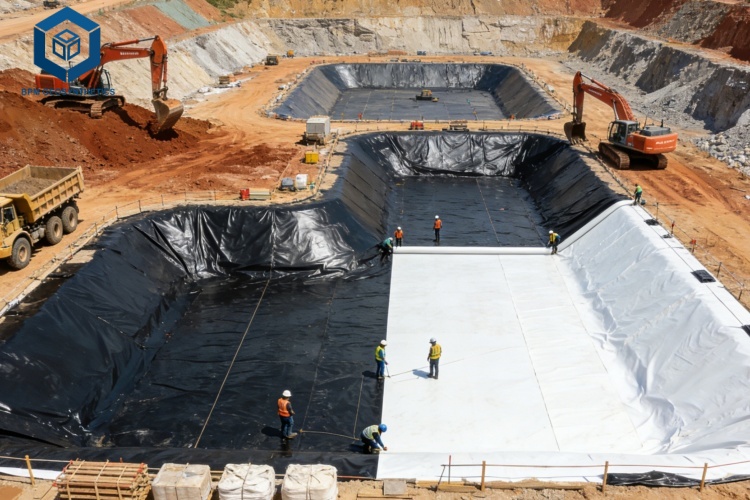
Mining tailings storage facilities requiring liner repair
Landfill leachate containment systems
Industrial wastewater treatment lagoons
Water reservoirs and irrigation ponds
EPC contractor infrastructure containment projects
Environmental remediation and hazardous waste containment
Core Pain Points and Solutions
1. Puncture Damage from Sharp Objects
Solution: Remove debris, clean the area, and apply HDPE patch welding with at least 100 mm overlap.
2. Seam Failure or Weak Welds
Solution: Grind the damaged seam and re-weld using calibrated extrusion welding equipment.
3. Mechanical Tearing During Installation
Solution: Install larger reinforcement patches and verify seam strength through non-destructive testing.
4. UV Degradation on Exposed Areas
Solution: Replace affected sections or apply protective cover layers where long-term exposure occurs.
Risk Warnings and Mitigation
Do not attempt repairs during rainfall or high humidity conditions.
Ensure the damaged surface is clean, dry, and free from contaminants.
Use compatible HDPE repair materials to prevent seam incompatibility.
Always conduct non-destructive seam testing after repair.
Follow welding temperature guidelines to prevent thermal degradation.
Procurement and Selection Guide
Confirm geomembrane thickness and compatibility with existing liner.
Request technical datasheets and welding parameters from suppliers.
Verify ISO or ASTM compliance for geomembrane materials.
Evaluate supplier experience in large containment repair projects.
Request repair patch samples for testing before bulk purchase.
Ensure availability of certified welding equipment and trained technicians.
Plan inspection procedures and quality documentation.
Engineering Case Study
Mining Tailings Pond Rehabilitation Project
Location: Copper mining facility
Area Repaired: 1,200 m² HDPE geomembrane liner
Damage Type: Mechanical punctures caused by heavy equipment
Repair Method: HDPE patch welding with extrusion welders
Quality Control: Vacuum box testing and spark testing
Outcome: Full containment restored with no detectable leakage
FAQ – How to Repair Damaged HDPE Geomembrane
1. What causes damage to HDPE geomembrane?
Common causes include punctures, seam defects, heavy equipment damage, and subgrade irregularities.
2. Can small punctures be repaired?
Yes. Small holes are typically repaired using extrusion-welded HDPE patches.
3. What tools are required for repair?
Extrusion welders, hot wedge welders, grinders, and seam testing equipment.
4. How large should a repair patch be?
Industry practice recommends at least 100 mm overlap beyond the damaged area.
5. Can repairs be performed underwater?
No. The surface must be dry to ensure proper welding.
6. How long does a repair typically last?
When properly welded, repairs can perform similarly to the original geomembrane.
7. How is repair quality verified?
Vacuum box testing, air pressure testing, and spark testing are commonly used.
8. Can HDPE liners be repaired multiple times?
Yes, provided sufficient material remains and structural integrity is maintained.
9. Should damaged sections ever be replaced entirely?
Yes. Large tears or extensive degradation may require panel replacement.
10. Who should perform geomembrane repairs?
Certified technicians with geomembrane welding experience should perform repairs.
Request Technical Documentation or Quotation
For EPC contractors, distributors, or engineering consultants requiring HDPE geomembrane repair materials or technical guidance, please contact our technical team for:
Engineering datasheets and repair specifications
Project-specific repair recommendations
Factory quotations for bulk geomembrane supply
Sample materials for field testing
Author Expertise (E-E-A-T)
This article was prepared by engineering specialists with over 15 years of experience in geomembrane manufacturing, installation, and environmental containment projects. The guidance reflects recognized engineering practices and international standards commonly applied in landfill, mining, and water infrastructure projects.