Geomembrane wrinkle problem during installation
The geomembrane wrinkle problem during installation refers to the formation of waves or folds on geomembrane liners caused by thermal expansion, improper placement, or subgrade irregularities. Excessive wrinkles may compromise seam welding quality, reduce liner stability, and increase leakage risk in containment systems.
Technical Parameters and Engineering Specifications
Controlling the geomembrane wrinkle problem during installation requires adherence to engineering installation standards and site condition management. Proper temperature ranges, panel sizes, and seam alignment play key roles in preventing wrinkle formation.
| Parameter | Recommended Value | Engineering Purpose |
|---|---|---|
| Installation temperature | 10°C – 40°C | Minimize thermal expansion |
| Panel width | 5 – 8 m typical | Control liner tension |
| Seam overlap | 100 – 150 mm | Ensure welding quality |
| Maximum wrinkle height before welding | ≤ 25 mm | Prevent seam defects |
| Subgrade smoothness tolerance | ±10 mm | Reduce liner deformation |
Maintaining these parameters significantly reduces the risk of geomembrane wrinkle problem during installation in large-scale containment projects.
Structure and Material Composition
Geomembrane liners are engineered barrier materials composed of multiple additives and polymer components designed for durability and weldability.
High-density polyethylene (HDPE) resin – primary impermeable polymer
Carbon black (2–3%) – UV resistance
Antioxidants – thermal aging resistance
Stabilizers – chemical durability
Surface texture (optional) – slope friction improvement
Material quality affects the flexibility and thermal behavior that influence the geomembrane wrinkle problem during installation.
Manufacturing Process
The manufacturing process directly impacts liner dimensional stability and installation performance.
Raw material blending
Polyethylene resin and additives are blended according to formulation.Extrusion melting
Industrial extruders heat and homogenize polymer material.Sheet forming
Flat die extrusion produces uniform geomembrane sheets.Cooling and calibration
Cooling rollers control thickness and surface flatness.Quality inspection
Automated systems check thickness, density, and defects.Rolling and packaging
Finished liners are rolled into transportable coils.
High manufacturing consistency reduces installation deformation and helps mitigate the geomembrane wrinkle problem during installation.
Industry Material Comparison
| Material | Wrinkle Sensitivity | Thermal Expansion | Typical Applications |
|---|---|---|---|
| HDPE Geomembrane | Moderate | High | Mining, landfill liners |
| LDPE Geomembrane | Low | Moderate | Agricultural ponds |
| PVC Liner | Low | Low | Water containment |
| EPDM Rubber | Very low | Low | Decorative ponds |
Application Scenarios
The geomembrane wrinkle problem during installation is commonly encountered in the following engineering environments:
Mining tailings storage facilities
Municipal landfill liner systems
Industrial wastewater treatment ponds
Agricultural irrigation reservoirs
Oil and gas containment basins
Users include EPC contractors, environmental engineering consultants, infrastructure developers, and geomembrane distributors responsible for large containment projects.
Core Engineering Pain Points and Solutions
1. Thermal expansion of HDPE liners
Problem: solar heating causes liner expansion and wrinkle formation.
Solution: install panels early morning when temperatures are stable.
2. Uneven subgrade preparation
Problem: rough ground surfaces create local deformation.
Solution: ensure proper grading and compaction of subgrade.
3. Large panel dimensions
Problem: oversized panels are difficult to tension during placement.
Solution: optimize panel width and installation sequence.
4. Delayed seam welding
Problem: wrinkles increase when panels remain exposed for long periods.
Solution: weld seams soon after placement.
Risk Warnings and Avoidance Recommendations
Avoid installation during extreme heat conditions.
Ensure subgrade is smooth and free of debris.
Minimize time between liner placement and welding.
Use temporary ballast such as sandbags to control liner movement.
Inspect wrinkles before seam welding operations.
Procurement and Engineering Selection Guide
Confirm geomembrane material type (HDPE, LDPE, PVC).
Select appropriate liner thickness for the project.
Verify supplier compliance with ASTM or GRI standards.
Confirm panel size recommendations for installation.
Review installation guidelines to prevent wrinkle formation.
Evaluate supplier engineering experience in similar projects.
Request samples and technical documentation.
Engineering Case Study
Mining Tailings Pond Project – Central Asia
A copper mining facility installed HDPE geomembrane over a 110,000 m² tailings storage area. During early installation phases, engineers encountered the geomembrane wrinkle problem during installation due to high midday temperatures.
Geomembrane thickness: 1.5 mm HDPE
Total liner area: 110,000 m²
Installation temperature: 15–28°C (controlled)
Panel width: 7 m
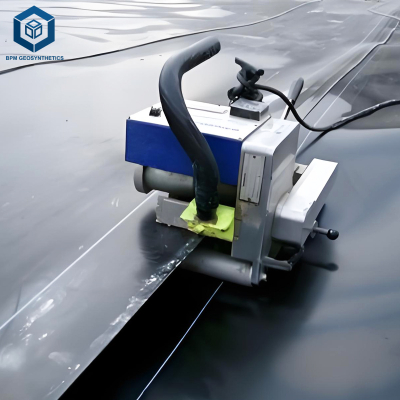
Welding method: hot wedge double seam
By adjusting installation timing to morning hours and reducing panel width, the project team minimized wrinkle formation and achieved seam quality compliant with ASTM welding standards.
FAQ – Geomembrane Wrinkle Problem During Installation
1. What causes geomembrane wrinkles?
Thermal expansion, uneven subgrade, and improper installation methods.
2. Are wrinkles always a problem?
Small wrinkles may be acceptable, but large wrinkles can affect welding quality.
3. What wrinkle height is acceptable before welding?
Typically less than 25 mm according to many installation guidelines.
4. Does temperature affect wrinkle formation?
Yes, high temperatures increase HDPE expansion and wrinkle risk.
5. Can wrinkles be removed after installation?
Minor wrinkles may flatten during welding, but large folds require repositioning.
6. Are textured geomembranes more prone to wrinkles?
No, but they require careful placement on slopes.
7. What time of day is best for installation?
Morning or late afternoon when temperatures are stable.
8. Does liner thickness affect wrinkles?
Thicker liners are slightly more stable but still affected by temperature.
9. How do contractors control liner movement?
Temporary ballast such as sandbags or anchor trenches.
10. Who manages wrinkle inspection?
Installation supervisors and quality control engineers.
Request Technical Information or Quotation
Engineering teams and procurement managers addressing the geomembrane wrinkle problem during installation may request:
Geomembrane technical data sheets
Installation and welding guidelines
Engineering samples for project testing
Bulk project quotations
Contact our technical team for engineering consultation, project specifications, and commercial proposals.
Author Expertise (E-E-A-T)
This technical guide is prepared by a geomembrane engineering specialist with extensive experience in landfill containment systems, mining tailings projects, and industrial geomembrane manufacturing. The information reflects practical field installation knowledge and internationally recognized standards including ASTM and GRI engineering practices.