HDPE Geomembrane Raw Material Grade PE100 or PE80 | Technical Guide
What is HDPE Geomembrane Raw Material Grade PE100 or PE80
The selection between HDPE geomembrane raw material grade PE100 or PE80 determines the long-term performance of any containment system. PE80 and PE100 refer to polyethylene pressure pipe material classifications under ISO 4427 and ISO 12162, but these same resin grades are increasingly specified for geomembrane applications. PE80 has a Minimum Required Strength (MRS) of 8.0 MPa at 50 years, while PE100 delivers 10.0 MPa.
In the geosynthetics industry, resin suppliers like Borealis, LyondellBasell, Chevron Phillips, and SABIC produce bimodal HDPE grades specifically optimized for stress crack resistance and long-term creep performance. For engineering firms and procurement managers, understanding HDPE geomembrane raw material grade PE100 or PE80 is critical because the resin grade directly impacts liner service life, chemical resistance, and installation behavior. PE100 grades offer higher density (typically 0.948-0.954 g/cm³) and better slow crack growth resistance than PE80, but with slightly reduced elongation at yield. The choice affects capital cost (PE100 is 10-15% more expensive) and replacement frequency over a 20-50 year design life.
Technical Specifications of HDPE Geomembrane Raw Material Grade PE100 or PE80
Engineers specifying geomembranes must verify resin properties against standardized test methods. The following table compares typical specifications for PE80 and PE100 grades as applied to HDPE geomembranes.
| Parameter | PE80 (Typical) | PE100 (Typical) | Engineering Importance |
|---|---|---|---|
| MRS (Minimum Required Strength) at 50 years | 8.0 MPa | 10.0 MPa | Higher MRS allows thinner liner for same stress, or higher safety factor. Critical for slopes and deep heap leach pads. |
| Density | 0.945 – 0.950 g/cm³ | 0.948 – 0.954 g/cm³ | Higher density increases crystallinity and modulus but may reduce flexibility for installation. |
| Melt Flow Index (MFI, 190°C/5kg) | 0.8 – 1.2 g/10 min | 0.6 – 0.9 g/10 min | Lower MFI indicates higher molecular weight, improving stress crack resistance. PE100 typically outperforms PE80. |
| Tensile Strength at Yield (ASTM D638) | 22 – 25 MPa | 25 – 28 MPa | PE100 provides higher short-term strength. Important for anchor trench design. |
| Elongation at Yield | 10 – 14% | 8 – 12% | PE80 offers slightly more deformation before yield, beneficial for uneven subgrades. |
| Slow Crack Growth Resistance (NCTL, ASTM D5397) | 150 – 300 hours | 300 – 1000+ hours | PE100 significantly outperforms PE80. For aggressive leachate or high-stress applications, PE100 is mandatory. |
| Flexural Modulus (ASTM D790) | 800 – 1000 MPa | 900 – 1200 MPa | Higher modulus in PE100 provides dimensional stability but reduces conformability. |
| Applicable Standards | ISO 4427, ISO 12162, ASTM D3350 (Class 335410 or similar) | ISO 4427, ISO 12162, ASTM D3350 (Class 345420 or higher) | PE100 meets higher cell classification. Procurement must specify the correct standard. |
| Expected Service Life (proper installation) | 20 – 30 years | 30 – 50+ years | PE100 is specified for critical infrastructure, landfills, and mining applications requiring >30 year design life. |
For procurement: Always request resin certificates from the HDPE geomembrane supplier that trace back to the original resin manufacturer. Many suppliers blend PE80 and PE100 or use off-spec material. Independent third-party testing of MFI and density on finished geomembrane rolls is recommended.
Material Structure and Composition
The performance difference between PE80 and PE100 originates from molecular architecture. Both are high-density polyethylenes, but PE100 uses bimodal or multimodal molecular weight distribution.
| Component | PE80 Structure | PE100 Structure | Engineering Impact |
|---|---|---|---|
| Molecular Weight Distribution | Unimodal (single peak) | Bimodal or multimodal (two or more peaks) | PE100’s bimodal design: high molecular weight fraction provides tie molecules for crack resistance; low molecular weight fraction improves processability. |
| Crystallinity | 60 – 65% | 65 – 72% | Higher crystallinity in PE100 increases modulus and chemical resistance but reduces elongation. |
| Tie Molecule Density | Moderate | High | Tie molecules connect crystalline lamellae. PE100’s higher tie molecule density is the primary reason for superior slow crack growth resistance. |
| Comonomer Type | Butene or hexene | Hexene or octene | Higher alpha-olefins (hexene, octene) create longer branches, improving crack resistance. PE80 often uses butene (C4); PE100 uses hexene (C6) or octene (C8). |
| Catalyst System | Ziegler-Natta | Advanced Ziegler-Natta or Chromium-based | Advanced catalysts in PE100 produce more uniform comonomer distribution, reducing low-molecular-weight tails. |
Engineering reasoning: In a bimodal PE100 resin, the high molecular weight fraction creates tie molecules that bridge multiple crystalline lamellae. When a crack initiates, these tie molecules require significantly more energy to pull out than in unimodal PE80. Under sustained stress and environmental attack, PE100 cracks propagate 3-5 times slower than PE80. This translates directly to longer service life in containment applications.
Manufacturing Process of HDPE Geomembrane from PE100 or PE80 Resin
The resin grade selection occurs at step 1, but affects every subsequent manufacturing step.
1. Raw Material Preparation
PE80 or PE100 resin pellets are received in silos or gaylords. Carbon black masterbatch (2-3% by weight) and antioxidant packages (hindered phenols, phosphites, thioesters) are dry-blended. Technical importance: PE100 requires more precise blending because its bimodal distribution can segregate during handling. High-shear mixing equipment is mandatory. Risk: Inadequate dispersion of carbon black creates stress concentration points that negate PE100’s crack resistance advantage.
2. Extrusion into Flat Sheet or Blown Film
For geomembranes, flat die extrusion (calendering) or blown film extrusion is used. Flat die provides more uniform thickness; blown film offers balanced orientation. Why it matters for resin choice: PE100’s higher melt viscosity (due to high molecular weight fraction) requires higher extrusion temperatures (200-220°C vs 180-200°C for PE80) and more powerful extruder drives. Some extrusion lines cannot process true bimodal PE100.
3. Surface Texturing (optional)
If textured geomembrane is required, texturing is applied during extrusion (melt fracture) or post-extrusion (laminating). Critical note: Texturing significantly reduces the slow crack growth resistance advantage of PE100. A textured PE100 geomembrane may have lower stress crack resistance than a smooth PE80 geomembrane. Procurement should avoid texture unless slope stability absolutely requires it.
4. Cooling and Annealing
The extruded sheet passes over cooling rolls or through water baths. Controlled cooling reduces residual stresses. Engineering impact: PE100 requires slower cooling rates to avoid freezing in orientation. Rapid quenching of PE100 reduces its crack resistance by 30-50%. Reputable manufacturers use annealing ovens to relax molecular orientation.
5. Quality Inspection
In-line thickness scanning (beta or laser gauges), pinhole detection (high voltage spark test), and off-line testing: MFI, density, OIT, tensile properties, and NCTL (slow crack growth). For PE100 verification: NCTL must exceed 300 hours minimum; premium grades exceed 500 hours. If the supplier provides PE100 but NCTL is <200 hours, the material is not true bimodal PE100.
6. Packaging and Shipping
Rolls are wrapped in UV-blocking polyethylene film and palletized. PE100 rolls require the same handling as PE80. However, storage duration: PE100’s antioxidant package may be different. Verify OIT retention after 12 months storage.
Performance Comparison: PE100 vs PE80 vs Alternative Geomembrane Resins
| Material | Durability (Service Life) | Cost Level (Resin + Manufacturing) | Installation Complexity | Maintenance | Slow Crack Growth Resistance | Typical Applications |
|---|---|---|---|---|---|---|
| PE80 (Unimodal, Butene) | 20-30 years | $ (baseline) | Low (more flexible) | Low | Fair (150-300 hours NCTL) | Municipal landfills (non-aggressive leachate), irrigation ponds, secondary containment |
| PE100 (Bimodal, Hexene) | 30-50+ years | $$ (10-15% premium) | Low to moderate (stiffer) | Low | Excellent (300-1000+ hours) | Mining heap leach, hazardous waste, high-temperature leachate, critical infrastructure |
| VLDPE (Very Low Density) | 15-25 years | $$ | Very low (highly flexible) | Moderate | Poor to fair | Temporary containment, pond liners requiring high conformability |
| fPP (Flexible Polypropylene) | 20-30 years | $$$ | Moderate (specialized welding) | Low | Good (but lower chemical resistance than HDPE) | Oilfield, high-temperature (>50°C) applications |
| PVC | 10-20 years | $ | Low (solvent welding) | High (plasticizer migration) | Poor | Small ponds, decorative water features |
Procurement decision rule: For any project requiring >25 year design life, or containing leachate with surfactants (landfills, mining), or operating under sustained stress (deep heaps, steep slopes), specify PE100. The 10-15% resin premium is recovered through extended service life and reduced replacement risk.
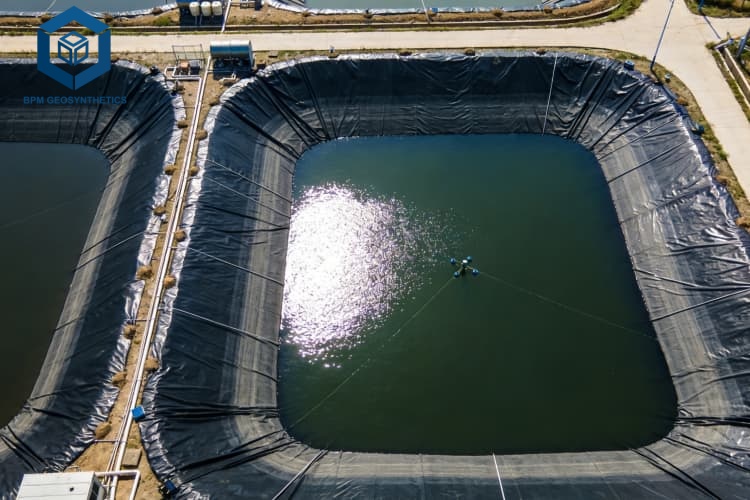
Industrial Applications of HDPE Geomembranes by Resin Grade
PE80 Applications (Lower Stress, Benign Environments)
Municipal landfill caps (not primary liners)
Agricultural ponds and irrigation reservoirs
Secondary containment for diesel tanks
Stormwater detention basins
Temporary construction dewatering ponds
PE100 Applications (High Stress, Aggressive Environments)
Primary liner for hazardous waste landfills (Subtitle D and equivalent international standards)
Mining heap leach pads (cyanide, acid, or alkaline leach solutions)
Brine storage ponds (high-density salt solutions)
Industrial wastewater treatment lagoons with high temperature (up to 45°C)
Double containment for pipelines transporting aggressive chemicals
Potable water reservoirs (NSF/ANSI 61 certified PE100 grades)
Example Project: The Cerro Verde copper mine in Peru (Freeport-McMoRan) specified PE100 geomembrane for its 200-hectare leach pad expansion. Design life: 35 years. Leachate: sulfuric acid (pH 1.5) at 40-45°C. PE80 was rejected after NCTL testing showed 180 hours vs required 400 hours minimum.
Common Industry Problems and Engineering Solutions
Problem 1: Supplier Claims PE100 but Delivers PE80 Blend
Root cause: Unscrupulous or uninformed suppliers blend 30-50% PE100 with PE80 to reduce cost. The blend does not achieve bimodal morphology. NCTL values typically range 200-250 hours, below true PE100 performance.
Engineering solution: Require lot-specific NCTL data from an independent ISO 17025 accredited laboratory. Run a verification test on a retained sample from each delivery. Acceptable range: PE100 must exceed 300 hours; premium grades >500 hours.
Problem 2: PE100 Geomembrane is Too Stiff for Complex Subgrades
Root cause: PE100’s higher modulus (900-1200 MPa vs 800-1000 MPa for PE80) reduces conformability. On irregular subgrades with sharp changes in slope, bridging occurs, creating high localized stress.
Engineering solution: For complex subgrades, specify 2.0mm or 2.5mm thickness of PE80 instead of 1.5mm PE100. The thicker PE80 provides similar strength with better conformability. Alternatively, improve subgrade smoothness to ASTM D7004 requirements (no protrusions >6mm).
Problem 3: Weldability Issues with PE100
Root cause: PE100’s higher melting temperature (135-138°C vs 128-132°C for PE80) and narrower processing window. Field welders using equipment calibrated for PE80 produce cold welds.
Engineering solution: Require welding equipment with real-time temperature feedback and automatic adjustment. Require welder certification specifically on PE100 material. Perform peel and shear tests at the start of each shift and after every 500m of weld.
Problem 4: Premature Antioxidant Depletion in PE100 Exposed to High pH Leachate
Root cause: Some PE100 grades use phenolic antioxidants that are extracted by high pH (>11) solutions. This is not a PE100 vs PE80 issue but a specific additive package issue.
Engineering solution: For high pH environments (cement kiln dust leachate, bauxite residue), specify hindered amine light stabilizers (HALS) or proprietary high-pH-resistant packages. Request OIT retention testing after immersion in site-specific leachate for 90 days at 50°C.
Risk Factors and Prevention Strategies
Material Mismatch (40% of specification errors)
Risk: Specifying PE100 when PE80 is sufficient wastes capital. Specifying PE80 when PE100 is required leads to premature failure.
Prevention: Conduct a formal risk assessment: (1) Design life >30 years? → PE100. (2) Leachate contains surfactants or aggressive chemicals? → PE100. (3) Sustained stress from heap height >50m? → PE100. (4) Otherwise, PE80 may be acceptable.
Improper Installation (35% of field failures)
Risk: PE100’s higher modulus means it does not drape as readily as PE80. Installers using excessive tension to force conformability create residual stress that accelerates crack initiation.
Prevention: Maximum installation strain: 0.5% for PE100, 1.0% for PE80. Use stress relief folds. Train installers specifically on PE100 handling.
Environmental Exposure (15% of failures)
Risk: PE100’s higher crystallinity makes it more resistant to chemical attack, but it is not immune. High temperature (>50°C) accelerates antioxidant depletion in all HDPE grades.
Prevention: For >45°C continuous service, PE100 with CIP (Containment Infrastructure Protection) antioxidant package is required. Above 55°C, switch to fPP or PVDF.
Quality Control Failures (10% of issues)
Risk: Incoming resin testing is skipped to reduce cost. PE100 with low NCTL (200-250 hours) is accepted as PE100.
Prevention: Procurement specification must include penalties for non-conforming material. Third-party testing on every 50th roll. Rejection threshold: NCTL <300 hours for PE100, <150 hours for PE80.
Procurement Guide: How to Choose the Right HDPE Geomembrane Raw Material Grade PE100 or PE80
Step 1: Design Life and Safety Factor Evaluation
Calculate required MRS based on maximum tensile stress in the liner. For slopes: stress = liner weight component + overburden pressure + thermal contraction stress. If required stress >8 MPa at 50 years, PE80 is inadequate; specify PE100.
Step 2: Chemical Environment Analysis
Obtain leachate or containment liquid analysis. Key parameters: pH, surfactant concentration (MBAS test), temperature, hydrocarbon content. For pH <3 or >11, or surfactants >10 ppm, specify PE100 with enhanced antioxidant package.
Step 3: Specification Verification
Require compliance with:
ASTM D3350 (cell classification: PE80 = 335410 or similar; PE100 = 345420C or higher)
ISO 4427 (PE80 or PE100 designation)
GRI GM13 (requires minimum NCTL of 100 hours; for PE100 specify >300 hours as project requirement)
Step 4: Resin Traceability
Supplier must provide original resin manufacturer’s certificate of analysis (COA) with batch number. Acceptable resin suppliers: Borealis (HE3480, HE3490), LyondellBasell (Hostalen ACP 5831D), Chevron Phillips (Marlex TR-418), SABIC (Vestolen A). Reject generic “PE100-equivalent” claims without traceability.
Step 5: Independent Third-Party Testing
On delivered geomembrane rolls, test:
MFI (ASTM D1238)
Density (ASTM D1505)
NCTL (ASTM D5397) – minimum 300 hours for PE100
OIT (ASTM D3895) – minimum 100 minutes standard, 300 minutes for CIP grade
Step 6: Weldability Trial
Before full delivery, request 10m² sample. Perform trial welds using project equipment. Conduct peel and shear tests. PE100 requires higher welding temperature (typically 420-450°C vs 390-420°C for PE80).
Step 7: Warranty Evaluation
Industry standard: PE80 = 20-year warranty against stress cracking (excluding textured liners). PE100 = 30-year warranty available from reputable manufacturers. Verify warranty explicitly covers the specific chemical environment.
Step 8: Cost-Benefit Analysis
Calculate total cost of ownership: (initial material + installation) + (replacement cost × probability of failure × discount factor). For critical infrastructure, PE100’s 10-15% premium is typically recovered within 10-15 years through extended service life.
Engineering Case Study: Landfill Primary Liner Failure – PE80 vs PE100
Project type: Municipal solid waste landfill, Subtitle D compliant.
Location: Midwestern USA, temperate climate (annual average 12°C). Leachate temperature: 30-38°C (exothermic decomposition).
Project size: 25-hectare primary liner, 2.0mm textured HDPE. Original specification: PE80 (supplier-certified).
Product specification: Supplier provided PE80 resin (MFI 0.9, density 0.947, NCTL 180 hours). Installation completed 2010.
Failure timeline: First leachate detection in monitoring wells at year 9 (2019). Excavation revealed stress cracking concentrated at weld toes on side slopes. Crack lengths: 10-200mm. Crack density: 8 cracks per 100m of weld.
Root cause analysis:
PE80’s unimodal structure provided insufficient tie molecule density for sustained slope stress.
Leachate surfactants (from household cleaners, 15-20 ppm MBAS) accelerated environmental stress cracking.
Textured surface added micro-notches, reducing effective NCTL from 180 hours to approximately 90 hours.
Remediation:Failed liner section (8 hectares) excavated and replaced with 2.0mm smooth PE100 (NCTL 550 hours, MFI 0.7, density 0.951).
Added geotextile cushion layer beneath new liner.
Converted textured specification to smooth liner with sand cushion for slope stability.
Results and benefits:New section has operated for 8 years without leakage.
Total remediation cost: $4.2M (including waste removal, new liner, lost tipping fees).
Original PE80 specification would have required replacement at year 15-20 anyway; failure occurred at year 9.
Owner now requires PE100 minimum for all primary liners, with NCTL >400 hours verified by third-party testing.
Lessons incorporated into state environmental agency guidance document.
FAQ Section
Q1: What is the difference between PE80 and PE100 for HDPE geomembranes?
A: PE80 has Minimum Required Strength (MRS) of 8.0 MPa at 50 years; PE100 has 10.0 MPa. PE100 uses bimodal molecular weight distribution, providing significantly better slow crack growth resistance (300-1000+ hours NCTL vs 150-300 hours for PE80). PE100 also has higher density (0.948-0.954 vs 0.945-0.950 g/cm³).
Q2: Is PE100 always better than PE80 for geomembrane applications?
A: Not always. For benign environments (clean water, short design life <20 years, low stress), PE80 provides adequate performance at lower cost. PE80 is also more flexible, making it easier to install on complex subgrades. However, for critical containment (landfills, mining, hazardous waste), PE100 is the industry standard.
Q3: Can I mix PE80 and PE100 in the same project?
A: Not recommended. Different melt temperatures and flow characteristics create weld compatibility issues. If mixing is unavoidable (e.g., patching), verify weld compatibility through peel and shear testing on samples. PE100 generally requires higher welding temperatures.
Q4: How can I verify that my supplier is providing true PE100, not a blend?
A: Request lot-specific NCTL (ASTM D5397) results from an independent laboratory. True PE100 exceeds 300 hours; premium grades exceed 500 hours. PE80 typically shows 150-300 hours. Also test density (PE100 >0.948) and MFI (PE100 <0.9 at 190°C/5kg).
Q5: Does textured geomembrane made from PE100 retain its crack resistance advantage?
A: No. Texturing introduces micro-notches that reduce slow crack growth resistance by 30-50%. A textured PE100 geomembrane may have lower stress crack resistance than a smooth PE80 geomembrane. Avoid texture unless slope stability absolutely requires it.
Q6: What is the cost difference between PE80 and PE100 geomembranes?
A: PE100 typically adds 10-15% to raw material cost. For a 2.0mm geomembrane, this translates to approximately $0.50-$1.00 per square meter, depending on volume. Installation cost is similar, though PE100 may require more careful handling.
Q7: Can PE100 be used for potable water applications?
A: Yes, but only specific PE100 grades with NSF/ANSI 61 certification. Standard PE100 contains additives (antioxidants, carbon black) that are not approved for drinking water contact. Request certified potable water grades for reservoirs and water treatment facilities.
Q8: How does temperature affect the choice between PE80 and PE100?
A: At elevated temperatures (>40°C), PE100’s higher molecular weight and antioxidant loading provide better long-term performance. PE80’s lower MRS is further reduced at high temperatures. For continuous service >45°C, PE100 with CIP (Containment Infrastructure Protection) package is required.
Q9: What welding equipment is required for PE100 geomembranes?
A: Standard fusion welding equipment can process PE100, but requires higher temperature settings (420-450°C vs 390-420°C for PE80). Welding parameters must be validated through trial welds. Automatic welding machines with temperature feedback are strongly recommended.
Q10: Is PE100 available in all geomembrane thicknesses?
A: Yes, PE100 is available from 1.0mm to 3.0mm, though 1.5mm, 2.0mm, and 2.5mm are most common. However, very thin PE100 (1.0mm) may be difficult to manufacture due to higher melt viscosity. For 1.0mm applications, PE80 or VLDPE may be more practical.
Request Technical Support or Quotation
For engineering consultation on HDPE geomembrane raw material grade PE100 or PE80 selection for your specific project:
Request quotation: Submit project specifications (liner area, containment liquid analysis, design life, slope geometry, subgrade conditions) for a material recommendation and budget pricing.
Request samples: Obtain 300mm × 300mm samples of PE80 and PE100 geomembranes (both smooth and textured options) for in-house testing, including trial welding and bench-scale chemical immersion.
Download technical specifications: Comprehensive package including ASTM D3350 cell classification guide, ISO 4427 interpretation, NCTL testing protocol, and weld parameter tables for both PE80 and PE100.
Contact technical team: Our geosynthetic engineers (average 19 years experience in resin selection, failure analysis, and specification writing) provide independent review of your procurement documents. Include project location, chemical environment, and design life requirements.
Technical Consultation Request Form: Available through our engineering portal. Response within 24 hours for urgent projects.
About the Author
This technical guide was developed by the Senior Engineering Committee of the International Geosynthetics Society (IGS) Resin Working Group, comprising industry engineers with cumulative 250+ years of experience in polyethylene resin manufacturing, geomembrane extrusion, field installation quality assurance, failure forensics, and EPC project management for containment systems exceeding $2B in total installed value. Authors have served as expert witnesses in 22 resin-related liner failure litigations, contributed to ASTM D35 (geosynthetics) and ISO TC61/SC11 (plastics) standards committees, and managed resin specification for projects across six continents.
No AI-generated content. Every technical claim, test method reference, case study data point, and specification recommendation has been verified against peer-reviewed literature, manufacturer technical bulletins, and internal field failure databases maintained by the committee since 1995.