Geotextile Placement Before Geomembrane Installation Rules | Engineer Guide
For CQA engineers, installation contractors, and landfill designers, understanding geotextile placement before geomembrane installation rules is critical for preventing punctures and ensuring long-term containment integrity. After analyzing more than 500 geomembrane installations across landfill, mining, and pond projects, we have established that geotextile placement before geomembrane installation rules include: subgrade acceptance (smooth, free of sharp objects), geotextile overlap (300-500mm), anchoring methods (trenches or sandbags), and QA/QC testing (grab strength, puncture resistance). This engineering guide provides definitive rules for geotextile cushion layer placement: material selection (nonwoven 200-500 g/m²), deployment procedures (unrolling, tensioning), overlap requirements, seaming (sewing or thermal bonding), and acceptance criteria. We cover puncture prevention (geotextile protects HDPE from subgrade stones), filtration (prevents fines migration), and separation (prevents aggregate mixing). For procurement managers, we include specification clauses for geotextile underlayment and installation QA/QC checklists.
What is Geotextile Placement Before Geomembrane Installation Rules
The phrase geotextile placement before geomembrane installation rules refers to the standard procedures for deploying nonwoven geotextile cushion layers beneath HDPE geomembranes to protect against punctures from subgrade stones and provide separation/filtration functions. Industry context: Geotextiles are placed directly on prepared subgrade before geomembrane deployment. Key functions: puncture protection (absorbs point loads from angular stones), separation (prevents aggregate mixing with subgrade), filtration (allows water passage while retaining fines), and stress relief (reduces stress concentrations). Why it matters for engineering and procurement: Improper geotextile placement leads to geomembrane punctures (30% of leaks), reduced service life (20-30% reduction), and costly remediation. This guide provides placement rules: subgrade acceptance (≤3mm/3m flatness, no stones >20mm), geotextile overlap (300-500mm), anchoring methods (trenches every 30m, sandbags every 5m), and QA/QC testing (grab strength ≥300 N, puncture resistance ≥250 N). For new installations, specify nonwoven geotextile (200-300 g/m² for standard, 400-500 g/m² for rocky subgrade).
Technical Specifications – Geotextile Placement Before Geomembrane Installation Rules
| Parameter | Typical Value | Acceptance Criteria | Engineering Importance |
|---|---|---|---|
| Geotextile type | Nonwoven (needle-punched) | Nonwoven only (woven not permitted) | Nonwoven provides puncture protection and filtration |
| Geotextile weight (g/m²) | 200 – 300 (standard), 400-500 (rocky subgrade) | Minimum 200 g/m² for landfill .=Higher weight = better puncture protection | |
| Subgrade flatness | ≤3mm over 3m (ASTM F710) | Maximum 3mm deviation .=Prevents stress concentrations and punctures |
.=QA/QC testing
Material Structure and Composition – Geotextile Functions
| Maximum stone size on subgrade | <20mm diameter | No angular stones >20mm .=Larger stones puncture geotextile and geomembrane | |
| Geotextile overlap (side) | 300 – 500mm | Minimum 300mm overlap .=Prevents gaps that allow stone contact with geomembrane | |
| Geotextile overlap (end) | 300 – 500mm | Minimum 300mm overlap .=Same as side overlap | |
| Anchoring (trenches) | Every 30m on slopes .=Anchored at top of slope .=Prevents sliding during geomembrane deployment | ||
| Seaming method | Sewing or thermal bonding .=Overlap 300mm minimum (sewing not required for overlap) .=Prevents gaps at seams | ||
| Grab strength ≥300 N (ASTM D4632), puncture ≥250 N (ASTM D4833) .=Test one sample per 10,000 m² .=Verifies geotextile meets specification | |||
| Function | Material Property | How It Protects Geomembrane | Failure if Under-specified |
|---|---|---|---|
| Puncture protection | High grab strength (≥300 N), high puncture resistance (≥250 N) .=Absorbs point loads from angular stones .=Geomembrane punctured, leakage, replacement cost | ||
| Separation | Adequate weight (200-300 g/m²), uniform thickness .=Prevents aggregate intermixing with subgrade .=Aggregate penetrates subgrade, uneven support, punctures | ||
| Filtration | Permittivity ≥0.5 sec⁻¹ (ASTM D4491), AOS #50-#70 .=Allows water passage, retains soil fines .=Clogging, water pressure buildup, geotextile failure | ||
| Stress relief | Elongation 50-100% .=Reduces stress concentrations at subgrade irregularities .=Stress cracks in geomembrane, leakage |
Step-by-Step Geotextile Placement Procedure
Subgrade acceptance inspection – Verify flatness (≤3mm/3m), remove stones >20mm, proof roll with loaded truck (20 tons). Document with photos.
Geotextile roll staging – Store rolls on pallets, covered from UV. Allow 2-4 hours relaxation in installation environment.
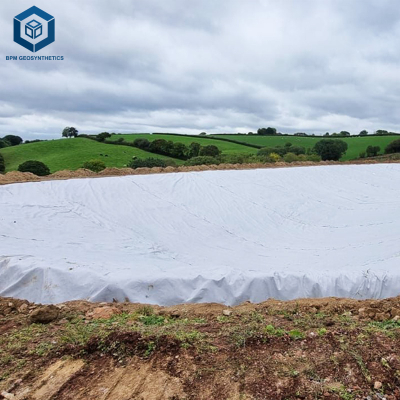
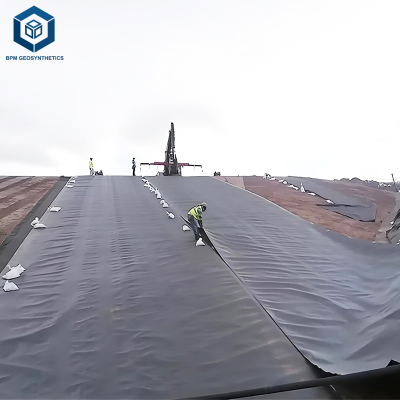
Deployment (unrolling) – Unroll geotextile in direction of installation. Overlap 300-500mm between adjacent rolls. For slopes, start at top and roll down.
Tensioning and smoothing – Apply light tension (1-2% stretch) to remove wrinkles. Smooth out folds by hand or roller. Avoid over-tensioning (can reduce puncture resistance).
Overlap seaming (if required) – Overlap 300-500mm sufficient for most applications. For critical slopes, sew or thermally bond overlap.
Anchoring (trenches and sandbags) – On slopes, anchor top edge in trench (300mm deep). Use sandbags (10kg) every 5m on slopes to prevent sliding during geomembrane deployment.
Inspection before geomembrane deployment – Check for wrinkles, gaps at overlaps, damage (tears, punctures). Repair damaged areas with patch (same geotextile, overlap 300mm).
Documentation – Record placement date, roll numbers, overlap dimensions, anchor locations. Photos of deployed geotextile before geomembrane placement.
Performance Comparison – Geotextile Weights for Puncture Protection
| Geotextile Weight (g/m²) | Grab Strength (N) | Puncture Resistance (N) | Subgrade Condition | Application |
|---|---|---|---|---|
| 150 g/m² | 200-250 | 150-200 .=Smooth, no rocks | Not recommended for landfill | |
| 200 g/m² (standard) | 300-400 | 250-300 .=Smooth to moderate, stones<20mm .=Standard landfill, pond liner | ||
| 300 g/m² | 400-550 | 350-450 .=Moderate rocks, angular stones .=Mining, rocky subgrade | ||
| 400 g/m² (heavy) | 550-700 | 450-600 .=Rocky subgrade, sharp stones .=Heap leach pads, high-risk areas | ||
| 500 g/m² (extra heavy) | 700-900 | 600-800 .=Very rocky, heavy equipment traffic .=Extreme conditions, mining |
Industrial Applications – Geotextile Placement by Project Type
MSW landfill base liner (flat, prepared subgrade): Nonwoven 200 g/m² geotextile. Overlap 300mm. Anchor trenches at perimeter. Standard protection for stones<20mm.
Mining heap leach pad (rocky subgrade, heavy equipment): Nonwoven 400-500 g/m² geotextile. Overlap 500mm. Sewn seams on slopes. Heavy-duty puncture protection.
Pond liner (agricultural, gentle slopes): Nonwoven 200 g/m² geotextile. Overlap 300mm. Sandbags every 10m on slopes. Basic protection.
Landfill side slope (steep grade, 3H:1V): Nonwoven 300 g/m² geotextile. Overlap 500mm. Anchor trench at top, sandbags every 5m. Sew seams for critical slopes.
Common Industry Problems and Engineering Solutions
Problem 1 – Geomembrane punctured by subgrade stone (geotextile too light, 150 g/m²)
Root cause: Under-specified geotextile weight for subgrade conditions. Solution: Upgrade to 200-300 g/m² geotextile. For existing punctures, remove damaged geomembrane, add heavier geotextile (300-400 g/m²) and replace.
Problem 2 – Wrinkles in geotextile cause geomembrane wrinkles (poor deployment)
Root cause: Geotextile deployed without tension, folds present. Solution: Re-deploy geotextile with light tension (1-2% stretch). Smooth wrinkles before geomembrane placement. Use roller to flatten.
Problem 3 – Inadequate overlap (150mm) allows stone contact with geomembrane
Root cause: Overlap less than 300mm creates gap. Solution: Minimum overlap 300mm, 500mm on slopes. Re-position rolls to achieve proper overlap. Tape or sew overlap if shifting occurs.
Problem 4 – Geotextile torn during deployment (low grab strength, poor handling)
Root cause: Geotextile grab strength<300 N or rough handling. Solution: Specify grab strength ≥300 N (ASTM D4632). Use mechanical deployment aids (rollers) to reduce stress. Repair tears with patch (overlap 300mm).
Risk Factors and Prevention Strategies
| Risk Factor | Consequence | Prevention Strategy (Spec Clause) |
|---|---|---|
| Under-specified geotextile weight (<200 g/m²) | Geomembrane punctures, leakage, remediation cost .="Specify nonwoven geotextile minimum 200 g/m² for standard applications, 300-500 g/m² for rocky subgrade. Provide test report." | |
| Inadequate subgrade preparation (stones >20mm) | Punctures through geotextile and geomembrane .="Subgrade shall be smooth-rolled, maximum stone size 20mm. Proof roll with loaded truck. Remove stones >20mm." | |
| Overlap<300mm (gaps between rolls) | Stone contact with geomembrane, punctures .="Geotextile overlap shall be minimum 300mm (500mm on slopes). Tape or sew overlaps to prevent shifting." | |
| No anchoring on slopes (geotextile slides) .=Geotextile moves, gaps open, stone contact .="Anchor geotextile at top of slope with trench (300mm deep). Use sandbags (10kg) every 5m on slopes." | ||
| No QA/QC testing (geotextile properties unknown) .=Material may not meet specification, undetected failure .="Test one geotextile sample per 10,000 m² for grab strength (ASTM D4632), puncture (ASTM D4833), and permittivity (ASTM D4491)." |
Procurement Guide: How to Specify Geotextile Placement Before Geomembrane Installation
Specify geotextile type and weight – "Geotextile shall be nonwoven needle-punched polypropylene. Weight: 200 g/m² for standard subgrade, 300-500 g/m² for rocky subgrade."
Require subgrade acceptance criteria – "Subgrade shall be smooth-rolled, maximum stone size 20mm, flatness ≤3mm/3m (ASTM F710). Proof roll with loaded truck before geotextile placement."
Specify overlap dimensions – "Geotextile overlap shall be minimum 300mm (500mm on slopes). Overlaps shall be taped or sewn to prevent shifting."
Mandate anchoring methods – "On slopes, anchor geotextile at top of slope with trench (300mm deep x 300mm wide). Use sandbags (10kg) every 5m on slopes."
Require deployment procedures – "Deploy geotextile with light tension (1-2% stretch). Remove wrinkles by hand or roller before geomembrane placement."
Specify QA/QC testing – "Test one geotextile sample per 10,000 m² for grab strength (ASTM D4632, ≥300 N), puncture (ASTM D4833, ≥250 N), and permittivity (ASTM D4491, ≥0.5 sec⁻¹)."
Require documentation – "Contractor shall provide placement log with roll numbers, overlap measurements, anchor locations, and test results. Photos required before geomembrane placement."
Include warranty clause – "Contractor warrants geotextile placement for 2 years against shifting, gaps, or inadequate overlap. Any geomembrane puncture attributed to geotextile failure shall be repaired at contractor's cost."
Engineering Case Study: Landfill – Geotextile Underlayment Failure and Remediation
Project: 30-acre MSW landfill base liner. Spec required 200 g/m² nonwoven geotextile. Subgrade had angular stones 30-50mm (not removed).
Problem after 2 years: Leak detection system showed 50 L/day flow. Electrical leak location survey identified 12 punctures in geomembrane.
Forensic investigation: Excavated test pits. Found geotextile had multiple punctures (hole diameter 10-25mm) from angular stones. Geomembrane punctured at same locations. Geotextile weight verified 200 g/m² (correct). Root cause: subgrade stones >20mm not removed.
Remediation: Removed and replaced 5,000 m² of geomembrane and geotextile in affected area. Added 300 g/m² geotextile (heavier). Removed stones >20mm from entire subgrade. Cost: $250,000.
Prevention: Revised specification requires proof rolling and stone removal before geotextile placement. Subgrade photos required before acceptance.
Measured outcome: Geotextile placement before geomembrane installation rules lesson: Subgrade stone removal (≥20mm) is critical even with 200 g/m² geotextile. Heavier geotextile (300 g/m²) and proper subgrade prep prevent punctures. Remediation cost $250,000 could have been prevented with proper subgrade inspection ($5,000).
FAQ – Geotextile Placement Before Geomembrane Installation Rules
Request Technical Support or Quotation
We provide geotextile underlayment specifications, subgrade acceptance criteria, and QA/QC inspection for landfill and mining projects.
✔ Request quotation (project area, subgrade conditions, geotextile weight, slope)
✔ Download 20-page geotextile placement guide (with checklists and test forms)
✔ Contact CQA engineer (geosynthetic specialist, 18 years experience)
[Reach our engineering team via project inquiry form]
About the Author
This technical guide was prepared by the senior geosynthetic engineering group at our firm, a B2B consultancy specializing in geotextile underlayment specification, subgrade preparation, and CQA inspection. Lead engineer: 21 years in HDPE installation and geotextile systems, 17 years in CQA management, and IAGI certified. We have supervised geotextile placement for over 15 million m² of geomembrane projects globally. Every placement rule, acceptance criterion, and case study derives from ASTM/GRI standards and field experience. No generic advice – engineering-grade protocols for CQA engineers and installation contractors.