Geotextile for Soft Soil Reinforcement Under Liner
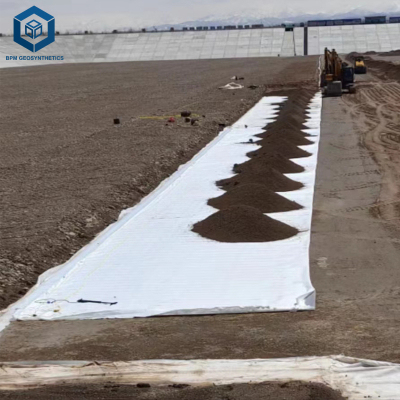
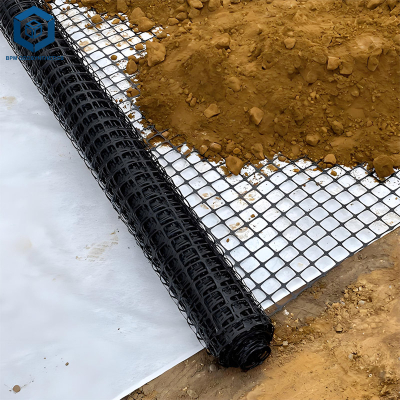
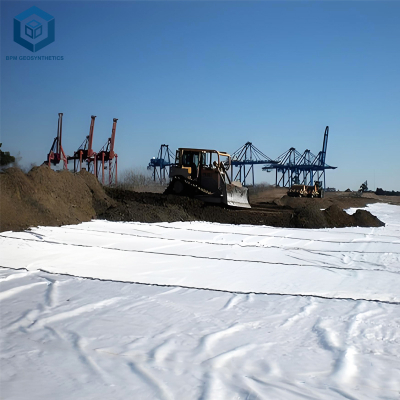
Geotextile for soft soil reinforcement under liner is a high-strength permeable geosynthetic layer installed between weak subgrade and geomembrane liner systems to improve bearing capacity, control differential settlement, provide separation, and enhance long-term structural stability in containment and hydraulic engineering projects.
Technical Parameters & Specifications
When specifying geotextile for soft soil reinforcement under liner systems, mechanical strength, elongation, puncture resistance, and filtration properties must align with project load conditions and groundwater characteristics.
| Parameter | Typical Range | Test Standard |
|---|---|---|
| Mass per Unit Area | 300 – 800 g/m² | ASTM D5261 |
| Tensile Strength (MD/CD) | 15 – 50 kN/m | ASTM D4595 |
| Elongation at Break | 40% – 100% (Nonwoven) | ASTM D4595 |
| CBR Puncture Strength | 2.0 – 6.0 kN | ASTM D6241 |
| Permittivity | ≥ 1.0 s⁻¹ | ASTM D4491 |
| Apparent Opening Size (AOS) | 0.075 – 0.30 mm | ASTM D4751 |
For highly compressible clay or silt foundations, ≥400 g/m² needle-punched nonwoven geotextile is commonly used beneath HDPE geomembrane liners.
Structure & Material Composition
Layer Configuration Under Liner
Compacted soft soil subgrade
Stabilization layer (if required)
Geotextile for soft soil reinforcement under liner
Protective soil or drainage layer
Material Composition
Virgin polypropylene (PP) fibers or polyester (PET)
Needle-punched nonwoven structure for cushioning and reinforcement
UV stabilizers (for temporary exposure)
The geotextile layer distributes stress and prevents direct liner contact with unstable subgrade.
Manufacturing Process
Fiber Production: PP or PET extrusion into continuous filaments.
Web Formation: Random fiber orientation via carding or air-laying.
Needle Punching: Mechanical entanglement to create 3D reinforcement matrix.
Thermal Bonding (Optional): Surface stabilization for added strength.
Rolling & Inspection: Thickness, mass, tensile testing per batch.
Quality Certification: Verification against ASTM and EN standards.
Controlled needle density directly impacts tensile strength and puncture resistance performance.
Industry Comparison
| Property | Nonwoven Geotextile | Woven Geotextile | Geogrid | Geocell |
|---|---|---|---|---|
| Separation Function | Excellent | Good | Limited | Moderate |
| Reinforcement | Moderate | High (Directional) | High | High |
| Puncture Protection for Liner | Excellent | Moderate | Low | Low |
| Filtration Capability | Excellent | Limited | None | None |
| Suitability Under Liner | Recommended | Conditional | Not Preferred Alone | Used with Soil |
Nonwoven geotextile for soft soil reinforcement under liner systems offers combined cushioning and filtration advantages.
Application Scenarios
Landfill base systems over soft clay
Wastewater lagoons on silty subgrade
Mining tailings containment areas
Aquaculture ponds with weak soil
Industrial evaporation ponds
Primary users include EPC contractors, environmental engineers, infrastructure developers, and procurement managers.
Core Pain Points & Engineering Solutions
1. Differential Settlement
Solution: Increase geotextile tensile strength and combine with soil stabilization.
2. Liner Puncture Risk
Solution: Use ≥400 g/m² nonwoven geotextile to enhance cushioning.
3. Mud Pumping and Soil Migration
Solution: Select proper AOS to maintain filtration compatibility.
4. Low Bearing Capacity
Solution: Integrate geotextile reinforcement with drainage blanket system.
5. Excess Pore Water Pressure
Solution: Design drainage layer to relieve subgrade pressure.
Risk Warnings & Mitigation
Under-specifying tensile strength may lead to excessive elongation.
Improper AOS selection can cause clogging or soil loss.
Direct liner placement on untreated soft soil increases rupture risk.
UV exposure beyond 30 days may degrade unprotected geotextile.
Poor installation overlap reduces reinforcement continuity.
Engineering verification and laboratory soil compatibility testing are recommended.
Procurement & Selection Guide
Conduct geotechnical investigation (CBR, shear strength, moisture content).
Determine expected load from liner, cover soil, and stored material.
Select geotextile mass per unit area ≥400 g/m² for soft clay.
Verify tensile strength meets calculated reinforcement requirement.
Confirm puncture resistance exceeds subgrade stone pressure.
Check filtration compatibility (AOS vs soil particle size).
Review manufacturer QA/QC documentation and test certificates.
Plan installation overlap (typically 300–500 mm).
A systematic design approach ensures effective geotextile for soft soil reinforcement under liner applications.
Engineering Case Study
Project: Municipal Wastewater Lagoon
Location: Soft clay subgrade (CBR 2%)
Area: 18,000 m²
System: 500 g/m² nonwoven geotextile + 1.5 mm HDPE liner
Challenge: High settlement risk during filling stage
Solution: Reinforced separation layer with drainage blanket
Outcome: Settlement reduced to<30 mm after 24 months operation.
FAQ
1. Is woven geotextile suitable under liners?
Only when directional tensile reinforcement is required.
2. What minimum weight is recommended?
Typically ≥400 g/m² for soft clay subgrades.
3. Does geotextile replace soil stabilization?
No, it complements but does not fully replace stabilization.
4. How is puncture resistance determined?
Using CBR puncture strength testing.
5. Can geotextile improve bearing capacity?
Yes, through stress distribution and confinement effects.
6. Is filtration performance important?
Yes, especially in saturated soft soil conditions.
7. What overlap is required during installation?
Generally 300–500 mm depending on site conditions.
8. Should seams be sewn?
Sewing is recommended for high-load applications.
9. How long can it be exposed to sunlight?
Preferably less than 30 days unless UV stabilized.
10. Is third-party testing recommended?
Yes, for large-scale environmental containment projects.
Request Quotation or Technical Documentation
For specification support on geotextile for soft soil reinforcement under liner projects, provide soil investigation reports, load data, and design drawings. Technical datasheets, reinforcement calculations, and commercial quotations are available upon request.
Author & Technical Authority
This document is prepared by a geosynthetics engineer with over 12 years of experience in landfill, mining, and hydraulic containment design. All parameters are aligned with ASTM standards and practical engineering applications to support professional procurement decisions.