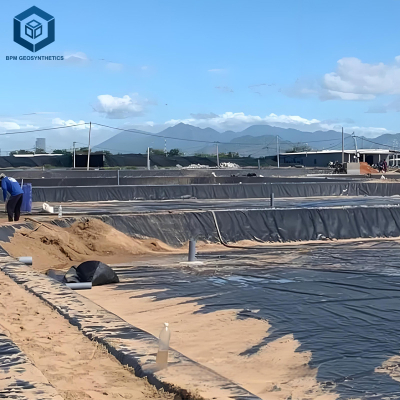
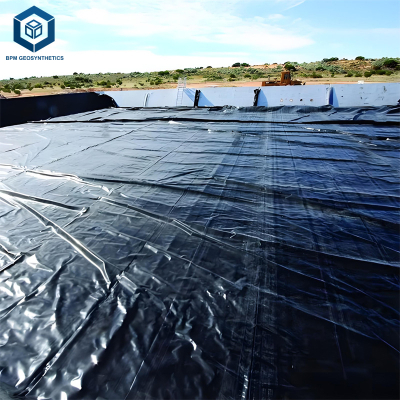
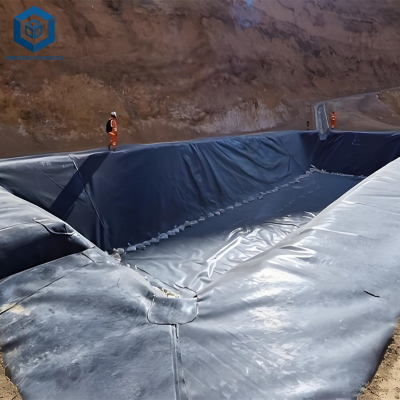
Anti Root Puncture Geomembrane for Landfill Cap
Anti Root Puncture Geomembrane for Landfill Cap Systems
Product Definition
Anti root puncture geomembrane for landfill cap is a high-density polyethylene (HDPE) or modified polyolefin liner engineered to resist root penetration and mechanical puncture in final cover systems, ensuring long-term containment integrity and environmental protection in capped landfill facilities.
Technical Parameters & Specifications
The following parameters reflect commonly specified engineering ranges for anti root puncture geomembrane for landfill cap applications:
| Parameter | Typical Value / Range | Test Standard |
|---|---|---|
| Thickness | 1.5 mm / 2.0 mm | ASTM D5199 |
| Density | ≥ 0.94 g/cm³ | ASTM D1505 |
| Tensile Strength (Yield) | ≥ 22 kN/m (1.5 mm) | ASTM D6693 |
| Puncture Resistance | ≥ 480 N (1.5 mm) | ASTM D4833 |
| Stress Crack Resistance | ≥ 500 hrs | ASTM D5397 |
| Carbon Black Content | 2–3% | ASTM D4218 |
| Root Resistance | No penetration | EN 14416 / CEN/TS 14416 |
| Oxidative Induction Time (OIT) | ≥ 100 min (Std OIT) | ASTM D3895 |
Thickness selection depends on final cover design, overburden load, and vegetation strategy.
Structure & Material Composition
Anti root puncture geomembrane for landfill cap typically consists of:
Virgin HDPE Resin Layer – Provides primary impermeability.
Carbon Black Stabilization – UV resistance and long-term durability.
Root-Resistant Additive Package – Enhances resistance to aggressive vegetation penetration.
Optional Textured Surface – Improves interface friction in slope applications.
Some systems incorporate co-extruded multilayer structures to enhance stress crack resistance and chemical durability.
Manufacturing Process
Raw Material Blending – Virgin resin mixed with carbon black and stabilizers.
Extrusion – Flat-die or blown-film extrusion under controlled temperature profile.
Thickness Calibration – Automatic gauge control ensures uniformity.
Surface Texturing (if required) – Nitrogen-assisted embossing or co-extrusion.
Cooling & Winding – Controlled cooling to prevent internal stress.
Quality Testing – Mechanical, OIT, and root resistance validation.
Process stability and resin quality are critical for long-term landfill cap performance.
Industry Comparison
| Criteria | Anti Root Puncture Geomembrane | Standard HDPE Geomembrane | Compacted Clay Layer | GCL |
|---|---|---|---|---|
| Root Resistance | High | Moderate | Low | Moderate |
| Permeability | Very Low | Very Low | Moderate | Low |
| Slope Stability | Good (Textured) | Moderate | High Mass | Requires Protection |
| Installation Speed | Fast | Fast | Slow | Fast |
| Long-Term Integrity | High | Moderate | Crack Risk | Hydration Dependent |
Application Scenarios
Anti root puncture geomembrane for landfill cap is widely specified in:
Municipal solid waste landfill final covers
Hazardous waste containment caps
Industrial waste cell closures
Brownfield remediation sites
Revegetated slope stabilization systems
Primary stakeholders include EPC contractors, environmental engineering firms, landfill operators, and geosynthetic distributors.
Core Pain Points & Solutions
Vegetation Root Intrusion – Specialized root-resistant formulation prevents liner penetration.
Slope Slippage Risk – Textured surfaces increase interface friction.
Long-Term Oxidation – Carbon black and antioxidants extend service life.
Mechanical Damage During Backfill – High puncture resistance reduces installation damage.
Regulatory Compliance – Tested under recognized international standards.
Risk Warnings & Mitigation
Improper welding may compromise root resistance; certified welders required.
Inadequate subgrade preparation increases puncture risk.
Vegetation type selection must align with root resistance performance.
UV exposure before cover placement should be minimized.
Procurement & Selection Guide
Review landfill closure design and regulatory requirements.
Select thickness based on slope angle and overburden load.
Confirm compliance with root resistance testing standards.
Evaluate stress crack resistance data (ASTM D5397).
Request third-party laboratory reports.
Assess manufacturer production capacity and roll dimensions.
Verify on-site welding support and QA/QC documentation.
Engineering Case Study
Project: Municipal landfill closure (18 hectares).
System: 1.5 mm textured anti root puncture geomembrane for landfill cap.
Slope Gradient: 1:3.
Installation Area: 165,000 m².
Challenge: Prevent root penetration in long-term revegetation plan.
Outcome: Installed with double-track wedge welding; post-installation vacuum box and air pressure tests passed. Vegetation established without liner penetration after 3-year inspection.
FAQ
Is root resistance mandatory for landfill caps? In vegetated covers, it is strongly recommended.
What thickness is typical? 1.5 mm or 2.0 mm depending on design.
Can it replace clay? Often used as primary barrier layer.
Is textured surface necessary? Recommended for slopes.
How long is service life? Designed for multi-decade performance.
What welding method is used? Dual-track hot wedge welding.
Is third-party testing required? Common in regulated projects.
Does vegetation selection matter? Yes, aggressive root species should be evaluated.
Can it be used with GCL? Frequently combined in composite caps.
What is roll width? Typically 5–8 meters depending on manufacturer.
Request Quotation & Technical Documentation
For project-specific pricing, technical datasheets, welding procedures, root resistance reports, or engineered samples of anti root puncture geomembrane for landfill cap, contact our technical sales department. Engineering consultation and tender documentation support are available for large-scale landfill closure projects.
Author & Industry Expertise
This article is prepared by a geosynthetics engineering team with over 15 years of experience in landfill liner systems, environmental containment, and international EPC project supply. Technical data references established ASTM and EN standards to ensure reliable procurement decisions for professional B2B buyers.