Composite Geomembrane vs Single HDPE Liner for Reservoir
Composite Geomembrane vs Single HDPE Liner for Reservoir Projects
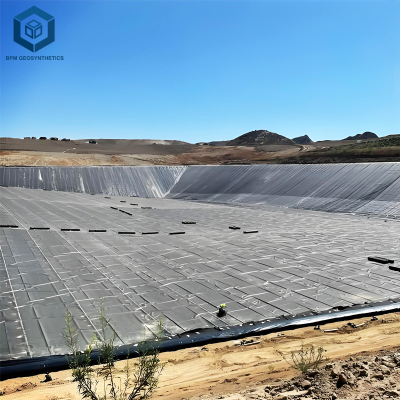
When evaluating composite geomembrane vs single HDPE liner for reservoir construction, engineers must consider hydraulic performance, puncture resistance, installation efficiency, long-term durability, and total lifecycle cost. Reservoir applications—including irrigation ponds, fire water storage, aquaculture basins, and potable water reservoirs—require impermeable systems that balance structural integrity with economic feasibility.
Both systems are widely used in water containment engineering. However, their structural configuration, mechanical behavior, and field installation methodology differ significantly, which directly impacts project risk and service life.
Product Definition
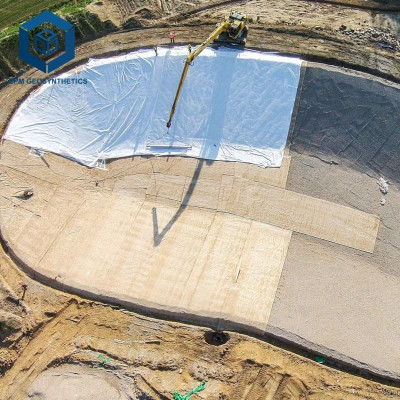
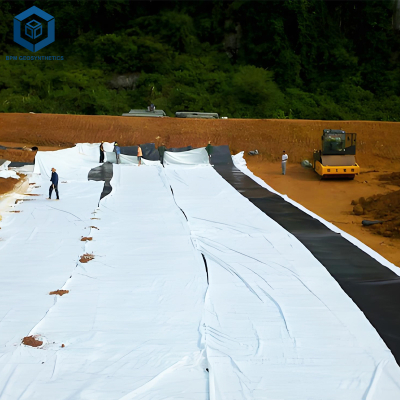
A composite geomembrane is a factory-bonded geosynthetic consisting of an HDPE geomembrane laminated with one or two layers of nonwoven geotextile. A single HDPE liner is a standalone high-density polyethylene impermeable sheet used independently for liquid containment in reservoir systems.
Technical Parameters & Specifications
In composite geomembrane vs single HDPE liner for reservoir evaluation, the following technical parameters are critical:
| Parameter | Composite Geomembrane | Single HDPE Liner | Test Standard |
|---|---|---|---|
| HDPE Thickness | 0.75–1.5 mm | 1.0–2.5 mm | GRI-GM13 |
| Geotextile Weight | 150–600 g/m² | N/A | ASTM D5261 |
| Tensile Strength | ≥ 10–25 kN/m | ≥ 15–35 kN/m | ASTM D6693 |
| Puncture Resistance | Enhanced (with geotextile) | Standard | ASTM D4833 |
| Permeability | ≤ 1×10⁻¹³ m/s | ≤ 1×10⁻¹³ m/s | ASTM D5887 |
| Service Life | 15–25 years | 20–30 years | Accelerated OIT |
Reservoir design depth, subgrade condition, and water chemistry influence whether composite geomembrane vs single HDPE liner for reservoir installation is more appropriate.
Structure & Material Composition
Composite Geomembrane Structure
HDPE core layer (impermeable barrier)
Upper nonwoven geotextile (protection layer)
Optional lower geotextile (dual-sided protection)
Thermal bonding interface
Single HDPE Liner Structure
97–98% virgin HDPE resin
2–3% carbon black (UV resistance)
Antioxidants and stabilizers
Smooth or textured surface
From a structural perspective, composite geomembrane vs single HDPE liner for reservoir systems differs primarily in integrated protection versus modular layer installation.
Manufacturing Process
Composite Geomembrane Production
HDPE sheet extrusion (flat die process)
Nonwoven geotextile needle punching
Thermal lamination bonding
Cooling and surface calibration
Quality inspection and rolling
Single HDPE Liner Production
Virgin resin blending
Flat die or blown film extrusion
Thickness auto-control monitoring
Cooling and trimming
Mechanical and OIT testing
Manufacturing control directly impacts seam welding performance and long-term durability in composite geomembrane vs single HDPE liner for reservoir applications.
Industry Comparison
| Criteria | Composite Geomembrane | Single HDPE Liner | EPDM Liner |
|---|---|---|---|
| Installation Speed | Faster (integrated protection) | Moderate | Fast |
| Subgrade Protection | High | Requires separate geotextile | Moderate |
| UV Resistance | Good | Excellent | Moderate |
| Cost Efficiency | Balanced | Cost-effective | Higher cost |
| Long-Term Durability | Moderate–High | High | Moderate |
Application Scenarios
Typical users evaluating composite geomembrane vs single HDPE liner for reservoir projects include:
EPC contractors for irrigation reservoirs
Agricultural water storage developers
Municipal water authorities
Aquaculture farm operators
Industrial fire water storage designers
Composite systems are preferred where subgrade is uneven or rocky. Single HDPE liners are often selected for large-scale reservoirs with engineered subgrade preparation.
Core Pain Points & Solutions
Puncture Risk from Subgrade
Solution: Use composite geomembrane or add 300–500 g/m² geotextile cushion.Seam Leakage
Solution: Dual-track hot wedge welding with air channel testing.Slope Stability Issues
Solution: Textured HDPE liner for slopes steeper than 3:1.UV Degradation in Exposed Reservoirs
Solution: Ensure carbon black content 2–3% and certified OIT values.Budget Constraints
Solution: Conduct lifecycle cost comparison rather than initial price comparison.
Risk Warnings & Avoidance Recommendations
Avoid reducing liner thickness below 1.0 mm in permanent reservoirs.
Do not skip subgrade compaction (≥95% Standard Proctor).
Ensure certified welding technicians on site.
Verify third-party laboratory test reports before procurement.
Implement leak detection testing after installation.
Procurement & Selection Guide
To determine the appropriate choice in composite geomembrane vs single HDPE liner for reservoir projects, follow these steps:
Assess subgrade roughness and soil conditions.
Determine reservoir depth and hydraulic load.
Evaluate UV exposure and climate conditions.
Calculate required puncture resistance.
Compare lifecycle cost over 20 years.
Review manufacturer production capacity and certifications.
Confirm installation contractor experience.
Engineering Case Example
Project: Agricultural Irrigation Reservoir Area: 48,000 m² Water Depth: 6 meters Subgrade: Compacted clay with minor gravel presence Selected System: 1.0 mm HDPE + 400 g/m² geotextile (field-installed composite equivalent) Installation Method: Hot wedge welding with vacuum box testing Outcome: Achieved hydraulic tightness with zero leakage after 72-hour water retention test.
During technical evaluation of composite geomembrane vs single HDPE liner for reservoir design, the engineering consultant determined that modular installation provided better cost control and long-term flexibility.
FAQ – Technical Clarifications
1. Which option is more puncture-resistant?
Composite geomembrane due to integrated geotextile protection.
2. Is HDPE suitable for potable water?
Yes, if certified for drinking water compliance.
3. What thickness is recommended for reservoirs over 5 m depth?
1.5 mm HDPE or higher.
4. Are composite liners harder to weld?
Edge trimming of geotextile is required before welding.
5. Can both systems be repaired easily?
Yes, using extrusion welding patches.
6. Which system lasts longer?
Single HDPE liner typically has longer UV durability.
7. Do reservoirs require textured surfaces?
Yes for steep slopes to improve friction.
8. Is geotextile mandatory under HDPE?
Yes if subgrade contains stones or irregularities.
9. What is typical roll width?
5–8 meters depending on manufacturer.
10. How to test liner integrity?
Air channel pressure testing and spark testing.
Request Technical Documentation or Quotation
For project-specific evaluation of composite geomembrane vs single HDPE liner for reservoir containment, provide reservoir dimensions, soil conditions, and design drawings. Technical datasheets, samples, and engineering consultation are available upon formal request.
Author & Technical Authority (E-E-A-T)
Prepared by a senior geosynthetics consultant with over 10 years of experience in reservoir lining, hydraulic containment engineering, and ASTM/GRI standard compliance review. All technical data reflects commonly accepted international engineering specifications for water containment infrastructure.