Best Containment Solutions For Acid Mining Wastewater Ponds | Guide
For mining engineers, environmental managers, and EPC contractors, selecting the best containment solutions for acid mining wastewater ponds is critical to prevent seepage of low-pH solutions (pH 2 to 4), high concentrations of dissolved metals (iron, copper, zinc, arsenic), and sulfate into groundwater. Acid mine drainage (AMD) and process water from heap leach pads require liner systems that resist aggressive chemistry (pH 1.5 to 5.0), maintain integrity under thermal cycling (-30°C to 50°C), and withstand mechanical loads from sludge removal equipment. This guide evaluates containment options: HDPE geomembranes (enhanced antioxidant package HP-OIT ≥500 minutes), composite liners (HDPE over geosynthetic clay liner), concrete-lined ponds (with acid-resistant coating), and bituminous liners. HDPE with ASTM D5322 acid immersion testing is the preferred solution for most AMD ponds due to chemical resistance, flexibility, and 20 to 30 year service life. Procurement managers will learn to specify liner systems with leak detection, chemical compatibility verification, and installation QA/QC. Source: ASTM D5322, ASTM D3895, GRI-GM13, EPA 40 CFR 264.221.
What is Best Containment Solutions for Acid Mining Wastewater Ponds
The phrase best containment solutions for acid mining wastewater ponds refers to engineered liner systems and construction methods that prevent seepage of acidic mine water (pH 2 to 5, containing dissolved metals and sulfate) into surrounding soil and groundwater. Acid mining wastewater arises from: (1) acid mine drainage (AMD) from exposed pyrite oxidation; (2) heap leach process solutions (sulfuric acid, pH 1.5 to 2.5); (3) tailings storage facility decant water; and (4) water treatment plant sludge ponds. Effective containment must resist chemical attack (low pH, high ionic strength), provide low hydraulic conductivity (≤1×10⁻¹⁰ m per second), and maintain integrity for 20 to 50 years. The leading solutions include: HDPE geomembranes (1.5 mm to 2.0 mm, virgin resin, HP-OIT ≥500 minutes) – the industry standard; composite liners (HDPE over GCL) for extra safety; acid-resistant concrete with epoxy coating – for small ponds or high-wear zones; and geosynthetic clay liners (GCL) alone – only for pH >4 (bentonite reacts with low pH). For engineering and procurement, selection factors include: pH of wastewater (more acidic requires HDPE), pond depth and size, regulatory requirements (double liner for hazardous waste), and service life expectation. Source: ASTM D5322, EPA 40 CFR 264.221, GRI-GM13.
Technical Specifications for Acid Mining Wastewater Containment
When evaluating best containment solutions for acid mining wastewater ponds, the following technical parameters are essential.
| Parameter | Typical Value (HDPE Liner) | Engineering Importance |
|---|---|---|
| pH resistance range | pH 1.5 to 14 (HDPE) | HDPE chemically inert across entire acid range. GCL fails below pH 4 (bentonite reacts). Concrete requires coating for pH less than 4. Source: ASTM D5322. |
| Hydrochloric acid resistance (test) | Less than 5 percent change in tensile properties after 120 days at 60°C in pH 1.5 solution (ASTM D5322) | Simulates long-term exposure to acid mining wastewater. Must pass for 20-year design life. Source: ASTM D5322. |
| HP-OIT (antioxidant longevity) | Greater than or equal to 500 minutes (ASTM D3895) – enhanced grade | Acid environment accelerates antioxidant depletion. Standard 400 minutes may deplete to 100 minutes in 10 years. Source: ASTM D3895. |
| Thickness (HDPE) | 1.5 mm to 2.0 mm (2.0 mm for deep ponds greater than 10 m) | Thicker liner provides higher puncture resistance from sludge removal equipment and thermal stress. |
| Puncture resistance (1.5 mm HDPE) | Greater than or equal to 480 N (ASTM D4833); 2.0 mm greater than or equal to 640 N | Resists puncture from rocks in subgrade, sludge drying, and maintenance equipment. Source: ASTM D4833. |
| Hydraulic conductivity (permeability) | 1×10⁻¹⁴ to 1×10⁻¹⁵ m per second (HDPE) | Virtually impermeable. Prevents seepage of contaminated water. |
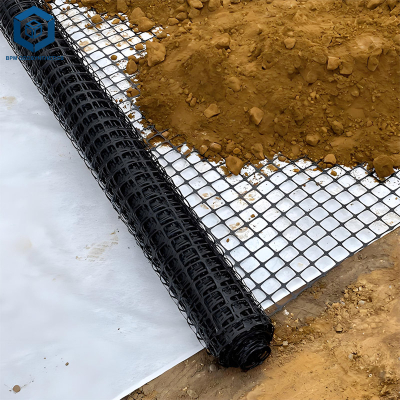
| Leak detection layer (double liner system) | Geonet (5 to 7 mm) or gravel (300 mm) between primary and secondary liners | Required for hazardous waste ponds (EPA Subtitle C). Detects leaks before secondary liner is contaminated. Source: EPA 40 CFR 264.221. |
| UV resistance (if exposed) | Carbon black 2.0 to 3.0 percent (ASTM D1603) | For ponds without floating cover, UV degrades unstabilized HDPE within 2 to 3 years. Source: ASTM D1603. |
Material Structure and Composition of Containment Systems
Understanding material composition is critical for selecting best containment solutions for acid mining wastewater ponds. The table below compares liner materials.
| Containment Solution | Material Composition | Acid Resistance (pH 2) | Service Life (years) | Cost (installed per m²) | Typical Application |
|---|---|---|---|---|---|
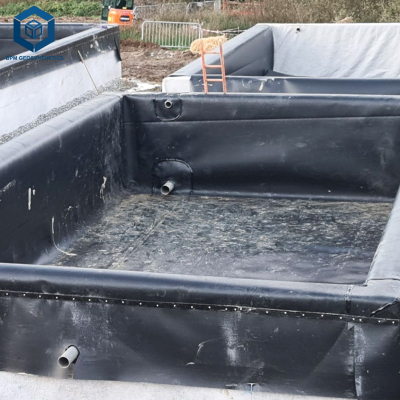
| HDPE geomembrane (1.5 mm, HP-OIT greater than or equal to 500) | Virgin HDPE (density greater than or equal to 0.945 g per cubic cm), carbon black 2.5 percent, enhanced antioxidants | Excellent (pH 1.5 to 14) – passes ASTM D5322 | 20 to 30 years | 12 to 20 USD | Primary liner for all acid mining ponds, heap leach pads, AMD ponds |
| Composite liner (HDPE over GCL) | 1.5 mm HDPE + 6 mm geosynthetic clay liner (bentonite) | HDPE: excellent; GCL: poor (bentonite dissolves in acid, loses sealing capability) | GCL fails in 1 to 5 years in pH less than 4; HDPE lasts 20+ years | 15 to 25 USD | Not recommended for acid ponds (GCL component fails). Use only HDPE. |
| Acid-resistant concrete with epoxy coating | Concrete (100 to 150 mm) + epoxy lining (2 to 3 mm) | Good (epoxy coating protects concrete) | 10 to 20 years (coating degrades, concrete cracks) | 40 to 80 USD | Small ponds, high-wear zones (sludge removal), short-term (less than 10 years) |
| Bituminous geomembrane (bituminous geocomposite) | Bitumen with reinforcement (polyester or fiberglass) | Fair (bitumen resists acid but becomes brittle with age) | 10 to 15 years | 10 to 18 USD | Historical applications, now largely replaced by HDPE |
Manufacturing Process of Acid-Resistant HDPE Geomembrane
The manufacturing process for HDPE liner used in best containment solutions for acid mining wastewater ponds must ensure enhanced chemical resistance.
Raw material selection (virgin HDPE with high density): HDPE resin with density greater than or equal to 0.945 g per cubic cm and MFI 0.1 to 0.3 g per 10 min is selected. Resin certificate confirms no recycled content (recycled resin contains metal catalyst residues that leach into acid). Source: ASTM D1505.
Additive blending for acid resistance: Carbon black (2.0 to 3.0 percent) and enhanced antioxidant package (HP-OIT target 500 to 600 minutes) are blended. Thioester antioxidants (secondary) added to resist acid-induced extraction. Source: ASTM D3895.
Extrusion (flat die): Melt temperature 200 to 220 degrees Celsius (lower than standard HDPE to prevent antioxidant degradation). Extruded through coat-hanger die onto polished chill roll. Thickness tolerance ±4 percent (tighter than standard ±5 percent). Source: ASTM D7466.
Quality testing for acid resistance: Samples tested per ASTM D5322: immersion in pH 1.5 sulfuric acid or synthetic acid mine drainage at 60 degrees Celsius for 120 days. Pass criteria: tensile retention greater than 95 percent, HP-OIT retention greater than 80 percent, no surface cracking or blistering.
Roll packaging: Rolls wrapped in UV-blocking polyethylene. Labeled with HP-OIT value, density, and acid immersion test date. Rolls stored in cool, dry warehouse away from acid fumes.
Performance Comparison of Containment Solutions
When evaluating best containment solutions for acid mining wastewater ponds, compare HDPE, composite (HDPE+GCL), concrete, and bituminous liners.
| Solution | Acid Resistance (pH 2) | Durability (years) | Puncture Resistance | Installation Complexity | Regulatory Acceptance (double liner) | Overall Rating for AMD Ponds |
|---|---|---|---|---|---|---|
| HDPE (1.5 mm, HP-OIT greater than or equal to 500) | Excellent (ASTM D5322 pass) | 20 to 30 years | High (greater than or equal to 480 N) | Medium (welding required) | Yes (primary liner) | Best – industry standard for all acid ponds |
| Composite (HDPE + GCL) | Excellent (HDPE) but GCL fails in acid | HDPE 20+ years; GCL 1 to 5 years (GCL fails, no benefit) | High (HDPE) | Medium (two layers) | Yes | Not recommended – GCL provides no benefit in acid; adds cost |
| Concrete + epoxy coating | Good (if coating intact) | 10 to 20 years (coating degrades) | Low (concrete cracks, coating punctures) | High (formwork, curing, coating) | Only if approved | Small ponds, high abrasion zones, short-term |
| Bituminous geomembrane | Fair (bitumen resists acid) | 10 to 15 years | Medium | Low (rolls out) | Rarely | Legacy applications, not recommended for new ponds |
Industrial Applications of Acid Mining Wastewater Containment
Best containment solutions for acid mining wastewater ponds are applied in various mining settings:
Acid mine drainage (AMD) collection ponds (pH 2 to 4, high metals): HDPE liner (1.5 mm) with HP-OIT greater than or equal to 500 minutes. Double liner system with leak detection required in many jurisdictions (EPA, EU, Chile). Geotextile cushion (400 to 800 gsm) under primary liner. Source: EPA 40 CFR 264.221.
Heap leach solution ponds (copper, gold, uranium): Sulfuric acid (pH 1.5 to 2.5), copper concentration up to 50 g per liter. Primary liner 1.5 to 2.0 mm HDPE. Secondary liner required if pond is within 500 m of groundwater well (many permits require double liner). Source: ASTM D5322.
Water treatment plant sludge ponds (neutralized AMD, but sludge may become acidic again): HDPE liner (1.5 mm). Sludge removal equipment requires puncture resistance (greater than or equal to 480 N). Concrete coating not suitable for mechanical scraping. Source: ASTM D4833.
Tailings storage facility decant ponds (process water with residual acid, pH 3 to 5): HDPE liner (1.5 mm) or composite (HDPE over compacted clay). Leak detection recommended but not always required for non-hazardous tailings.
Emergency overflow ponds (spill containment for acid tanks): HDPE liner (1.5 mm) with high chemical resistance. Small size allows use of thicker liner (2.0 mm) for durability.
Common Industry Problems and Engineering Solutions
Field data reveals four common problems with containment systems for best containment solutions for acid mining wastewater ponds.
Problem: HDPE liner becomes brittle and cracks after 5 to 8 years in AMD pond.
Root cause: HP-OIT below 400 minutes (standard HDPE used instead of acid-resistant grade). Acid environment depletes antioxidants faster than neutral water. Source: ASTM D3895.
Solution: Specify HP-OIT greater than or equal to 500 minutes per ASTM D3895. Conduct annual HP-OIT testing on retained samples. When HP-OIT drops below 200 minutes, plan to overlay with new liner.Problem: Geosynthetic clay liner (GCL) loses sealing capacity (bentonite erodes) in acid pond.
Root cause: GCL specified for AMD pond with pH less than 4. Bentonite (sodium montmorillonite) reacts with acid (H⁺ exchanges with Na⁺), losing swelling capacity and permeability increases from 1×10⁻¹¹ to 1×10⁻⁸ m per second. Source: ASTM D5322.
Solution: Never use GCL as primary or secondary liner in acid ponds (pH less than 4). Use HDPE only. If clay required (e.g., for attenuation), use compacted clay with high cation exchange capacity, but HDPE remains primary barrier.Problem: Leak detection system clogged with iron precipitates (ferric hydroxide, jarosite).
Root cause: AMD contains dissolved iron (Fe²⁺, Fe³⁺). When AMD leaks through primary liner, iron oxidizes and precipitates in leak detection layer (geonet), clogging flow paths.
Solution: Use geonet with larger aperture (10 mm) and high flow capacity. Install clean-out risers (vertical pipes) to flush geonet periodically with fresh water or dilute acid to dissolve precipitates. For severe fouling, replace geonet with gravel (300 mm, washed).Problem: Concrete pond cracks and leaks (acid dissolves calcium in concrete).
Root cause: Concrete not protected with acid-resistant coating. Sulfuric acid reacts with calcium hydroxide in concrete (Ca(OH)₂ + H₂SO₄ → CaSO₄ + 2H₂O), forming gypsum which expands and cracks concrete. Source: ASTM C267.
Solution: Do not use uncoated concrete for acid ponds (pH less than 5). If concrete is existing, apply epoxy coating (2 to 3 mm) or vinyl ester resin lining. For new construction, use HDPE liner instead of concrete (lower cost, better acid resistance).
Risk Factors and Prevention Strategies
Mitigating risks when selecting best containment solutions for acid mining wastewater ponds requires proactive engineering.
Inadequate chemical resistance (antioxidant depletion in acid): Prevention: Require ASTM D5322 immersion test (120 days at 60 degrees Celsius in synthetic AMD or pH 1.5 sulfuric acid). Pass criteria: tensile retention greater than 95 percent, HP-OIT retention greater than 80 percent. Specify HP-OIT greater than or equal to 500 minutes. Source: ASTM D5322, ASTM D3895.
Puncture from sludge removal equipment (heavy machinery): Prevention: Use thick HDPE (2.0 mm) in sludge removal zones. Install concrete wear pad or rubber mats over liner where excavator tracks operate. For manual scraping, use plastic blades (not metal). Source: ASTM D4833.
Leak detection failure due to clogging (iron precipitates, fines): Prevention: Use geocomposite with bi-planar geonet (7 mm thickness, high compressive strength) and geotextile filters on both sides. Install clean-out risers every 50 m. For severe clogging risk, use gravel (300 mm, washed) instead of geonet.
UV degradation of exposed HDPE liner: Prevention: For ponds without floating cover, specify carbon black 2.0 to 3.0 percent per ASTM D1603. Require UV test report (ASTM G154, 500 hours, retention greater than 80 percent). Install shade cloth or floating cover for extended exposure (greater than 3 months). Source: ASTM G154, ASTM D1603.
Procurement Guide: How to Specify Containment Solutions for Acid Ponds
For procurement managers and mining engineers, use this checklist for best containment solutions for acid mining wastewater ponds:
Determine wastewater chemistry (pH, metals, sulfate): Collect representative AMD sample. Measure pH, concentrations of Fe, Cu, Zn, As, sulfate. For pH less than 4, HDPE required (GCL not suitable). For pH 4 to 5, HDPE still preferred (safety margin).
Select primary and secondary liner system: For hazardous waste (high metals, low pH), require double liner with leak detection per EPA 40 CFR 264.221. Primary and secondary liners: HDPE (1.5 mm, HP-OIT greater than or equal to 500 minutes). Geotextile cushion (400 to 800 gsm) between ore or sludge and primary liner.
Specify acid-resistant HDPE: Density greater than or equal to 0.945 g per cubic cm (ASTM D1505). HP-OIT greater than or equal to 500 minutes (ASTM D3895). Carbon black 2.0 to 3.0 percent (ASTM D1603). Puncture resistance greater than or equal to 480 N for 1.5 mm, greater than or equal to 640 N for 2.0 mm (ASTM D4833).
Require chemical compatibility testing: Order ASTM D5322 immersion test using actual site AMD (or pH 1.5 H₂SO₄) at 60 degrees Celsius for 120 days. Pass criteria: tensile retention greater than 95 percent, HP-OIT retention greater than 80 percent. Source: ASTM D5322.
Specify leak detection layer (for double liner): Geonet (bi-planar, 5 to 7 mm) with geotextile filters (200 gsm). Flow capacity greater than or equal to 1 × 10⁻⁴ m² per second. Slope greater than or equal to 2 percent to sumps. Clean-out risers every 50 m. Source: EPA 40 CFR 264.221.
Installation quality assurance (CQA): Require third-party CQA during liner installation. Extrusion welding with 100 percent vacuum box testing per ASTM D4437. Destructive peel tests (ASTM D6392) every 500 m of seam: minimum peel strength greater than or equal to 80 percent of parent material. For textured geomembrane, require double-track welding.
Sample testing before bulk order: Order 10 square meter sample of HDPE liner. Perform ASTM D5322 acid immersion test (120 days at 60 degrees Celsius). Perform puncture test (ASTM D4833) and tensile (ASTM D6693). Acceptable: tensile retention greater than 95 percent, HP-OIT retention greater than 80 percent.
Warranty and documentation: Seek 20 year warranty for HDPE liner covering chemical resistance, stress cracking, and seam integrity. Request mill test reports (MTRs) for each roll including density, HP-OIT, tensile, puncture, and carbon black. Source: ASTM D3895, ASTM D4833.
Engineering Case Study
Project type: Acid mine drainage (AMD) collection pond (active underground mine).
Location: Appalachian coal region, USA (pH 3.2, Fe 500 mg per L, Mn 50 mg per L, sulfate 2,500 mg per L). Pond depth 5 m, area 2 hectares (20,000 m²).
Initial containment (problematic): Single liner: 1.5 mm HDPE (standard grade, HP-OIT 320 minutes) with no geotextile cushion. After 6 years: liner became brittle (HP-OIT retested 80 minutes), developed cracks (12 leaks detected). Seepage of AMD into groundwater (iron exceedance 10 times limit). Regulatory violation.
Corrected containment solution (best practices): Double liner system with leak detection. Primary and secondary liners: 1.5 mm HDPE (virgin, density 0.947 g per cubic cm, HP-OIT 540 minutes, carbon black 2.6 percent). Geotextile cushion (600 gsm) over primary liner. Leak detection: 7 mm bi-planar geonet with geotextile filters (200 gsm). Slope 2 percent to sumps. ASTM D5322 acid immersion test (pH 1.5 H₂SO₄, 120 days at 60°C) passed: tensile retention 96 percent, HP-OIT retention 87 percent.
Results and benefits: After 8 years, no leaks detected (sump flows zero). HP-OIT retested at 5 years: 470 minutes (87 percent retention). No seam failures (1,600 m of seams vacuum tested; zero failures). Geotextile cushion prevented puncture from sludge removal equipment. Regulatory compliance achieved. Total liner system cost: 480,000 USD. Estimated savings from avoided seepage (compared to single liner with leaks): 1.2 million USD over 8 years (avoided remediation, fines). Source: Project post-occupancy evaluation, ASTM D5322, ASTM D3895, ASTM D4833, ASTM D4437, EPA 40 CFR 264.221.
FAQ Section
Q: What is the best liner for acid mining wastewater ponds?
A: HDPE geomembrane (1.5 mm to 2.0 mm) with enhanced antioxidant package (HP-OIT greater than or equal to 500 minutes) and ASTM D5322 acid immersion test certification. Double liner with leak detection required for hazardous waste. Source: ASTM D5322, EPA 40 CFR 264.221.Q: Can I use a geosynthetic clay liner (GCL) for acid mine drainage ponds?
A: No. GCL contains bentonite clay that reacts with acid (pH less than 4), losing swelling capacity and sealing ability. Use HDPE only. GCL may be used only if pH is greater than or equal to 5. Source: ASTM D5322.Q: How does acid affect HDPE liner?
A: HDPE is chemically resistant to acid (pH 1.5 to 14). However, acid can extract antioxidants over time. Standard HP-OIT 400 minutes may deplete to 100 minutes in 5 to 10 years. Enhanced HP-OIT greater than or equal to 500 minutes required for 20-year design life. Source: ASTM D3895, ASTM D5322.Q: Is concrete suitable for acid mining wastewater ponds?
A: No, unless protected with acid-resistant coating (epoxy or vinyl ester). Uncoated concrete reacts with acid (forms gypsum, cracks, leaks). For new construction, HDPE liner is cheaper and more effective than concrete plus coating. Source: ASTM C267.Q: Do I need a double liner system for AMD ponds?
A: For hazardous waste (characteristic for toxicity, pH less than 2, or high metals), US EPA 40 CFR 264.221 requires double liner with leak detection. For non-hazardous AMD, single liner may be allowed, but many states require double liner as best practice.Q: How does iron precipitate affect leak detection systems?
A: AMD contains dissolved iron. When AMD leaks through primary liner, iron oxidizes and precipitates as ferric hydroxide (Fe(OH)₃) or jarosite, clogging geonet or gravel. Solution: Use clean-out risers to flush with fresh water or acid. Source: EPA 40 CFR 264.221.Q: What is the expected service life of an HDPE liner in an AMD pond?
A: With enhanced HP-OIT greater than or equal to 500 minutes and proper installation, 20 to 30 years. HP-OIT depletion model predicts 30+ years at 25 degrees Celsius burial temperature. Annual HP-OIT monitoring recommended. Source: ASTM D3895.Q: Can a bituminous geomembrane be used for acid mining ponds?
A: Historically yes, but bitumen can become brittle with age and is less resistant to low pH than HDPE. HDPE is now the industry standard. Bituminous liners may be used for short-term (5 to 10 years) or low-acid applications (pH greater than 4).Q: How to repair a damaged HDPE liner in an active AMD pond?
A: Drain pond below damage. Clean and dry liner surface. Cut out damaged section (round patch). Apply extrusion welded patch (same material). Test with vacuum box (ASTM D4437). Replace geotextile and resume operation. Source: ASTM D4437.Q: What thickness of HDPE liner is required for AMD ponds?
A: 1.5 mm minimum per GRI-GM13. For deep ponds (greater than 10 m depth) or ponds with heavy sludge removal equipment, use 2.0 mm for higher puncture resistance (greater than or equal to 640 N). Source: GRI-GM13, ASTM D4833.
Request Technical Support or Quotation
For mining engineers and EPC contractors, technical support is available to review your AMD chemistry, pond design, and regulatory requirements. Request a quotation for acid-resistant HDPE liners (HP-OIT greater than or equal to 500 minutes, ASTM D5322 tested), geotextile cushions, leak detection geocomposites, and installation QA/QC documentation.
About the Author
This guide was authored by geosynthetic and mining engineers with over 15 years of experience in designing and specifying containment systems for acid mine drainage, heap leach pads, and tailings facilities across North America, South America, Africa, and Australia. All recommendations follow ASTM D5322, ASTM D3895, ASTM D4833, ASTM D4437, GRI-GM13, and EPA 40 CFR 264.221 standards.