The 8 Best Geo Textile Material Review
Geo Textile Material is now an essential part of the work in modern civil engineering, environmental protection, and building projects. They perform key functions like soil stabilization, separation, filtration, drainage, and erosion control. The worldwide geotextile market was around USD 7.8 billion in 2024, and it is expected to grow to USD 12.4 billion by 2030. Selecting top-notch geotextiles can significantly cut construction expenses by 15%-30% and also increase project durability by 20%-50%. In this paper, 8 top geotextile materials of various types (woven, non-woven, composite, etc.) are reviewed in terms of their features, performance, application, advantages, and disadvantages to assist engineers, contractors, and project managers in their decision-making.
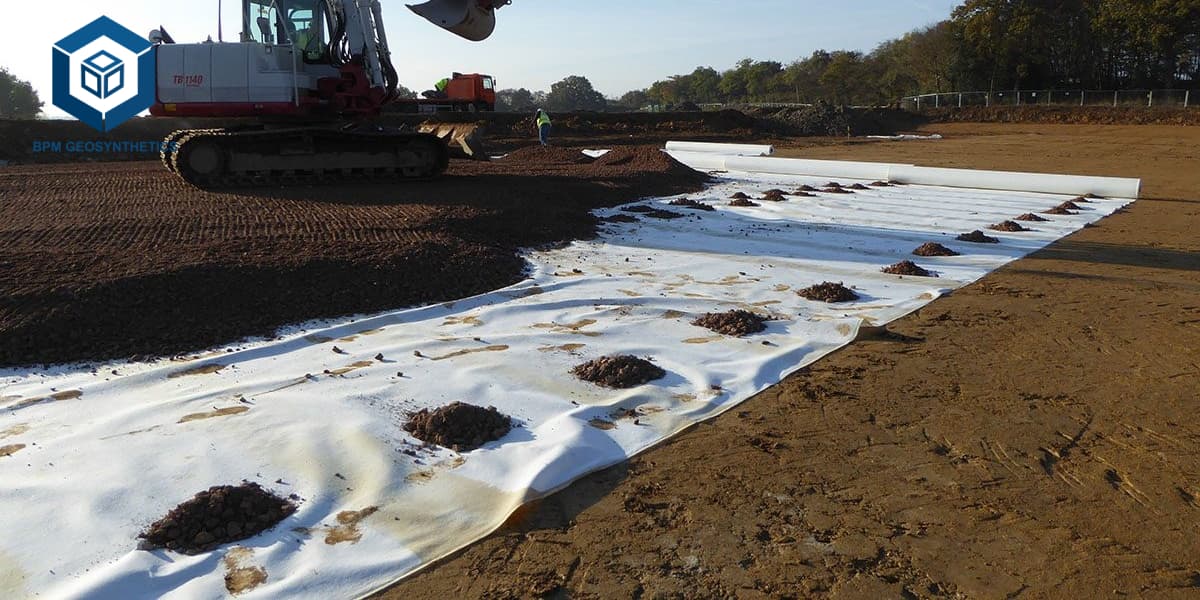
1. Geo Sincere Woven Slit Film Polypropylene Geo Textile Material (W-PP-80)
1.1 Main Details
- Composition: 100% polypropylene slit film;
- Weight: 200 g/m²;
- Strength at Break: 80 kN/m (ASTM D4595);
- Resistance to Puncture: 800 N (ASTM D4833);
- Permeability: 0.08 cm/s;
- Width: 5 m;
- Roll Length: 150 m.
1.2 Application Areas
This geotextile fabric is a good match for soil reinforcement and separation in major infrastructural projects like highways and railway subgrades, retaining walls, and slopes stabilization. It was recorded in a Pune, India, 2 km road stretch usage as a separator and reinforcement leading to no distress on the road for 18 months (compared to 6 months for a normal road). Non woven geotextile fabric is also a good option for erosion control in coastal and riverbank projects.
1.3 Key Features of the Product
Being very strong and resistant to damage through a sharp object, it can be used in very heavy-load operations and working on the soil shear strength, it can increase it by 50% in even very steep slopes of up to 1:1. Woven fabric stopping the intermixing of two totally different types of soil (for instance subgrade and aggregate) and hence, structural integrity is maintained at 95% (ASTM D5818). UV resistance has been added and it is highly resistant to even very tough environmental conditions, making it a perfect product when issues of durability arise for outdoor projects.
1.4 Advantages & Disadvantages
Advantages – Extraordinary tensile strength, decent puncture resistance, perfect for reinforcement, quite a long service life. Disadvantages – A bit less permeable than non-woven geotextiles, not so good in high-drainage situations.
2. TenCate Geosynthetics Non-Woven Polyester Geo Textile Material (NW-PET-600)
2.1 Main Details
- Material: 100% polyester (PET);
- Weight: 600 g/m²;
- Tensile Strength: 35 kN/m;
- Elongation at Break: 25%;
- Permeability: 0.2 cm/s;
- Temperature Resistance: -40°C to 120°C;
- Width: 4 m; Roll Length: 75 m.
2.2 Application Areas
It can be taken as a good option in projects where there are very high temperature levels and also very high levels of stress such as reinforcement of bitumen pavements, landfill liners, and industrial waste treatment areas. Its frequent use is as a protective layer for geomembranes protecting them from punctures and thereby increasing the lifespan of a geomembrane by 20 years. Additionally, it is a good product for steep slope erosion control, coastal protection, and USACE data showed that it is capable of reducing soil loss by 70%.
2.3 Key Features of the Product
Polyester offers excellent stability of the chemical properties as well as temperature resistance and therefore applicable in highly polluted, industrial settings. It can be expected to perform almost all soil and pavement reinforcing works due to its high tensile strength coupled with low elongation. Due to its non-woven design, it achieves an exceptional level of filtration and drainage and this feature makes it fit for compliance with ASTM D4751 standards as far as stormwater management is concerned. Besides, it can also be used along with geosynthetic clay liners (GCLs) meant for landfill containment purposes.
2.4 Advantages & Disadvantages
Advantages – Very high-temperature resistance, great chemical stability, strong reinforcement and filtration even, GCLs compatible.
Disadvantages – More expensive than polypropylene geotextiles, heavier and less flexible when installing.
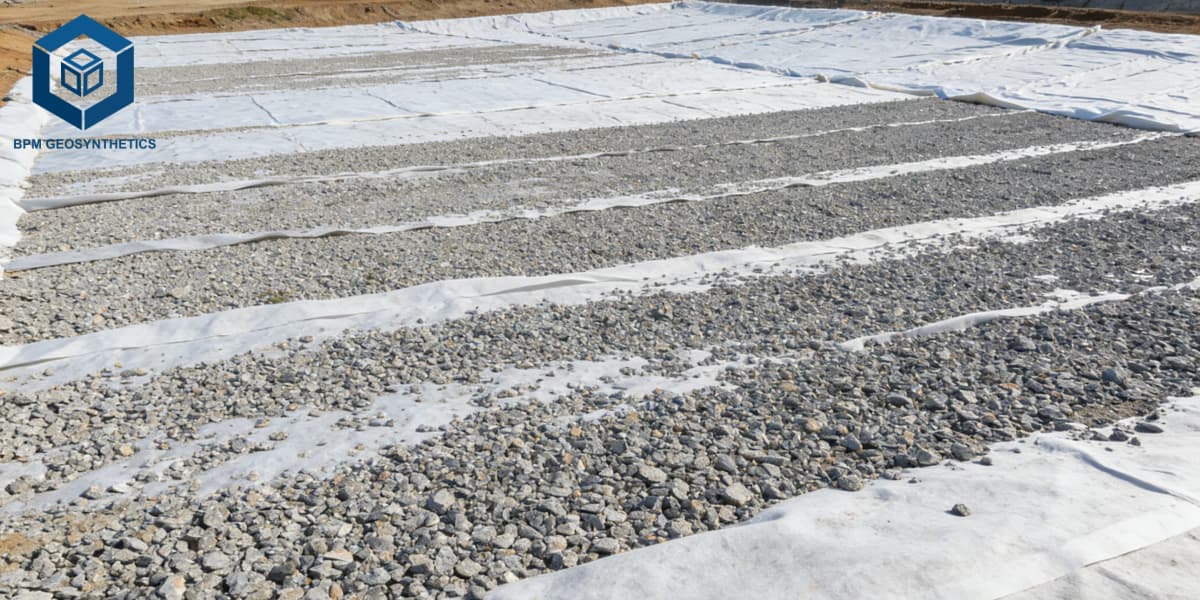
3. Solmax Geocomposite Drainage Geo Textile Material (GC-D-300)
3.1 Core Specifications:
- Material: PP non-woven geotextile + HDPE drainage core;
- Weight: 300 g/m²;
- Tensile Strength: 12 kN/m;
- Drainage Capacity: 200 L/m²·s;
- Thickness: 5.0 mm;
- Width: 3–5 m;
- Roll Length: 100 m.
3.2 Application Scenarios
Its main use extends to drainage and filtration in various civil engineering projects like road subgrades, embankments, and underground drainage network systems.
Among other things, Nonwoven geotextile fabric is an ideal solution for dewatering large areas, water reservoirs, and wastewater treatment plants, besides being a green substitute to mechanical dewatering methods. Moreover, they are very efficient in landfill leachate collection and slope drainage where hydrostatic pressure needs to be avoided.
3.3 Performance Highlights
The 3D HDPE core creates effective channels for water flow while the linked geotextile drainage fabric keeps soil particles from clogging the system. As a result, it remains at 95% of its hydraulic conductivity after 50 years. This is a dual-function geosynthetic that performs the filtration role of geotextile filter fabric and matches the drainage capacity of geonets reducing hydrostatic pressure by as much as 95%. Besides, it is light in weight and quite handy here, adjusting well to the complex topography and reducing time for construction.
3.4 Pros & Cons
Pros – Combination of filtration and drainage; very effective; environmentally friendly; installation is a breeze.
Cons – Not very strong in terms of tensile strength; unsuitable for heavy-load reinforcement; higher price compared to single-layer geotextiles.
4. Huesker Group Knitted Polypropylene Geo Textile Material (K-PP-250)
4.1 Core Specifications:
- Material: 100% PP yarn;
- Weight: 250 g/m²;
- Tensile Strength: 25 kN/m;
- Elongation at Break: 40%;
- Permeability: 0.12 cm/s;
- Flexibility: High;
- Width: 5 m;
- Roll Length: 120 m.
4.2 Application Scenarios
With its high flexibility and good adaptability, egbing it in achieving reinforcement and erosion control in irregular terrains, mountainous road subgrades, riverbank protection, and landscaping projects is possible. Besides it is played at temporary construction sites for soil stabilization and sediment control and in high flexibility requirements in niche applications.
4.3 Performance Highlights
In short, it has a lot of benefits with extra more flexibility and and elongation that allows it to in fact change the soil deformation without tearing. Geotextile fabric under gravel is both Ireland proof and UV-stabilized. Even after long exposures to outdoor elements, it can still function just as well.
4.4 Pros & Cons
Pros – Great flexibility, works well on uneven terrain, simple installation, affordable.
Cons – Lower puncture resistance than woven geotextiles, not suitable for high-pressure or sharp-object environments.
5. Fibertex Nonwovens Budget Non-Woven PP Geo Textile Material (NW-PP-150)
5.1 Core Specifications:
- Material: 100% PP;
- Weight: 150 g/m²;
- Tensile Strength: 8 kN/m;
- Permeability: 0.1 cm/s;
- Thickness: 1.8 mm;
- Width: 6 m;
- Roll Length: 200 m;
- Price Range: $0.15–$0.30/m².
5.2 Application Scenarios
This is an economical alternative for lightweight projects such as home landscaping, limited scale drainage systems, and temporary erosion control. Non woven geotextile drainage fabric can also be used as a separation layer convenient for gardens and small drainage systems. It will be suitable for projects that have low budgets and load requirements.
5.3 Performance Highlights
It can perform two main functions of basic filtration and separation, even though it was designed to be light weight. Geotextile road fabric restricts soil particles from moving and allows water to flow through. It is easy to cut and does not require specialized equipment for installation. Different from the UV-resistant one, it is biodegradable-resistant as well. Non woven geotextile landscape fabric has a service life of 15-20 years for light-duty applications. Its wide roll width and long length are benefits in minimizing installation time and material waste.
5.4 Pros & Cons
Pros – Very affordable, can be widely main light-duty project, installation is easy, roll size is large.
Cons – Low tensile strength, it is not appropriate for heavy-load or long-term infrastructure projects.
6. Dawnview Geosynthetics Biaxial Woven Geo Textile Material (W-BIAX-100)
6.1 Core Specifications
- Material: PP multifilament;
- Weight: 300 g/m²;
- Tensile Strength: 100 kN/m (biaxial);
- Puncture Resistance: 1200 N;
- Permeability: 0.05 cm/s;
- Width: 4 m;
- Roll Length: 100 m.
6.2 Application Scenarios
Perfectly engineered to meet the high demand for reinforcing heavy-duty in huge infrastructural projects, for example, very fast train subgrades, massive embankments, and the construction of retaining walls. Non woven geotextile filter fabric also finds application in land reclamation schemes and port building where high rates of tensile strength and load capacity are most desirable. Geotextile stabilization fabric is appropriate for projects with weak subgrades which call for drastic strength enhancement.
6.3 Performance Highlights
Biaxial tensile strength makes sure that the load is evenly distributed in both the lengthwise and widthwise directions, which results in increase of the soil bearing capacity from 3 to 10 times. The woven multifilament structure is characterized by excellent puncture resistance and durability, thus being able to withstand the rough soil conditions and heavy construction equipment. It is ASTM D4595- and GRI-GT 13-compliant, so it can be trusted to perform well in the most demanding projects. Being UV-stabilized and resistant to chemicals, it is estimated that its service life can extend to 50 years or even more.
6.4 Pros & Cons
Pros: - High biaxial tensile strength, - Excellent resistance to punctures, - Very suitable for heavy-duty reinforcement, - Long service life.
Cons: - Expensive, - Lower permeability, - Installation requires specialized equipment.
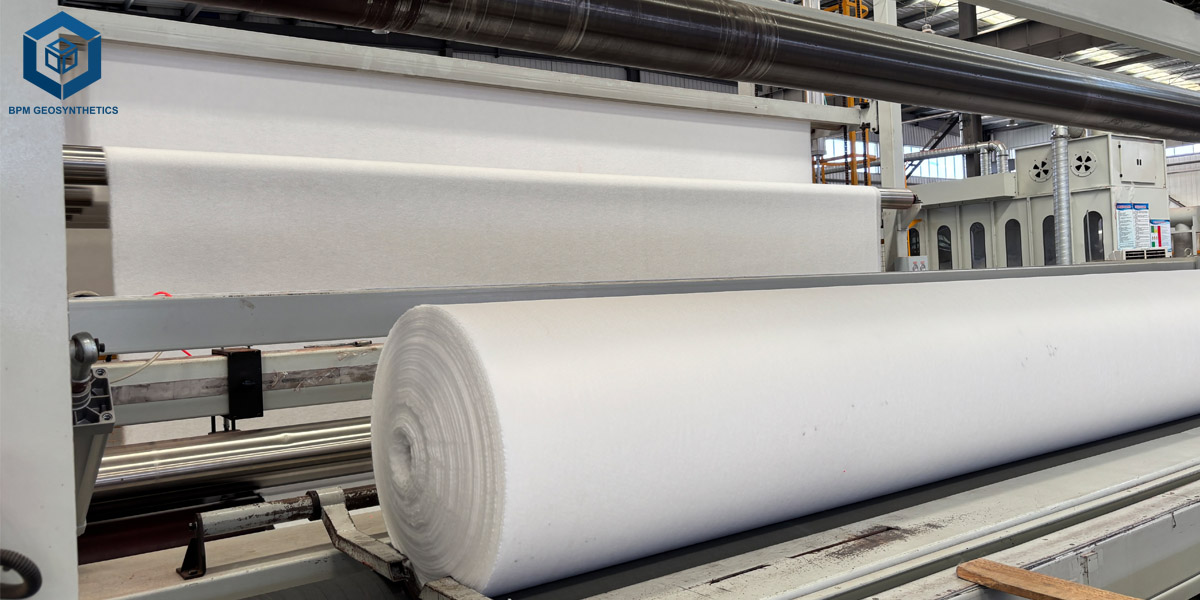
7. BPM Non-Woven Needle-Punched Polypropylene Geo Textile Material (NW-PP-400)
7.1 Core Specifications
- Material: 100% polypropylene (PP);
- Weight: 400 g/m²;
- Tensile Strength: 18 kN/m (ASTM D4595);
- Permeability: 0.15 cm/s (ASTM D4491);
- Thickness: 3.2 mm;
- UV Resistance: OIT > 100 min;
- Width: 4–6 m;
- Roll Length: 100 m.
7.2 Application Scenarios
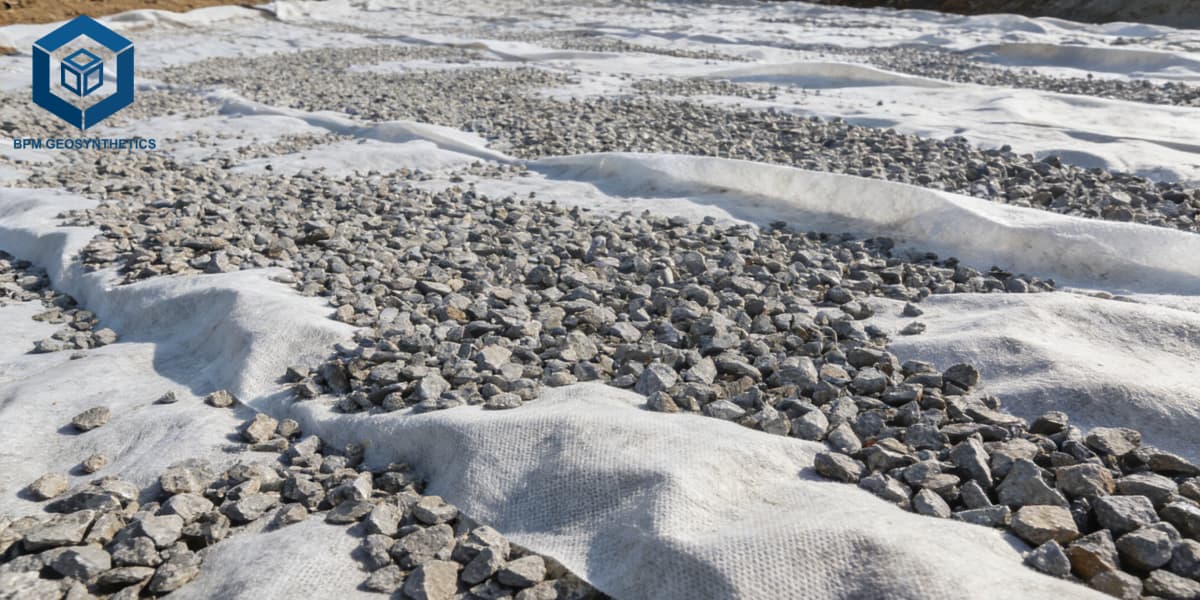
Primarily used as a filter and drain in road subgrades, embankments, and landfill leachate systems. Drainage geotextile is especially effective in soft soil stabilization where it halts soil particle migration and enhances water flow, thereby lowering hydrostatic pressure even by 50%. Furthermore, it can be used for separating soil and aggregate layers in highway construction to preserve structural integrity.
7.3 Performance Highlights
The high permeability and filtration efficiency are guaranteed by the needle-punched production process. Retain 95% of fine soil particles whereas water can pass freely resulting in 90% decrease of clogging. Chemical corrosion, biological degradation, and UV radiation are what it resists best among others and even with proper conditions, the life of the product is more than 50 years. Being lightweight yet tough, best non woven geotextile fabric is very simple to install and it follows the contours of the ground easily.
7.4 Pros & Cons
Pros: - Excellent filtration performance, - Economic, - Able to be used in many different situations, - Easy to install.
Cons: - Not as strong as woven fabrics when it comes to tensile, - Cannot be used in reinforcement of heavy-load cases.
8. Jute Biodegradable Geo Textile Material (Bio-J-200)
8.1 Core Specifications
- Material: 100% natural jute;
- Weight: 200 g/m²;
- Tensile Strength: 6 kN/m;
- Biodegradation Time: 6–12 months;
- Permeability: 0.18 cm/s;
- Width: 3 m;
- Roll Length: 50 m.
8.2 Application Scenarios
An environmentally safe alternative for temporary erosion control and vegetation establishment such as slope stabilization, riverbank protection, and reforestation projects. As it is biodegradable, it causes no long-term pollution in sensitive areas where the use of synthetic materials is not allowed such as wetlands and natural reserves. Besides, geotextile nonwoven fabric is also utilized in agricultural projects for soil conservation and seed protection.
8.2 Performance Highlights
Being a natural product, jute is biodegradable and there-fore do not require removal after project completion. At the same time, it offers temporary erosion control, halving the soil loss on the slopes, and allowing the vegetation to establish itself and gradually replace the permeable geotextile fabric. It is highly permeable to water, thus preventing waterlogging and encouraging plant growth. It is renewable and environmentally friendly and also meets the requirements of green construction standards.
8.3 Pros & Cons
Pros: - Environmentally friendly, - Can be broken down, - Great for sensitive areas, - Helps vegetation growth.
Cons: - Has very little strength in tension, - Service life is very short (temporary use only), - Not resistant to moisture and mold in humid environments.
9. Geo Textile Material Buying Guide & Final Recommendations
When it comes to picking a geotextile material, you need to take into account the following aspects: the nature of the project (reinforcement, filtration, drainage, erosion control), the condition of the soil (soft soil, rocky terrain, high moisture), the needs in terms of load, the environmental factors (UV exposure, chemical corrosion), and the budget. On the other hand, here are some example recommendations for each specific project type:
9.1 Best Overall
BPM Non-Woven Needle-Punched PP Geotextile (NW-PP-400) - A good balance of filtration, drainage and cost effectiveness makes it suitable for nearly all civil engineering projects.
9.2 Best for Heavy-Duty Reinforcement
Dawnview Geosynthetics Biaxial Woven Geotextile (W-BIAX-100) - Has outstanding biaxial tensile strength for big infrastructure projects.
9.3 Best for High-Temperature/Industrial Projects
TenCate Geosynthetics Non-Woven PET Geotextile (NW-PET-600) – Superior temperature and chemical resistance.
9.4 Best for Drainage
Solmax Geocomposite Drainage Geotextile (GC-D-300) – Integrated filtration and drainage for efficient water management.
9.5 Best Budget Option
Fibertex Nonwovens Budget Non-Woven PP Geotextile (NW-PP-150) – Cost-effective for light-duty projects.
9.6 Best Eco-Friendly Option
Jute Biodegradable Geotextile (Bio-J-200) – Temporary erosion control for environmentally sensitive areas.
Conclusion
The right The Best Project Material Co., Ltd.(BPM Geosynthetics)Geo Textile Material can significantly improve project durability, reduce maintenance costs, and ensure long-term performance. By aligning the material’s specifications with the project’s unique needs, engineers and contractors can achieve optimal results while adhering to industry standards (ASTM, GRI) and sustainability goals.