How to Choose Right Composite Geomembrane?
In the world of geotechnical and environmental engineering, the vital to incorporate liquids, gases, and solids is paramount. From safeguarding groundwater in opposition to landfill leachate to making sure the structural integrity of a water reservoir, the desire of lining device is a fundamental selection that incorporates large long-term economic and environmental consequences. While easy geomembranes are high quality for many applications, complicated initiatives demand a higher-performance solution: the composite geomembrane.
A composite geomembrane, or Geosynthetic Clay Liner (GCL) when paired with bentonite, is an engineered cloth that combines a geomembrane (typically HDPE, LLDPE, or PVC) with a geotextile or clay layer. This synergy creates a device the place the geomembrane presents a primary, low-permeability barrier, while the geotextile element affords protection, drainage, and friction. Selecting the proper one is no longer a rely of choosing a product from a catalog; it is a rigorous system of aligning fabric residences with project-specific demands. This information outlines the systematic method to making that indispensable choice.
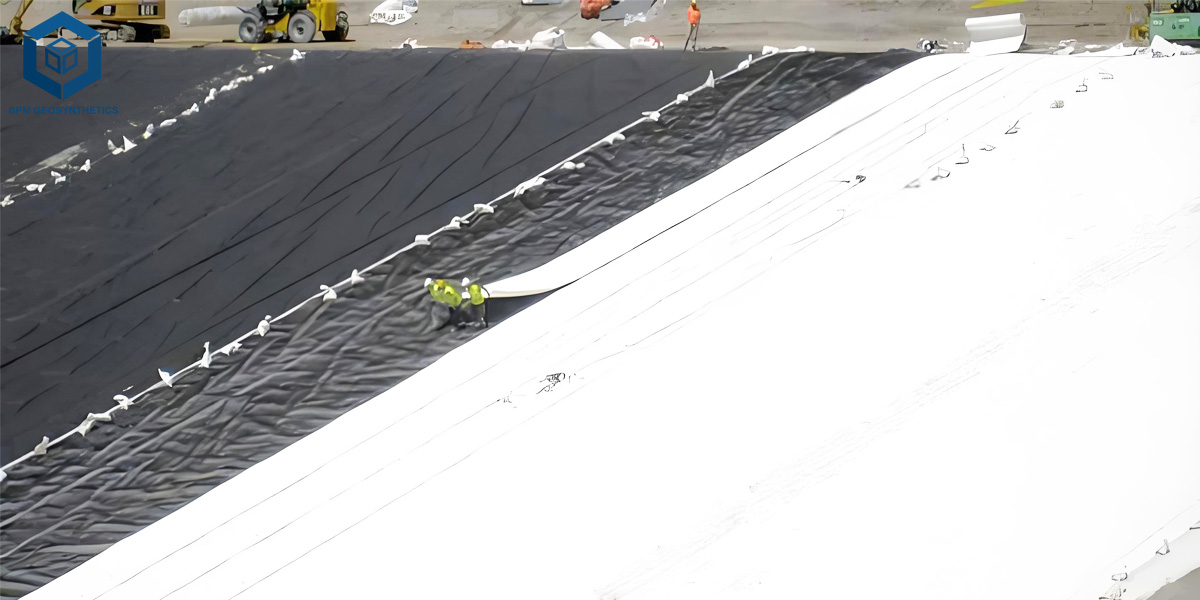
1. What is Composite Geomembrane?
Composite geomembrane liner is made of geotextile (base fabric can be fliament of short fiber needle punched geotextile , woven geotextile ) and high polymer by calendering and hot-melt technology , It remiains the mechanical properties of base fabric and uniformity of film which imporve the impermity of film which imporve the impermeablility , Embossed processing on the geomembrane liner stengthen its friction coeffcient , stablity adn easy for installation .
2. How to Choose Right Composite Geomembrane?
2.1 Define the Composite Geomembrane Project's Primary Function and Performance Criteria
The first and most essential step is to set up a clear technical brief. Every subsequent desire flows from this foundation.
• Containment Function: Is the device containing potable water (as in our case), wastewater, leachate, hazardous liquids, or stable waste? The chemical composition of the contained substance is the most important driver for fabric resistance.
• Regulatory Requirements: What are the obligatory permeability rates, composite geo membrane liner thicknesses, and fabric requirements set through neighborhood environmental agencies? For a potable water reservoir, policies are regularly extremely stringent, requiring very low permeability (≤ 1 x 10⁻¹² m/s).
• Design Life: Is this a transient building dewatering pond or a everlasting reservoir? The chosen polymer need to have most fulfilling antioxidant applications and stress crack resistance for long-term applications.
• Hydraulic Conditions: What is the most hydraulic head the HDPE composite geomembrane will be subjected to? A deeper reservoir exerts extra pressure, influencing the required thickness and power of the geomembrane.
For Clearwater Reservoir: The characteristic is to incorporate potable water. The key overall performance standards are a most allowable permeability, a 50-year diagram life, and steadiness below a 15-meter hydraulic head.
2.2 Select the Appropriate Geomembrane Polymer
The geomembrane layer is the barrier. The preference of polymer relies upon on chemical resistance, durability, and mechanical properties.
• HDPE Geomembrane (High-Density Polyethylene): The enterprise fashionable for essential containment. It affords tremendous chemical resistance, very low permeability, excessive tensile strength, and top-quality UV and environmental stress crack resistance (ESCR). It is stiff, making it perfect for flat bases however difficult on steep slopes due to decrease friction angles. Ideal for landfills, reservoirs, and mining.
• LLDPE Geomembrane (Linear Low-Density Polyethylene): More bendy than HDPE, with higher ESCR and elongation. It conforms to subgrade irregularities greater without problems and performs nicely on slopes. Its chemical resistance is very good, even though typically barely much less wide than HDPE.
• FPP Geomembrane (flexible Polypropylene): Highly bendy and awesome for uncovered purposes due to its brilliant UV and thermal expansion/contraction resistance. Often used in uncovered floating covers.
• PVC Geomembrane (Polyvinyl Chloride): Highly bendy and seamable, however with lower chemical resistance and workable for plasticizer migration over time, which can embrittle the material. Less frequent in vital everlasting applications.
For Clearwater Reservoir: Given the want for absolute impermeability, chemical inertness (to make certain water quality), and lengthy diagram life, HDPE is the unequivocal preference for the geomembrane component.
2.3 Choose the Geotextile Component and Configuration
The geotextile side provides mechanical functions. The configuration defines the composite's behavior.
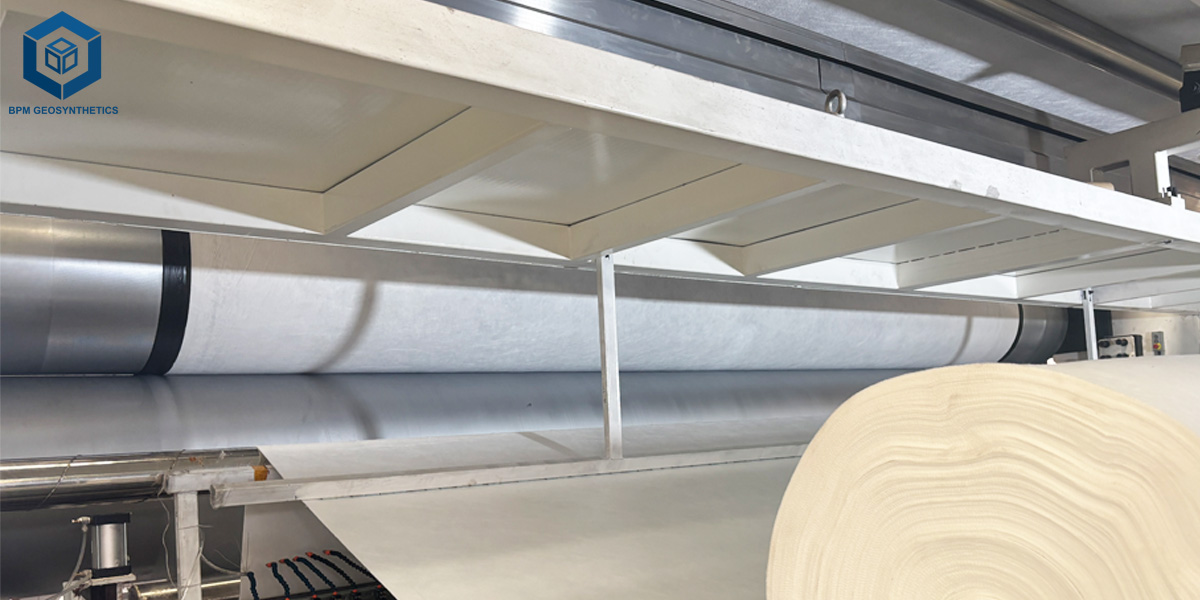
• Non Woven Geotextile: The most common choice. It provides protection: cushions the geomembrane from puncture by sharp subgrade particles. Drainage: Allows lateral transmission of gases or liquids that might otherwise build up pressure beneath the liner (subsurface gas/water management).Friction: Offers a higher interface shear strength compared to a smooth geomembrane, crucial for slope stability.
• Woven Geotextile: Offers higher tensile strength but less surface friction and filtration capability. Used less frequently in composites.
Composites can be single-sided (geomembrane laminated to one geotextile) or double-sided (sandwiched between two geotextiles). A single-sided composite is often used with the geotextile placed against the subgrade for protection and the smooth geomembrane face against the contained material for easy cleaning. A double-sided composite offers protection on both sides and higher friction angles.
For Clearwater Reservoir: The subgrade is a well-compacted clay. The primary concerns are slope stability and protecting the HDPE from any residual sharp particles. A single-sided composite is selected, with a thick, nonwoven geotextile (e.g., 400 g/m²) facing the subgrade. This provides excellent puncture protection and a high-friction interface with the compacted clay to prevent sliding on the slopes. The smooth HDPE face will be oriented towards the water for minimal friction and ease of maintenance.
2.4 Determine the Required Composite Geomembrane Specifications and Properties
With the cloth kind chosen, precise engineering residences have to be quantified.
• Geomembrane Thickness: For HDPE liner in a reservoir, a thickness of 1.5 mm (60 mil) is standard. For greater hydraulic heads or aggressive subgrades, two mm (80 mil) may also be specified.
• Puncture Resistance: The composite's final puncture resistance have to exceed the stresses anticipated from the subgrade. The CBR puncture take a look at is key.
• Interface Shear Strength: This is necessary for slope design. The friction attitude between the composite's geotextile and the subsoil (and between the composite and any overlying materials) need to be examined by using direct shear checking out to make certain world stability.
• Permeability: While the impermeable geomembrane itself is successfully impermeable, the composite system's permeability is ruled by way of the geomembrane and the fine of its seams. The permeability of the geotextile fabric is many orders of magnitude greater and is now not a limiting factor.
• Seamability: The chosen HDPE composite should be seamed the usage of dual-track fusion welding, growing an air channel for non-destructive checking out to make sure seam continuity and integrity.
For Clearwater Reservoir: The ultimate specification is a 1.5mm HDPE / 400 g/m² non-woven polypropylene geotextile composite. The specification sheet mandates minimal values for tensile strength, peel adhesion (the bond between the geomembrane and geotextile), CBR puncture, and a required interface friction perspective with the clay subgrade, established thru site-specific testing.
2.5 Partner with a Reputable Composite Geomembrane Manufacturer and Installer
The fine product is solely as properly as its installation. The producer need to have a verified first-class assurance/quality manage (QA/QC) application for the duration of production. Crucially, the installer have to be licensed by using the geomembrane sheet producer for the unique product. They should use certified welders and rigorous QA/QC procedures, such as unfavourable and non-destructive seam testing.
3. Summary
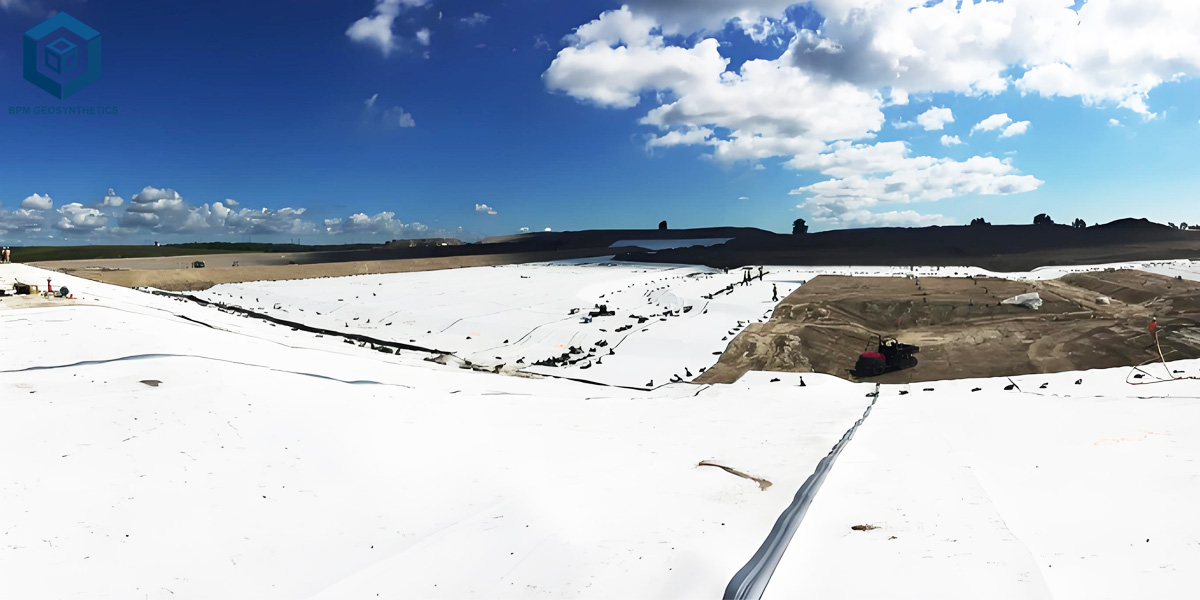
Choosing the right composite liner is a multi-disciplinary process that synthesizes geotechnical engineering, hydraulic science, chemistry, and construction management. There is no universal "best" product, only the "most fit-for-purpose" solution. By rigorously following these steps—defining the function, selecting the polymer, configuring the composite, specifying key properties, and vetting the supply and installation chain—engineers can ensure that their containment solution is not just a line item on a bill of quantities, but a guaranteed guardian of environmental and structural integrity for decades to come. The success of the Clearwater Reservoir, and projects like it, hinges on this meticulous, informed selection process.
As for composite geomembrane manufacturer of BPM Geosynthetics already developing more than 20years , The Best Project Material Co., Ltd.(BPM Geosynthetics)always been committed to the productions , research and development , sales and service of geotechnical materials . with high quality products and professional sales and after sales teams .BPM Geosynthetics has passed the ISO9001 quality management system , ISO14001 environmental management system , ISO45001 occupational health system certification , and passed Soncap , SAAO and BV certification and SGS and intertek tests , BPM BPM Geosynthetics have reached the world leading level . can widely used in aquaculture soil erosion resistance .drainage systems , mining etc .
BPM Geosynthetics are willing to become your partners with high cost performance , innovative geomembrane and geosythetic products , excellent quality and perfect after sale service ,
join BPM , win our future .