Mining Liner Design Challenges In Rocky Subgrade Conditions | Guide
For mining engineers, geotechnical specialists, and EPC contractors, addressing mining liner design challenges in rocky subgrade conditions is critical to prevent geomembrane puncture, ensure long-term containment, and avoid costly environmental remediation. Rocky subgrades (common in open-pit mines, waste rock dumps, and mountainous terrain) present sharp angular particles (5 mm to 300 mm diameter) that can penetrate or abrade HDPE, LLDPE, or RPE liners under hydraulic head (up to 30 m) and dynamic loads (equipment traffic, seismic events). Key challenges include: puncture protection (geotextile cushion design, thickness selection), subgrade preparation (removal of rocks >20 mm, compaction, and smoothing), and anchor trench stability in fractured rock. This guide covers engineering solutions: heavy nonwoven geotextiles (800 to 2000 gsm), sand or gravel cushions (100 to 300 mm), increased geomembrane thickness (1.5 mm to 2.5 mm), and use of composite liners (geotextile + geomembrane + geotextile). Procurement managers will learn to specify puncture protection systems that extend liner service life from 5 to 25+ years. Source: ASTM D4833, ASTM D7466, GRI-GM13.
What is Mining Liner Design Challenges in Rocky Subgrade Conditions
Mining liner design challenges in rocky subgrade conditions refer to the engineering difficulties encountered when installing geomembrane liners (HDPE, LLDPE, RPE) on subgrades containing sharp, angular rock fragments (typically from blasted or excavated rock in mining operations). Unlike clay or sandy subgrades, rocky subgrades create point loads (localized high pressure) that can puncture the liner under hydrostatic head or mechanical loads. Key challenges include: (1) puncture risk – angular rock edges (cobble to boulder size) penetrate geotextile cushion and geomembrane; (2) uneven surface – differential settlement causes stress concentrations; (3) anchor trench excavation – blasting or rock sawing required; (4) protection layer design – sand or gravel cushion may be washed away on slopes; (5) economic trade-offs – full subgrade removal (excavating and replacing with compacted fill) vs geotextile cushion + thicker liner. For engineering and procurement, successful design requires: geotextile with puncture resistance ≥3000 N (ASTM D4833), geomembrane thickness ≥1.5 mm, and sand or gravel cushion (150 to 300 mm) on steep slopes. Service life reduction from 50 years (ideal subgrade) to 10 to 20 years on rocky subgrade if improperly designed. Source: ASTM D4833, ASTM D7466, GRI-GM13.
Technical Specifications for Rocky Subgrade Liner Systems
When addressing mining liner design challenges in rocky subgrade conditions, the following technical parameters are critical.
| Parameter | Typical Value (Rocky Subgrade) | Engineering Importance |
|---|---|---|
| Rock particle size range | 5 mm to 300 mm (cobbles and boulders common) | Particles >20 mm diameter pose puncture risk. Particles >50 mm require removal or heavy protection. Source: ASTM D4833. |
| Geotextile cushion mass (upper protection) | 800 to 2000 gsm (nonwoven needle-punched polypropylene) | Higher mass provides puncture protection. 800 gsm suitable for angular particles up to 30 mm; 1200 gsm for 30 to 100 mm; 2000 gsm for cobbles >100 mm. Source: ASTM D5261. |
| Geotextile puncture resistance (ASTM D4833, CBR) | 800 gsm: ≥1500 N; 1200 gsm: ≥2500 N; 2000 gsm: ≥4000 N | Geotextile must resist puncture from rocks before load transfers to geomembrane. Source: ASTM D4833. |
| Geomembrane thickness (primary liner) | 1.5 mm to 2.5 mm HDPE (2.0 mm typical for rocky subgrade) | Thicker liner (≥2.0 mm) has puncture resistance ≥640 N (vs 480 N for 1.5 mm). Provides redundancy after geotextile failure. Source: GRI-GM13. |
| Sand / gravel cushion thickness (above geomembrane) | 150 to 300 mm (washed, rounded particles 5 to 20 mm) | Sand cushion distributes point loads from overlying tailings or equipment. Protects geomembrane from abrasion. |
| Subgrade preparation (rock removal) | Remove all particles >20 mm to 50 mm (depending on protection design) | Full removal reduces geotextile requirement but increases excavation cost. Source: ASTM F710. |
| Anchor trench excavation in rock | Blasting or rock saw (depth 0.5 m to 1.0 m, width 0.5 m) | Anchor trench required to secure liner perimeter. In rock, use concrete backfill or rock bolts instead of compacted soil. |
| Expected service life (rocky subgrade with protection) | 15 to 30 years (vs 50+ years on ideal subgrade) | Accelerated puncture risk reduces design life. Regular inspection (every 2 to 5 years) required. Source: ASTM D4833. |
Material Structure and Composition for Rocky Subgrade Protection
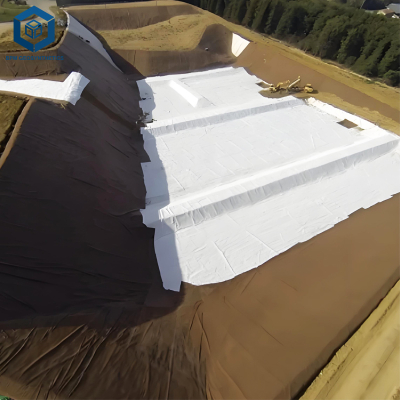
A multi-layer system for mining liner design challenges in rocky subgrade conditions includes protection layers above and below the geomembrane.
| Layer | Material | Thickness / Mass | Function in Rocky Subgrade | |
|---|---|---|---|---|
| Upper protection (above primary liner) | Nonwoven polypropylene geotextile (heavy) | 800 to 2000 gsm (2 to 5 mm thick) | Distributes point loads from overlying tailings or equipment. Must resist abrasion from angular particles. Source: ASTM D4833. | |
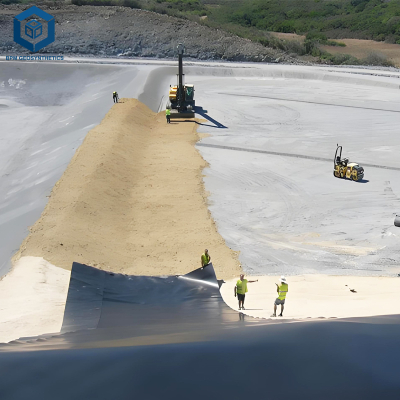
| Upper cushion (sand/gravel) | Washed sand or rounded gravel (5 to 20 mm) | 150 to 300 mm | Provides uniform load distribution; prevents direct contact between rock and geomembrane. Also acts as drainage layer. | |
| Primary geomembrane | HDPE (smooth or textured) | 1.5 mm to 2.5 mm | Primary barrier. Thicker for rocky subgrade (2.0 mm recommended). Source: GRI-GM13. | |
| Lower protection (below geomembrane) | Nonwoven polypropylene geotextile (heavy) | 800 to 1200 gsm | Protects geomembrane from subgrade rocks (particles that remain after removal). Also separates geomembrane from subgrade soil. | |
| Subgrade smoothing (compacted) | Compacted crushed rock or select fill | 150 to 300 mm (over native rock) | Provides stable, less angular surface. Remove particles >50 mm before compaction. Source: ASTM F710. |
Manufacturing Process of Protection Geotextiles for Rocky Subgrade
The manufacturing process for heavy protection geotextiles used in mining liner design challenges in rocky subgrade conditions ensures high puncture resistance.
Polymer selection (polypropylene or polyester): Polypropylene (PP) is preferred for mining applications (resists pH 2 to 13, no hydrolysis). Polyester (PET) degrades in alkaline or acidic conditions (avoid). Source: ASTM D5322.
Fiber extrusion (continuous filament): PP chips are melted (230 to 260 degrees Celsius) and extruded through spinnerets to form continuous filaments. Continuous filament geotextiles have higher puncture resistance than staple fiber for same mass.
Web formation and needle-punching (high density): Fibers are laid into a random web and needle-punched at high density (200 to 500 punches per cm²) to achieve mass 800 to 2000 gsm. Higher needle density increases puncture resistance (ASTM D4833).
Heat-setting (calendering): Light calendering (low pressure) to stabilize dimensions without reducing thickness. Heavy calendering reduces puncture resistance – avoid for protection layers. Source: ASTM D4833.
Quality testing for puncture resistance: Each roll tested per ASTM D4833 (CBR puncture test, 50 mm diameter plunger). For 1200 gsm geotextile, minimum 2500 N puncture resistance. Also test trapezoidal tear (ASTM D4533, minimum 800 N).
Performance Comparison of Protective Layers for Rocky Subgrade
When addressing mining liner design challenges in rocky subgrade conditions, compare different protection strategies.
| Protection Strategy | Puncture Resistance (ASTM D4833 equivalent) | Relative Cost (per m²) | Installation Complexity | Suitable for Rock Size (mm) | Service Life (years, rocky subgrade) |
|---|---|---|---|---|---|
| Remove all rocks >20 mm + 1.5 mm HDPE + 400 gsm geotextile | Moderate (geotextile 800 N, geomembrane 480 N) | Baseline (1.0x) | Medium (rock removal labor) | 5 to 20 mm | 15 to 20 years |
| Remove rocks >50 mm + 1.5 mm HDPE + 800 gsm geotextile + sand 150 mm | High (geotextile 1500 N, geomembrane 480 N) | 1.3x baseline | Medium to high | 20 to 50 mm | 20 to 25 years |
| Remove no rocks + 2.0 mm HDPE + 1200 gsm geotextile + sand 300 mm | Very high (geotextile 2500 N, geomembrane 640 N) | 1.6x baseline | High (sand placement on slopes) | 50 to 150 mm | 25 to 30 years |
| Remove no rocks + 2.5 mm HDPE + 2000 gsm geotextile + sand 300 mm + upper geotextile | Extreme (geotextile 4000 N, geomembrane 800 N) | 2.2x baseline | Very high (multiple layers) | 100 to 300 mm (cobbles) | 30 to 40 years |
Industrial Applications of Rocky Subgrade Liner Design
Mining liner design challenges in rocky subgrade conditions are encountered in various mining facilities:
Heap leach pads (copper, gold) built on blasted rock: Subgrade consists of angular crushed rock (20 to 100 mm). Design solution: 1200 gsm geotextile + 2.0 mm HDPE + 300 mm sand cushion (under leach ore). Anchor trenches excavated with rock saws. Source: ASTM D4833.
Tailings storage facilities (TSF) in mountainous terrain: Natural rocky subgrade with boulders (100 to 500 mm). Design: Remove boulders >300 mm, compact crushed rock fill, then 2000 gsm geotextile + 2.5 mm HDPE + 150 mm sand cushion. Trench anchor backfilled with concrete. Source: GRI-GM13.
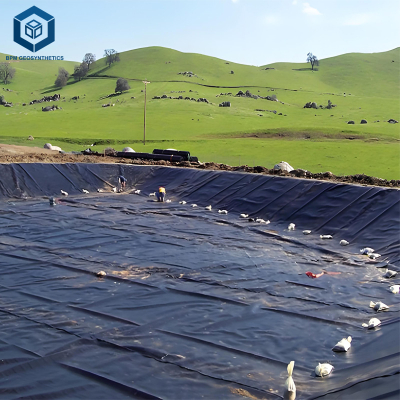
Evaporation ponds for brine (lithium, potash) on rocky playa: Subgrade has sharp salt-encrusted rocks (5 to 50 mm). Design: 800 gsm geotextile + 1.5 mm HDPE (smooth) + 150 mm sand cushion. Salt-resistant geotextile (polypropylene).
Process water ponds near waste rock dumps: Subgrade may have buried rocks from dump erosion. Design: Remove rocks >50 mm, place 400 gsm geotextile + 1.5 mm HDPE + 300 mm compacted clay cover (to prevent UV degradation).
Emergency spill containment basins in quarries: Rough blasted rock subgrade. Design: 1200 gsm geotextile + 2.0 mm HDPE (textured for slope stability) + 150 mm sand cushion. Use concrete anchors due to steep slopes. Source: ASTM D5321.
Common Industry Problems and Engineering Solutions
Field data reveals four common problems related to mining liner design challenges in rocky subgrade conditions.
Problem: Geomembrane punctured by 30 mm angular rock despite 800 gsm geotextile.
Root cause: Geotextile puncture resistance insufficient for rock size and angularity. 800 gsm geotextile (puncture 1500 N) tested with 50 mm diameter plunger, but 30 mm angular rock creates higher point pressure (contact area smaller). Source: ASTM D4833.
Solution: Increase geotextile mass to 1200 gsm (puncture ≥2500 N). Add sand cushion (150 mm) between geotextile and geomembrane. Use double geotextile layer (800 gsm + 800 gsm).Problem: Sand cushion erodes from 1V:2H slope before geomembrane is covered.
Root cause: Slope too steep for sand (angle of repose 1V:1.5H for dry sand, but rain washes it away). Source: ASTM D7466.
Solution: Use shotcrete (sprayed concrete) or soil cement to stabilize sand on slopes. Alternatively, use geotextile as upper protection (instead of sand) and place tailings immediately after liner installation. Reduce slope angle to 1V:3H or flatter.Problem: Geotextile tears during installation on sharp rock outcrop.
Root cause: Geotextile trapezoidal tear strength insufficient (400 N for 800 gsm geotextile). Rock edge snags geotextile during deployment, causing tear propagation. Source: ASTM D4533.
Solution: Use geotextile with higher tear strength (≥800 N for 1200 gsm). Remove sharp rock protrusions (grind down) before geotextile placement. Use 150 mm sand layer under geotextile (smooths surface).Problem: Liner floats in rocky subgrade (air trapped beneath geomembrane).
Root cause: Irregular rock surface creates voids that trap air. As water rises, air pressure lifts geomembrane, causing wrinkles and stress concentrations. Source: ASTM D7466.
Solution: Install subgrade venting system (perforated pipes) in high spots. Fill pond slowly (≤50 mm per hour) and walk on liner (soft shoes) to push air toward edges. Use textured geomembrane (allows air escape through micro-channels).
Risk Factors and Prevention Strategies
Mitigating risks when addressing mining liner design challenges in rocky subgrade conditions requires proactive engineering.
Inadequate puncture protection (geotextile under-specified): Prevention: Calculate required puncture resistance based on rock size and angularity. For angular rock with diameter d (mm), required geotextile puncture resistance (N) = 50 × d. For d = 50 mm, require 2500 N (1200 gsm geotextile). Source: ASTM D4833.
Sand cushion erosion on slopes: Prevention: For slopes steeper than 1V:3H, do not use sand alone. Use geotextile (heavy) as primary protection, or mix sand with cement (soil cement, 5 to 10 percent cement). For slopes steeper than 1V:2H, use shotcrete (50 to 100 mm). Source: ASTM D7466.
Subgrade rock protrusions (points) not removed: Prevention: Conduct subgrade survey (visual inspection, grid 5 m × 5 m). Remove or grind down all rocks with protrusion >50 mm above surrounding surface. Proof-roll with smooth drum roller (10 ton) to identify high points. Source: ASTM F710.
Anchor trench failure in fractured rock: Prevention: For rock trenches, do not rely on soil backfill (which washes out). Use concrete backfill (minimum 20 MPa compressive strength) or rock bolts with anchor plates (spacing 1 m). Extend liner into trench 0.5 m minimum. Source: GRI-GM19.
Procurement Guide: How to Specify Liner Systems for Rocky Subgrade
For procurement managers and mining engineers, use this checklist for mining liner design challenges in rocky subgrade conditions:
Characterize subgrade rock size and angularity: Perform sieve analysis or visual inspection (rock diameter range, percentage of angular vs rounded). For cobbles >100 mm, require removal or heavy protection (2000 gsm geotextile + 2.5 mm HDPE).
Specify geotextile protection (upper and lower): Lower protection (between subgrade and geomembrane): 800 to 1200 gsm nonwoven PP. Upper protection (between geomembrane and overburden): 800 to 1200 gsm (if no sand cushion). Puncture resistance per ASTM D4833: ≥2500 N for 1200 gsm. Tear strength per ASTM D4533: ≥800 N.
Specify geomembrane thickness for rocky subgrade: Minimum 1.5 mm HDPE (2.0 mm recommended). For cobble subgrade (rocks >100 mm), specify 2.5 mm HDPE. Puncture resistance per ASTM D4833: 1.5 mm ≥480 N; 2.0 mm ≥640 N; 2.5 mm ≥800 N. Source: GRI-GM13.
Specify sand cushion (if used): Washed sand, particle size 5 to 20 mm (rounded, no sharp edges). Thickness 150 to 300 mm (300 mm for slopes >1V:3H). Chloride content<0.1 percent. For slopes, specify soil cement (5 to 10 percent cement) to prevent erosion.
Subgrade preparation specification: Remove all particles >20 mm (or >50 mm depending on protection design). Compact remaining fill to 90 percent standard Proctor. Flatness tolerance ≤25 mm over 3 m per ASTM F710. Proof-roll with 10 ton smooth drum roller.
Anchor trench specification (rock subgrade): Excavation by rock saw or blasting (controlled). Depth 0.5 to 1.0 m, width 0.5 m. Backfill with concrete (20 MPa) or rock bolts (spacing 1 m) with steel anchor plate (200 mm × 200 mm). Source: GRI-GM19.
Sample testing before bulk order: Order 5 m² of geotextile and 5 m² of geomembrane. Assemble test pad (2 m × 2 m) over representative rocky subgrade. Apply hydraulic head (1 m water) for 7 days. After draining, inspect for punctures. Perform ASTM D4833 puncture test on geotextile (pass: ≥2500 N for 1200 gsm). Perform ASTM D4833 on geomembrane (pass: ≥640 N for 2.0 mm).
Warranty and documentation: Seek 15 year warranty for liner system on rocky subgrade (reduced from 25 years for ideal subgrade). Warranty must cover puncture protection, seam integrity, and UV degradation (if exposed). Request mill test reports (MTRs) for geotextile (mass, puncture, tear) and geomembrane (thickness, puncture, tensile).
Engineering Case Study
Project type: Copper heap leach pad expansion (25 ha) on blasted rock subgrade.
Location: Andes Mountains, Chile (rock type: andesite, angular fragments 30 to 150 mm, subgrade uneven).
Initial design (problematic): 400 gsm geotextile + 1.5 mm HDPE, no sand cushion. After 18 months, leak detection showed elevated flow (5 L per min). Excavation revealed 47 punctures in geomembrane (rocks penetrated geotextile).
Redesigned protection system: 1200 gsm nonwoven PP geotextile (puncture resistance 2600 N) + 2.0 mm HDPE (puncture 640 N) + 300 mm sand cushion (washed, 5 to 10 mm). Removed rocks >50 mm from subgrade. Anchor trenches: concrete backfill (0.8 m deep). Upper protection: 800 gsm geotextile under leach ore.
Results and benefits: After 5 years, leak detection sumps dry (zero leaks). Regular inspections (camera) show no punctures. Sand cushion effectively distributes point loads from leach ore. Total additional cost for protection upgrade: 2.50 USD per m² (geotextile + sand + thicker HDPE) = 625,000 USD for 250,000 m². Avoided repair cost (estimated 2 million USD) and environmental fines (1 million USD). The mine now specifies 1200 gsm geotextile + 2.0 mm HDPE + sand cushion for all heap leach pads on rocky subgrade. Source: Project post-occupancy evaluation, ASTM D4833, ASTM D4533, GRI-GM13, ASTM F710.
FAQ Section
Q: What is the biggest challenge of mining liner design on rocky subgrade?
A: Puncture of the geomembrane by sharp, angular rocks under hydrostatic pressure (up to 30 m water head) or dynamic loads (equipment traffic). Puncture risk is highest when geotextile cushion is underspecified or omitted. Source: ASTM D4833.Q: What geotextile mass is needed for protection against 50 mm angular rocks?
A: Minimum 1200 gsm nonwoven polypropylene geotextile (puncture resistance ≥2500 N per ASTM D4833). For 50 mm rounded rocks, 800 gsm may suffice. Always increase mass for angularity. Source: ASTM D4833.Q: Can I omit geotextile if I use a thick geomembrane (2.5 mm)?
A: Not recommended. Thick geomembrane (2.5 mm) has higher puncture resistance (≥800 N) but may still be punctured by angular rocks under high head. Geotextile provides redundancy and reduces point load stress. Always use geotextile cushion on rocky subgrade. Source: GRI-GM13.Q: How does rock angularity affect puncture risk?
A: Angular rocks (crushed, blasted) have sharp edges that concentrate force, reducing puncture resistance by 30 to 50 percent compared to rounded rocks of same size. Always assume worse-case angularity and increase geotextile mass by one grade. Source: ASTM D4833.Q: Is sand cushion necessary if using heavy geotextile?
A: For very angular rocks (cobble to boulder size, >50 mm), sand cushion (150 to 300 mm) provides additional load distribution and prevents direct contact between rock and geomembrane. On slopes, sand may erode; use geotextile only on steep slopes.Q: How to anchor a liner in fractured rock without soil backfill?
A: Use concrete backfill (20 MPa) in anchor trench. Alternatively, install rock bolts (1 m spacing) with steel anchor plate (200 mm × 200 mm) and secure liner edge to plate using batten strips (stainless steel). Source: GRI-GM19.Q: What subgrade flatness tolerance is required for rocky subgrade?
A: Remove protrusions >25 mm over 3 m length (ASTM F710). For rocky subgrade, this may require extensive rock removal or grinding. Use sand cushion (150 to 300 mm) to smooth out remaining irregularities. Source: ASTM F710.Q: Does geomembrane thickness affect puncture resistance proportionally?
A: Approximately linearly. 1.5 mm HDPE puncture = 480 N; 2.0 mm = 640 N (33 percent increase); 2.5 mm = 800 N (67 percent increase from 1.5 mm). For rocky subgrade, 2.0 mm is minimum; 2.5 mm recommended for cobbles >100 mm. Source: ASTM D4833.Q: How to inspect a liner after installation on rocky subgrade?
A: Use electrical leak location (ELL) survey per ASTM D7703 for conductive geomembranes. For non-conductive, use water lance method (pressurized water probe). Conduct survey before adding sand cushion or overburden. Repair all detected punctures. Source: ASTM D7703.Q: What is the expected service life of a liner on rocky subgrade?
A: With proper protection (1200 gsm geotextile + 2.0 mm HDPE + 150 mm sand cushion), 15 to 30 years. Without protection, 5 to 10 years (or less). Regular inspection (every 3 to 5 years) via leak detection system recommended. Source: ASTM D4833.
Request Technical Support or Quotation
For mining engineers and EPC contractors, technical support is available to review your subgrade rock size and angularity, geotextile cushion design, and anchor trench requirements. Request a quotation for heavy nonwoven polypropylene geotextiles (800 to 2000 gsm, ASTM D4833 puncture tested), HDPE liners (1.5 mm to 2.5 mm, GRI-GM13), and sand cushion materials with full installation QA/QC documentation.
About the Author
This guide was authored by geosynthetic and mining engineers with over 15 years of experience in designing and specifying liner systems for heap leach pads, tailings facilities, and process water ponds on rocky subgrade across North America, South America, Africa, and Australia. All recommendations follow ASTM D4833, ASTM D4533, ASTM D5261, ASTM F710, GRI-GM13, GRI-GM19, and ASTM D7703 standards.