geomembrane geotextile factory
A geomembrane geotextile factory is an industrial manufacturing facility specialized in producing impermeable geomembranes and permeable geotextiles used in civil, environmental, and mining engineering. These factories integrate polymer processing, textile engineering, and quality control systems to supply standardized geosynthetic materials for large-scale infrastructure projects.
Technical Parameters and Specifications
A qualified geomembrane geotextile factory typically produces multiple product categories. The following parameters reflect commonly accepted engineering ranges.
Geomembrane Specifications
Material types: HDPE, LLDPE, LDPE, PVC
Thickness range: 0.5 mm – 3.0 mm
Tensile strength: ≥15–28 MPa (ASTM D6693)
Elongation at break: ≥700%
Carbon black content: 2.0–3.0%
Oxidative induction time: ≥100 min (standard OIT)
Water vapor permeability: ≤1.0 × 10⁻¹³ m/s
Geotextile Specifications
Manufacturing type: Needle-punched nonwoven / Woven
Mass per unit area: 100–800 g/m²
Tensile strength: 8–50 kN/m
CBR puncture resistance: 1.5–6.5 kN
Permittivity: 0.5–2.5 s⁻¹
UV resistance: ≥70% retained strength after 500 h
Structure and Material Composition
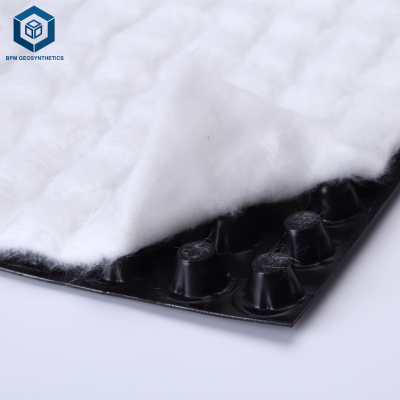
Products supplied by a geomembrane geotextile factory are engineered composites rather than single-layer materials.
Geomembrane Composition
Polyethylene resin matrix (virgin or controlled recycled content)
Carbon black dispersion for UV protection
Antioxidants and thermal stabilizers
Geotextile Composition
Continuous filament or staple polypropylene/polyester fibers
Mechanical bonding through needle punching or weaving
Optional surface calendering or heat setting
Manufacturing Process
1. Raw Material Handling
Polymer resins and fibers are automatically dosed using gravimetric systems to ensure consistency across production batches.
2. Extrusion and Sheet Formation (Geomembrane)
Flat-die or blown-film extrusion lines form continuous sheets. Critical controls include melt temperature, die pressure, and thickness uniformity.
3. Fiber Web Formation (Geotextile)
Carding and cross-lapping systems create uniform fiber webs prior to mechanical bonding.
4. Bonding and Finishing
Needle punching, thermal bonding, or weaving provides structural integrity. Products are then trimmed, rolled, and labeled.
5. Quality Control and Testing
In-house laboratories conduct tensile, puncture, permeability, and aging tests in accordance with ASTM and ISO standards.
Industry Comparison
| Factory Type | Product Range | Quality Control | Typical Applications |
|---|---|---|---|
| Integrated Geomembrane Geotextile Factory | Geomembrane + Geotextile | In-house lab & batch tracking | Mining, landfills, water works |
| Geomembrane-only Producer | Impermeable liners | Limited to polymer testing | Containment systems |
| Geotextile-only Mill | Filtration & separation | Textile-focused testing | Roads, drainage |
Application Scenarios
Distributors: One-stop sourcing for geosynthetic product portfolios
EPC Contractors: Integrated materials for complex engineering packages
Engineering Firms: Verified materials aligned with design assumptions
Importers: Stable supply with documented compliance
Core Pain Points and Solutions
Inconsistent material quality: Solved by automated dosing and batch traceability
Delayed project delivery: Mitigated through integrated production lines
Specification mismatch: Addressed via pre-production sampling and testing
Installation failure risk: Reduced by supplying compatible geomembrane–geotextile systems
Risk Warnings and Mitigation
Risks include uncertified recycled content, inadequate UV stabilization, and lack of factory testing capability. Buyers should require third-party test reports, factory audits, and long-term supply documentation.
Procurement and Selection Guide
Define project standards and regulatory requirements
Confirm factory production scope and capacity
Review detailed technical data sheets
Request recent laboratory test reports
Assess quality management and traceability systems
Evaluate logistics, packaging, and delivery capability
Conduct pre-shipment inspection if required
Engineering Application Example
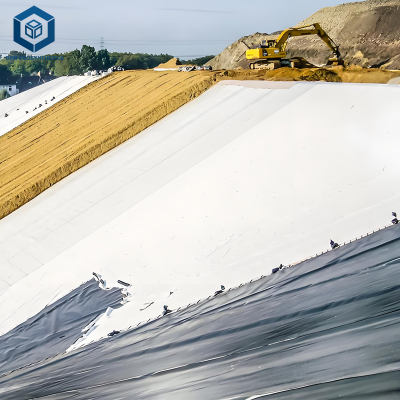
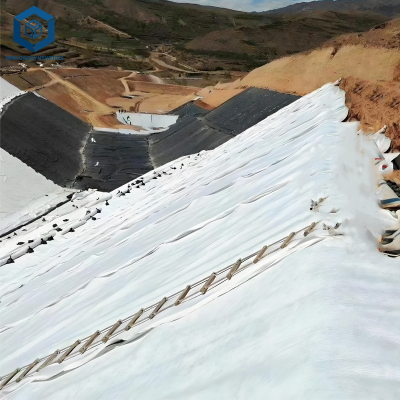
In a municipal landfill expansion project, an integrated geomembrane geotextile factory supplied 2.0 mm HDPE liners combined with 600 g/m² nonwoven geotextiles. The system achieved verified leakage control and subgrade protection across 180,000 m² of containment area.
FAQ
Can one factory supply both materials? Yes, integrated factories are common.
Are products tested in-house? Qualified factories maintain internal labs.
What standards are typically followed? ASTM, ISO, and regional specifications.
Is custom sizing available? Yes, within equipment limits.
Can recycled materials be used? Only if controlled and documented.
How is UV resistance ensured? Through carbon black and stabilizers.
Are installation guidelines provided? Usually upon request.
What roll sizes are typical? Widths up to 8 m, lengths vary.
Is third-party testing mandatory? Often required for public projects.
What causes early failure? Poor resin quality or improper installation.
CTA – Commercial and Technical Requests
For pricing inquiries, factory capability profiles, compliance documentation, or project-specific samples, procurement teams and consultants may submit formal requests for quotation or technical data packages.
E-E-A-T Author Statement
This article is prepared by professionals with experience in geosynthetics manufacturing, quality assurance, and international infrastructure supply, supporting informed technical and procurement decisions in B2B engineering markets.