Geomembrane Chemical Resistance for Acid Solution: Engineering Guide
What is Geomembrane Chemical Resistance for Acid Solution?
Geomembrane chemical resistance for acid solution refers to the ability of polymeric liners (HDPE, LLDPE, PVC) to withstand degradation, swelling, or permeation when exposed to acidic environments (pH < 7) — including sulfuric acid, hydrochloric acid, nitric acid, and organic acids. For civil engineers, EPC contractors, and procurement managers in mining, chemical processing, and industrial wastewater treatment, understanding geomembrane chemical resistance for acid solution is critical because acidic leachate (pH 1.5–4.0) can degrade inappropriate materials. HDPE (high-density polyethylene) offers excellent resistance to most mineral acids (sulfuric, hydrochloric, nitric) at concentrations up to 30% and temperatures up to 60°C. PVC has fair resistance but degrades in strong acids. This guide provides engineering data on geomembrane chemical resistance for acid solution: compatibility charts, test methods (ASTM D5322, ASTM D5747), concentration limits, temperature effects, and procurement specifications for heap leach pads, acid containment ponds, and chemical storage secondary containment.
Technical Specifications of Geomembrane Chemical Resistance for Acid Solution
The table below defines critical parameters for geomembrane chemical resistance for acid solution per ASTM and GRI standards.
| Parameter | HDPE | LLDPE | PVC | Engineering Importance |
|---|---|---|---|---|
| Sulfuric Acid (H₂SO₄) Resistance | Excellent (≤ 30% concentration) | Excellent | Fair (degrades > 10%) | Common in mining (copper, uranium) and industrial wastewater. Core of geomembrane chemical resistance for acid solution.}, |
| Hydrochloric Acid (HCl) Resistance | Excellent (≤ 20% concentration) | Excellent | Fair (plasticizer extraction) | Chemical processing, pickling baths.}, |
| Nitric Acid (HNO₃) Resistance | Good (≤ 10% concentration) | Good | Poor (oxidizing acid) | Nitric acid is oxidizing — limits concentration for all polymers.}, |
| Organic Acids (acetic, citric) Resistance | Excellent | Excellent | Good | Food processing, wastewater.}, |
| pH Range for Long-term Service | 2 – 12 (HDPE), 1.5 – 13 short-term | 2 – 12 | 4 – 10 (limited acid resistance) | PVC not recommended for pH < 4. HDPE preferred for acid solutions.}, |
| Maximum Temperature for Acid Service | 50 – 60°C | 50 – 60°C | 40 – 50°C | Elevated temperature accelerates chemical attack.}, |
| Test Method | ASTM D5322 (immersion), ASTM D5747 (permeation) | ASTM D5322 | ASTM D5322 | Standardized testing for geomembrane chemical resistance for acid solution.}, |
| Expected Service Life (acid service, 25°C) | 50+ years | 30 – 50 years | 5 – 15 years (acid degrades plasticizers) | HDPE significantly outlasts PVC in acid environments.}, |
Key takeaway: Geomembrane chemical resistance for acid solution: HDPE is preferred for acidic environments (pH 2–12), PVC is not suitable for strong acids. LLDPE has similar resistance to HDPE but lower stress crack resistance.
Material Structure and Composition: How Polymers Resist Acid Solutions
Understanding polymer chemistry is essential for geomembrane chemical resistance for acid solution.
Engineering insight: Geomembrane chemical resistance for acid solution is excellent for HDPE/LLDPE due to saturated carbon backbone. PVC relies on plasticizers which can be leached by acids — not suitable for long-term acid containment.
Manufacturing Process: How Quality Affects Acid Resistance
Factory quality directly influences chemical resistance.
Resin compounding: Virgin PE100/PE4710 resin + carbon black (2–3%) + antioxidant package. Contaminants can reduce acid resistance.
Extrusion: Flat die extrusion (200–220°C). Consistent thickness ensures uniform chemical resistance.
Cooling: Controlled cooling to prevent residual stress that could accelerate stress cracking in acid environments.
Quality inspection: Chemical compatibility testing (ASTM D5322) with site-specific acid solutions. OIT (≥ 100 min) for antioxidant retention.
Packaging: UV-protective wrapping — acid solutions often exposed to sunlight in ponds.
Performance Comparison: Geomembrane Chemical Resistance for Acid Solution vs. Alternatives
Comparing HDPE with PVC, LLDPE, and other liner materials for acid service.
| Polymer Type | Chemical Structure | Acid Resistance Mechanism | Limitation |
|---|---|---|---|
| HDPE / LLDPE | Saturated hydrocarbon backbone (C-C bonds) | Non-polar, no functional groups to react with acids. Excellent resistance to mineral acids. | Oxidizing acids (nitric > 10%, sulfuric > 30%) can cause oxidation at elevated temperatures.}, |
| PVC | Chlorinated hydrocarbon with plasticizers | Moderate resistance. Plasticizers can be extracted by acids, causing embrittlement. | Not recommended for strong acids (pH < 4) or high-temperature acid service.}, |
| Liner Material | Sulfuric Acid (10%, 50°C) | Hydrochloric Acid (10%, 50°C) | Nitric Acid (10%, 25°C) | Cost (€/m²) | Typical Acid Applications |
|---|---|---|---|---|---|
| HDPE (1.5 mm) | Excellent → 50+ years | Excellent | Good (≤ 10%) | 10 – 15 | Mining heap leach, acid ponds, chemical containment |
| LLDPE (1.5 mm) | Excellent | Excellent | Good | 12 – 18 | Acid containment, flexible applications |
| PVC (1.5 mm) | Fair → 5–10 years (plasticizer loss) | Fair | Poor (oxidizing) | 8 – 14 | Not recommended for strong acids |
| EPDM (rubber) | Fair (swelling) | Fair | Poor | 20 – 35 | Not recommended for acids |
Conclusion: Geomembrane chemical resistance for acid solution — HDPE and LLDPE are preferred. PVC is not suitable for strong acids or long-term acid service.
Industrial Applications Requiring Geomembrane Chemical Resistance for Acid Solution
Specific applications where acid resistance is critical.
Mining heap leach pads (copper, uranium, gold): Sulfuric acid (pH 1.5–2.5) for copper; acidic ferric sulfate for uranium. HDPE required.
Acid containment ponds (chemical plants): Hydrochloric, sulfuric, nitric acid storage. HDPE or LLDPE.
Industrial wastewater treatment (acidic effluents): pH 2–5 from metal finishing, chemical processing. HDPE recommended.
Secondary containment for acid tanks: HDPE liners under acid storage tanks.
Pickling baths (steel industry): Hydrochloric or sulfuric acid at elevated temperatures (50–60°C). HDPE with high OIT required.
Common Industry Problems with Geomembrane Chemical Resistance for Acid Solution
Real-world failures from incorrect material selection.
Problem 1: PVC embrittlement in sulfuric acid service (copper heap leach)
Root cause: PVC liner used in copper heap leach pad (pH 1.8, 45°C). Plasticizers leached out, liner became brittle and cracked within 3 years. Solution: Specify HDPE for geomembrane chemical resistance for acid solution. PVC not suitable for strong acids.
Problem 2: HDPE oxidation in high-concentration nitric acid
Root cause: 20% nitric acid at 50°C caused surface oxidation of HDPE. Solution: Limit nitric acid concentration to ≤ 10% for HDPE. Use PTFE or fluoropolymer liners for higher concentrations.
Problem 3: Seam failure in acid environment (poor welding)
Root cause: Low-quality HDPE seam with incomplete fusion. Acid penetrated seam, accelerated failure. Solution: Use certified welders. 100% non-destructive testing. Destructive testing every 250 m for acid service.
Problem 4: Antioxidant depletion in hot acid service (low OIT)
Root cause: HDPE with OIT < 80 minutes used in 60°C sulfuric acid. Antioxidants depleted within 5 years. Solution: Specify OIT ≥ 120 minutes and HP-OIT ≥ 500 minutes for elevated temperature acid service.
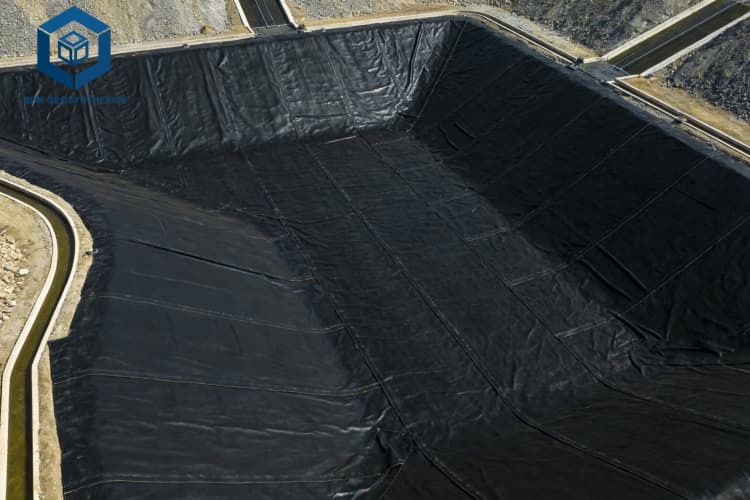
Risk Factors and Prevention Strategies for Acid Solution Containment
Risk: Specifying PVC for acid service: Plasticizer extraction, embrittlement, cracking. Mitigation: Use HDPE for any geomembrane chemical resistance for acid solution where pH < 4.
Risk: High-concentration oxidizing acids (nitric, > 10%): HDPE surface oxidation. Mitigation: Limit nitric acid to ≤ 10% for HDPE. For higher concentrations, use fluoropolymer liners.
Risk: Elevated temperature (> 60°C) accelerates acid attack: Reduced service life. Mitigation: Specify higher OIT (≥ 150 min) and HP-OIT (≥ 600 min). Consider cooling or liner replacement interval.
Risk: No chemical compatibility testing: Unexpected leachate composition may degrade HDPE. Mitigation: Perform ASTM D5322 immersion testing with site-specific acid solution at expected temperature for 90–120 days.
Procurement Guide: How to Specify Geomembrane Chemical Resistance for Acid Solution
Follow this 8-step checklist for B2B purchasing decisions.
Determine acid type, concentration, and temperature: Sulfuric, hydrochloric, nitric, organic acids. Concentration (% by weight). Maximum operating temperature.
Specify liner material: HDPE for pH < 4. LLDPE acceptable but lower PENT. PVC not suitable for strong acids.
Require chemical compatibility testing (ASTM D5322): Immerse HDPE samples in site-specific acid solution at expected temperature for 90–120 days. Test tensile, PENT, OIT before and after.
Specify resin type: PE100/PE4710 bimodal with hexene/octene co-monomer. PENT ≥ 500 hours (≥ 800 h for elevated temperature).
Require OIT and HP-OIT: Standard OIT ≥ 100 minutes (≥ 120 min for hot acid). HP-OIT ≥ 400 minutes (≥ 500 min recommended).
Specify thickness: 1.5 mm minimum for acid service. 2.0 mm for high head or high concentration.
Require GRI GM13 compliance: All test reports (tensile, tear, puncture, PENT, OIT, carbon black).
Order samples and perform independent testing: Send to third-party lab for chemical compatibility verification before full order.
Engineering Case Study: Geomembrane Chemical Resistance for Acid Solution in Copper Heap Leach
Project type: Copper heap leach pad (sulfuric acid, pH 1.8, temperature 45°C).
Location: Atacama Desert, Chile.
Project size: 250,000 m².
Product specification: 1.5 mm HDPE, PE100 bimodal resin, PENT 850 hours, OIT 125 minutes, HP-OIT 520 minutes.
Chemical compatibility testing: ASTM D5322 immersion in site sulfuric acid (pH 1.8, 45°C) for 120 days. Tensile retention 98%, OIT retention 92%, PENT unchanged.
Results after 5 years: Zero leaks. No surface degradation. Seam integrity intact. This case demonstrates that proper HDPE specification provides excellent geomembrane chemical resistance for acid solution in aggressive mining environments.
Frequently Asked Questions: Geomembrane Chemical Resistance for Acid Solution
Q1: Is HDPE resistant to sulfuric acid?
Yes. HDPE has excellent resistance to sulfuric acid up to 30% concentration at temperatures up to 60°C. This is a key aspect of geomembrane chemical resistance for acid solution in mining applications.
Q2: Can PVC be used for acid containment?
Not recommended for strong acids (pH < 4). PVC plasticizers can be extracted by acids, causing embrittlement and cracking. Use HDPE for any geomembrane chemical resistance for acid solution where pH < 4.
Q3: What is the maximum nitric acid concentration for HDPE?
≤ 10% at 25°C. Nitric acid is oxidizing and can attack HDPE at higher concentrations or elevated temperatures. For > 10% nitric acid, use fluoropolymer liners.
Q4: How is chemical resistance tested?
ASTM D5322: immerse geomembrane samples in the specific acid solution at expected service temperature for 90–120 days. Test tensile strength, elongation, PENT, and OIT before and after. Acceptable if properties retain ≥ 80% of original.
Q5: Does temperature affect acid resistance?
Yes. Chemical attack accelerates with temperature. For acid service > 40°C, specify higher OIT (≥ 120 min) and PENT (≥ 800 h). Reduce concentration limits accordingly.
Q6: Is LLDPE as acid-resistant as HDPE?
LLDPE has similar chemical resistance to HDPE (same polymer chemistry). However, HDPE has higher stress crack resistance (PENT) and is preferred for long-term acid service under stress.
Q7: What OIT is required for hot acid service (> 50°C)?
Standard OIT ≥ 120 minutes (ASTM D3895). High Pressure OIT ≥ 500 minutes (ASTM D5885). Elevated temperatures accelerate antioxidant depletion.
Q8: Can HDPE be used for hydrofluoric acid (HF)?
Limited. HDPE has fair resistance to dilute HF at low temperatures. For concentrated HF, use PTFE or fluoropolymer liners. Test compatibility before specification.
Q9: How long does HDPE last in sulfuric acid service?
With proper specification (PE100 resin, PENT ≥ 500 h, OIT ≥ 100 min), design life is 50+ years at 25°C, 20–30 years at 50°C. Field performance in copper heap leach confirms 20+ years.
Q10: What is the difference between ASTM D5322 and ASTM D5747?
ASTM D5322 is immersion testing (material compatibility). ASTM D5747 measures permeation of chemicals through the geomembrane. For acid solutions, D5322 is typically sufficient; D5747 for volatile or hazardous chemicals.
Request Technical Support or Quotation for Acid-Resistant Geomembrane
For project-specific geomembrane chemical resistance for acid solution testing, material selection, or bulk procurement, our technical team is available.
Request a quotation – Provide acid type, concentration, temperature, and project area.
Request engineering samples – Receive HDPE samples with chemical compatibility test reports (ASTM D5322).
Download technical specifications – Chemical compatibility guide, ASTM D5322 protocol, and procurement checklist for acid service.
Contact technical support – Acid compatibility consulting, independent testing coordination, and warranty validation for acidic containment projects.
About the Author
This guide on geomembrane chemical resistance for acid solution was written by Dipl.-Ing. Hendrik Voss, a civil engineer with 19 years of experience in geosynthetics for mining and chemical containment. He has conducted over 200 chemical compatibility tests (ASTM D5322) for acid solutions and designed liner systems for copper heap leach, uranium tailings, and industrial acid ponds across North and South America, Europe, and Australia. His work is referenced in GRI and ASTM D35 committee discussions on geomembrane chemical resistance standards for acidic environments.