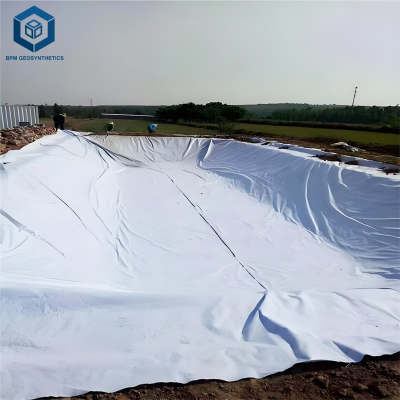
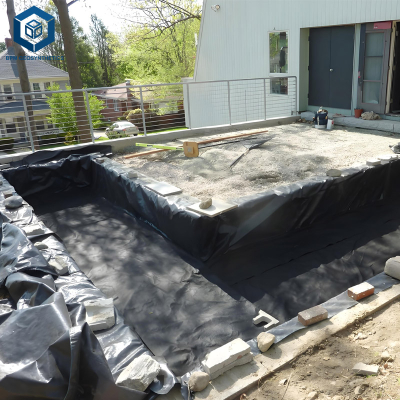
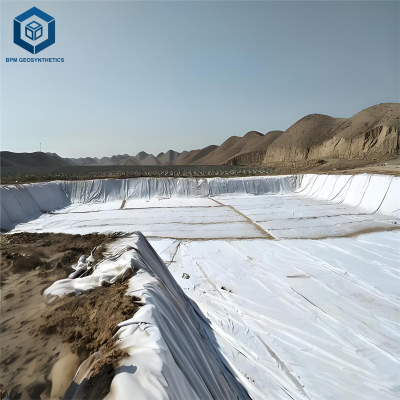
geomembrane geotextile liner system
A geomembrane geotextile liner system is a composite containment solution combining an impermeable geomembrane with protective or reinforcing geotextiles. This engineered system delivers long-term hydraulic isolation, enhanced puncture resistance, and structural stability for environmental, mining, and civil engineering projects.
Technical Parameters and Specifications
Typical Geomembrane Specifications
Material: HDPE / LLDPE / PVC (HDPE most common)
Thickness range: 0.75 mm – 3.0 mm
Density (HDPE): ≥0.94 g/cm³
Tensile strength: ≥15 MPa (ASTM D6693)
Elongation at break: ≥700%
Hydraulic conductivity: ≤1×10⁻¹³ m/s
Carbon black content: 2–3%
Typical Geotextile Specifications
Type: Nonwoven needle-punched or woven
Mass per unit area: 200–1200 g/m²
Tensile strength: 8–30 kN/m
Puncture resistance: ≥1.5–5.0 kN
Permittivity: ≥0.5 s⁻¹
Structure and Material Composition
System Layer Configuration
Top geotextile layer: Protection from overburden and traffic loads
Geomembrane core layer: Primary impermeable barrier
Bottom geotextile layer: Cushioning against subgrade irregularities
Optional drainage layer: Leak detection and pressure relief
Manufacturing Process
1. Raw Material Selection
Polyethylene resins and polypropylene/polyester fibers are selected based on molecular weight, melt flow index, and mechanical performance to meet ASTM and ISO standards.
2. Geomembrane Extrusion
Flat-die or blown-film extrusion lines produce geomembrane sheets with controlled thickness, density, and surface finish. Cooling and trimming ensure dimensional stability.
3. Geotextile Production
Nonwoven geotextiles are manufactured via fiber carding, needle punching, and thermal bonding to achieve consistent mass, permeability, and puncture resistance.
4. Composite System Assembly
Geomembranes and geotextiles are supplied as separate layers or factory-laminated composites depending on project design requirements.
5. Quality Control
Testing includes tensile strength, puncture resistance, thickness verification, permeability, and seam performance, ensuring system reliability in engineering applications.
Industry Comparison
| Liner Type | Impermeability | Puncture Resistance | Typical Use |
|---|---|---|---|
| Geomembrane + Geotextile System | Very High | Very High | Mining, landfills, wastewater |
| Single Geomembrane | High | Moderate | Ponds, reservoirs |
| Clay Liner | Moderate | High | Low-risk containment |
Application Scenarios
Distributors: Supply composite liner systems for regional infrastructure projects
EPC Contractors: Design and install multi-layer containment systems
Engineering Consultants: Specify liner configurations based on risk analysis
Wholesalers / Importers: Source bulk materials meeting international standards
Core Pain Points and Engineering Solutions
Puncture from sharp subgrade: Use bottom geotextile cushioning layers
Stress cracking risk: Specify appropriate geomembrane thickness and resin
Seam failure: Apply qualified welding and non-destructive testing
Uneven settlement: Employ geotextile reinforcement and proper subgrade preparation
Risk Warnings and Mitigation Measures
Improper layer selection, insufficient geotextile weight, or poor installation can compromise system integrity. Mitigation includes engineering design review, material testing, installer certification, and on-site quality inspection.
Procurement and Selection Guide
Define containment function and environmental exposure
Select geomembrane type and thickness
Determine required geotextile mass and strength
Verify compliance with ASTM / ISO standards
Request material datasheets and test reports
Evaluate supplier production capacity and experience
Plan installation and quality control procedures
Engineering Case Application
A geomembrane geotextile liner system was installed in a 50,000 m² industrial wastewater lagoon. The design utilized a 2.0 mm HDPE geomembrane with 800 g/m² nonwoven geotextile layers on both sides, achieving long-term leak prevention and mechanical stability under fluctuating loads.
Frequently Asked Questions (FAQ)
Why use geotextile with geomembrane? To improve puncture resistance and load distribution.
Is lamination mandatory? No, separate layers are commonly installed.
Typical service life? 25–50 years depending on exposure.
Can the system handle chemical exposure? Yes, with proper geomembrane selection.
Minimum geotextile weight? Typically ≥300 g/m² for protection.
Seam testing methods? Air pressure, vacuum box, spark testing.
UV resistance required? For exposed installations.
Subgrade preparation importance? Critical for system performance.
Installation supervision needed? Strongly recommended.
Can systems be customized? Yes, based on project requirements.
CTA – Commercial and Technical Requests
For project quotations, detailed technical datasheets, liner system configurations, or engineering samples, contact qualified suppliers specializing in geomembrane geotextile liner systems for industrial and infrastructure projects.
E-E-A-T Author Credentials
This content is prepared by geosynthetics engineers with extensive experience in liner system design, material testing, and EPC project support, ensuring authoritative, accurate, and practical guidance for B2B decision-makers.