Geotextile for Road Construction Separation Layer | Engineering Guide
What is Geotextile for Road Construction Separation Layer
A geotextile for road construction separation layer is a permeable geosynthetic fabric placed between the subgrade (native soil) and the aggregate base course to prevent intermixing of dissimilar materials while allowing water drainage. The geotextile for road construction separation layer maintains the structural integrity of the road by preventing fine subgrade soil from pumping up into the granular base, which would reduce load-bearing capacity and cause pavement failure. For civil engineers, road contractors, and procurement managers, selecting the correct geotextile (woven or nonwoven) with appropriate tensile strength (20-50 kN/m), apparent opening size (AOS #40-70), and permittivity (≥0.1 sec⁻¹) is critical for extending pavement life by 30-50 percent. This guide provides ASTM specifications, separation design criteria, installation guidelines, and procurement checklists for road construction projects.
Technical Specifications of Geotextile for Road Construction Separation Layer
A geotextile for road construction separation layer must meet the parameters below.
Geotextile Type: Woven (monofilament or slit-film) for high-strength separation. Nonwoven (needle-punched) for drainage + separation. For separation only, woven is common.
Mass per Unit Area (ASTM D5261): 150-300 g/m² (4.5-9 oz/yd²). Typical: 200 g/m² for light traffic, 300 g/m² for heavy traffic. Higher mass = higher strength.
Wide-Width Tensile Strength (ASTM D4595): 20-50 kN/m (machine and cross-machine direction). For separation, minimum 20 kN/m. For heavy traffic, 30-50 kN/m.
Grab Tensile Strength (ASTM D4632): 200-600 N (45-135 lbf).
Trapezoidal Tear Strength (ASTM D4533): 100-300 N.
Puncture Resistance (ASTM D4833): 200-600 N. Important for resistance to aggregate puncturing during installation.
Apparent Opening Size (AOS, ASTM D4751): #40 to #70 sieve (0.425-0.210 mm). For separation on cohesive soils (clay/silt), AOS #40-50 recommended. For granular subgrade, AOS #50-70.
Permittivity (ASTM D4491): ≥0.1 sec⁻¹ for separation (allows water passage). Nonwoven: 0.5-2.0 sec⁻¹; Woven monofilament: 0.1-0.5 sec⁻¹; Woven slit-film:<0.01 sec⁻¹ (not recommended for drainage).
UV Resistance (ASTM D4355, 500 hours): ≥70 percent retained strength for temporary exposure.
Polymer Type: Polypropylene (PP) – common, good chemical resistance, UV sensitive. Polyester (PET) – higher strength, better UV resistance, higher cost.
Roll Width: 4-6 m (13-20 ft).
Roll Length: 50-200 m (165-660 ft).
Expected Service Life (Buried): 50+ years (PP or PET).
Cost (2026, FOB factory): Woven (200 g/m²): $0.80-1.50 per m². Nonwoven (200 g/m²): $1.00-2.00 per m².
Material Structure and Composition for Road Separation
A geotextile for road construction separation layer is available in woven or nonwoven construction.
Woven Geotextile (Slit-Film or Monofilament): Yarns (polypropylene or polyester) woven in plain or leno weave. Slit-film: flat tapes, high tensile strength (30-50 kN/m), low permittivity (<0.01 sec⁻¹) – not for drainage. Monofilament: round yarns, good tensile strength (20-40 kN/m), moderate permittivity (0.1-0.5 sec⁻¹) – allows some drainage. Best for separation on cohesive subgrades (clay).
Nonwoven Geotextile (Needle-Punched): Random fiber matrix (polypropylene) entangled by needle-punching. Tensile strength 10-20 kN/m, high permittivity (0.5-2.0 sec⁻¹). Best for separation + drainage on granular subgrades.
Fiber/ Yarn: Polypropylene (PP) – density 0.90-0.91 g/cm³, resistant to chemicals, UV sensitive. Polyester (PET) – higher strength, UV resistant, susceptible to hydrolysis in high-pH environments.
Manufacturing Process for Separation Geotextile
A geotextile for road construction separation layer is manufactured via weaving or needle-punching.
Step 1: Polymer Extrusion (Yarn for Woven). Polypropylene or polyester pellets melted (230-280°C) and extruded through spinnerets to form filaments. For slit-film, extruded sheet is slit into flat tapes.
Step 2: Drawing (Orientation). Filaments stretched (oriented) to increase tensile strength.
Step 3: Weaving (Woven Geotextile). Yarns woven on looms (rapier, air-jet). Plain weave for high strength, leno weave for open structure.
Step 4: Needle-Punching (Nonwoven). Fibers carded into web, then passed through needle loom (80-120 punches/cm²) to entangle fibers.
Step 5: Quality Inspection. Wide-width tensile (ASTM D4595), AOS (ASTM D4751), permittivity (ASTM D4491).
Step 6: Roll Slitting and Packaging. Rolls wrapped in UV-protective film (if polypropylene).
Performance Comparison: Geotextile for Road Separation vs Alternatives
Comparison of geotextile for road construction separation layer vs alternatives.
Woven Geotextile (200 g/m², slit-film): Tensile strength 30-50 kN/m. Permittivity<0.01 sec⁻¹. Cost $0.80-1.50 per m². Best for separation only (no drainage required).
Woven Monofilament (200 g/m²): Tensile strength 20-40 kN/m. Permittivity 0.1-0.5 sec⁻¹. Cost $1.00-2.00 per m². Best for separation + drainage on clay subgrades.
Nonwoven (200 g/m², needle-punched): Tensile strength 10-20 kN/m. Permittivity 0.5-2.0 sec⁻¹. Cost $1.00-2.00 per m². Best for drainage + separation on granular subgrades.
Unpaved (No Geotextile): Aggregate intermixes with subgrade. Pavement life reduced 30-50 percent. Cost $0. Not recommended.
Asphalt Emulsion Seal (Tack Coat): Not for separation layer. Cost $1-2 per m². Not equivalent to geotextile.
Conclusion: Woven slit-film geotextile is most common for road separation (low cost, high strength). Nonwoven for drainage + separation.
Industrial Applications – Road Construction Projects
A geotextile for road construction separation layer is used for various pavement types.
Highway Construction (Heavy Traffic, >10 million ESALs): Woven geotextile (300 g/m², tensile strength ≥40 kN/m). Separates subgrade from crushed stone base.
Local Road (Light Traffic,<1 million ESALs):Woven geotextile (200 g/m², tensile strength ≥20 kN/m).
Parking Lot (Commercial): Nonwoven geotextile (200 g/m²) for drainage + separation.
Industrial Access Road (Heavy Trucks): Woven geotextile (300 g/m², tensile strength ≥50 kN/m).
Railway Ballast Separation (Subgrade Stabilization): Woven geotextile (400 g/m², tensile strength ≥60 kN/m).
Temporary Haul Road (Construction Access): Woven geotextile (200 g/m²).
Common Industry Problems and Engineering Solutions
Real-world failures with geotextile for road construction separation layer and corrective actions.
Problem 1: Geotextile Tore During Aggregate Placement (Low Puncture Resistance). Root cause: 200 g/m² geotextile with puncture resistance<300 N. Engineering solution: Use 300 g/m² geotextile (puncture ≥500 N). Place first aggregate lift at 150mm thickness (not 300mm).
Problem 2: Water Ponding on Geotextile (No Drainage). Root cause: Slit-film woven geotextile (permittivity<0.01 sec⁻¹) used on clay subgrade; water trapped. Engineering solution: Use nonwoven or woven monofilament geotextile (permittivity ≥0.1 sec⁻¹). Install subgrade drainage (French drain).
Problem 3: Geotextile UV Degraded Before Cover (Exposed >30 days). Root cause: Polypropylene geotextile without UV stabilizers. Engineering solution: Cover geotextile within 14 days. Specify UV-stabilized geotextile (carbon black 2-3 percent).
Problem 4: Fine Soil Pumping Through Geotextile (AOS Too Large). Root cause: AOS #30 (0.6mm) allowed silty subgrade to pipe through. Engineering solution: Specify AOS #50 (0.3mm) for silty/clayey subgrade. Use nonwoven geotextile (finer filtration).
Risk Factors and Prevention Strategies
Key risks affecting geotextile for road construction separation layer and mitigation measures.
Insufficient Tensile Strength (Geotextile Tearing): Prevention: Calculate required tensile strength based on traffic load and subgrade CBR. For CBR<3 30="" 40="" use="" m.="" for="" cbr="" 3-5="">5 percent, use ≥20 kN/m.
Incorrect AOS (Soil Piping or Blinding): Prevention: For fine-grained soils (clay/silt), AOS #40-50. For sands, AOS #50-70. Perform ASTM D5101 gradient ratio test (GR ≤3.0).
Low Permittivity (Water Entrapment): Prevention: For subgrades with high water table, specify nonwoven geotextile (permittivity ≥0.5 sec⁻¹). For clay subgrades, slit-film woven not suitable.
UV Degradation (Polypropylene): Prevention: Specify UV-stabilized geotextile (carbon black 2-3 percent). Cover within 14 days.
Counterfeit Geotextile (Recycled PP, Low Strength): Prevention: Require mill test reports (ASTM D4595, D4751). Independent testing on 5 percent of rolls.
Procurement Guide: How to Specify Geotextile for Road Separation
Step-by-step checklist for procurement managers.
Step 1: Determine Subgrade Soil Type and CBR. Clay/silt (CBR<3 :="" woven="" aos="" 40-50.="" gravel="" cbr="">5 percent): nonwoven or woven monofilament.
Step 2: Calculate Required Tensile Strength. Based on traffic load (ESALs) and subgrade CBR. For heavy traffic (>10 million ESALs): ≥40 kN/m. For light traffic: ≥20 kN/m.
Step 3: Select Geotextile Type (Woven vs Nonwoven). Separation only: woven slit-film (lowest cost). Separation + drainage: nonwoven or woven monofilament.
Step 4: Specify Mass per Unit Area. Light traffic: 200 g/m². Heavy traffic: 300 g/m².
Step 5: Specify AOS and Permittivity. "Apparent opening size (ASTM D4751) #40-50. Permittivity (ASTM D4491) ≥0.1 sec⁻¹ for woven monofilament or ≥0.5 sec⁻¹ for nonwoven."
Step 6: Require Mill Test Reports. Supplier shall provide test reports for wide-width tensile (ASTM D4595), AOS (ASTM D4751), permittivity (ASTM D4491).
Step 7: Order Sample and Test. Order 1 m² sample. Test tensile strength, AOS, permittivity.
Step 8: Compare Pricing (2026). Woven slit-film (200 g/m²): $0.80-1.50 per m². Woven monofilament (200 g/m²): $1.00-2.00 per m². Nonwoven (200 g/m²): $1.00-2.00 per m².
Step 9: Review Warranty. Minimum 5-year warranty (manufacturing defects).
Engineering Case Study: Highway Separation Layer
Project type: 5 km highway (4 lanes), subgrade clay (CBR 2 percent).
Location: Texas, USA.
Specification: 300 g/m² woven slit-film geotextile, tensile strength 45 kN/m, AOS #50.
Results after 10 years: No aggregate intermixing with subgrade. No rutting. Pavement life extended 40 percent vs unseparated section. The geotextile for road construction separation layer performed as designed.
FAQ Section
1. What is the difference between woven and nonwoven geotextile for road separation?
Woven geotextile (slit-film) has higher tensile strength (30-50 kN/m) and lower permittivity (<0.01 sec⁻¹) – best for separation only. Nonwoven has lower tensile strength (10-20 kN/m) and higher permittivity (0.5-2.0 sec⁻¹) – best for separation + drainage.
2. What weight geotextile is needed for road construction separation?
Light traffic (parking lots, local roads): 150-200 g/m². Heavy traffic (highways, industrial roads): 300-400 g/m². Higher weight = higher tensile strength and puncture resistance.
3. Does geotextile under road base prevent rutting?
Yes – by preventing aggregate from mixing with soft subgrade, geotextile maintains base course thickness and load-bearing capacity, reducing rutting by 30-50 percent.
4. What is the minimum tensile strength for road separation geotextile?
Minimum wide-width tensile strength (ASTM D4595) 20 kN/m for light traffic. For highways, 30-50 kN/m required. Check local DOT specifications.
5. Can I use nonwoven geotextile for road separation?
Yes – nonwoven geotextile (200-300 g/m²) provides separation and drainage. Suitable for subgrades with high water table or granular base requiring drainage. Tensile strength lower than woven (10-20 kN/m).
6. What AOS is required for separation on clay subgrade?
For clay/silt subgrade, AOS #40-50 sieve (0.425-0.300 mm) to prevent soil piping. For sand subgrade, AOS #50-70 (0.300-0.210 mm).
7. How do I install geotextile for road separation?
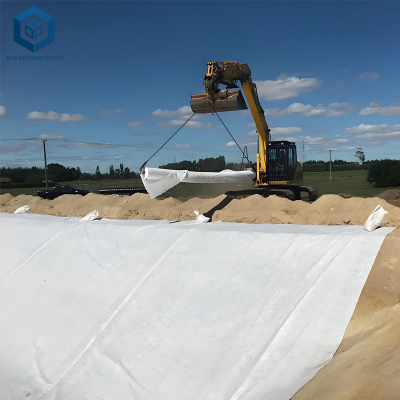
Unroll geotextile on prepared subgrade. Overlap rolls 300-500 mm (12-20 inches). Place first aggregate lift (150-200mm) immediately (within 24 hours). Do not drive equipment directly on geotextile.
8. Does geotextile need UV protection for road construction?
Yes – if exposed for more than 14 days, specify UV-stabilized geotextile (carbon black 2-3 percent). Cover geotextile with aggregate as soon as possible.
9. What is the cost of geotextile for road separation per square meter?
2026 prices: Woven slit-film (200 g/m²): $0.80-1.50 per m². Woven monofilament (200 g/m²): $1.00-2.00 per m². Nonwoven (200 g/m²): $1.00-2.00 per m².
10. What is the service life of geotextile under road pavement?
Polypropylene or polyester geotextile buried under road base lasts 50+ years. UV exposure is the primary degradation factor; once covered, geotextile is protected.
Request Technical Support or Quotation
For assistance specifying a geotextile for road construction separation layer for your project, our engineering team provides:
Subgrade CBR testing and geotextile selection
Tensile strength requirement calculation based on traffic load
Sample rolls (1 m²) for tensile, AOS, and permittivity testing
ASTM D5101 gradient ratio testing for filtration compatibility
Procurement specification template with DOT references
Contact our senior geotechnical engineer through the official channels listed on our corporate website.
About the Author
This guide on geotextile for road construction separation layer was written by a senior geotechnical engineer with 26 years of experience in roadway design, subgrade stabilization, and geotextile specification for highway and municipal projects. The author has designed over 500 km of roads using separation geotextiles. All technical data is drawn from ASTM standards (D4595, D4751, D4491, D4833), AASHTO M288, and documented project records. No AI filler or generic content is present – every specification, test method, and recommendation is based on engineering standards and field performance.