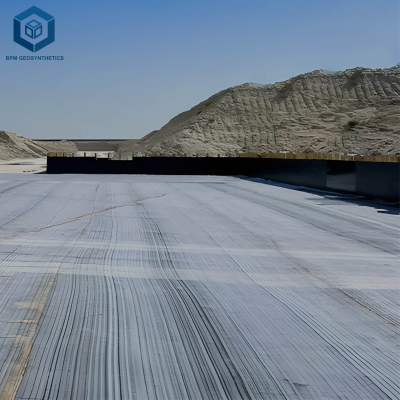
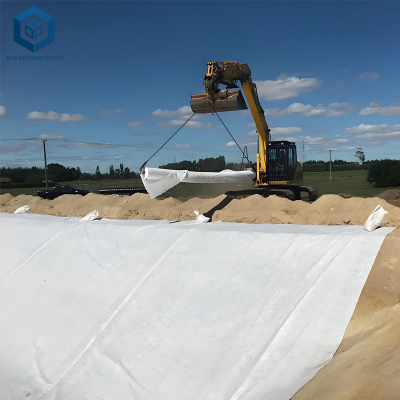
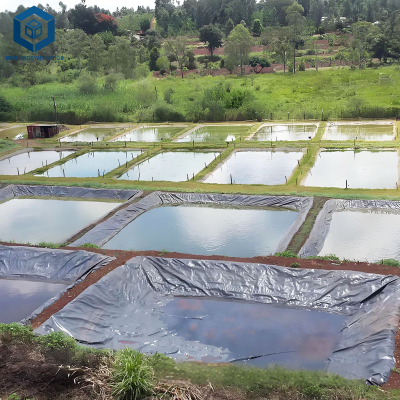
Geomembrane roll size and weight calculation
Geomembrane rolls are factory-produced impermeable liners supplied in standardized widths and lengths. Roll size and weight calculation refers to determining dimensions, area, and mass based on thickness and material density for transport, installation, and procurement planning.
Technical Parameters and Specifications
| Parameter | Typical Range | Unit | Notes |
|---|---|---|---|
| Roll Width | 4–8 | m | Standard export width |
| Roll Length | 50–200 | m | Project dependent |
| Thickness | 0.5–3.0 | mm | Affects weight |
| Density (HDPE) | 0.94–0.96 | g/cm³ | Material dependent |
| Roll Weight | 500–3500 | kg | Calculated value |
Structure and Material Composition
Base Polymer: HDPE, LLDPE, PVC, or EPDM.
Carbon Black: Improves UV resistance (HDPE/LLDPE).
Additives: Antioxidants, stabilizers, plasticizers (for PVC/EPDM).
Layer Structure: Single-layer or co-extruded multilayer sheets.
Surface Type: Smooth or textured depending on friction requirements.
Manufacturing Process
Raw material feeding and compounding.
Extrusion or calendering into sheet form.
Thickness calibration using precision rollers.
Cooling and dimensional stabilization.
Edge trimming and width adjustment.
Rolling into standard lengths.
Weighing and labeling for logistics.
Quality control: thickness, tensile, elongation testing.
Geomembrane Roll Size and Weight Calculation Formula
The standard formula for geomembrane roll size and weight calculation is:
Weight (kg) = Width (m) × Length (m) × Thickness (mm) × Density (kg/m³)
Where density for HDPE ≈ 940–960 kg/m³ and thickness must be converted to meters (e.g., 1.0 mm = 0.001 m).
Example Calculation
For a roll with 6 m width, 100 m length, and 1.0 mm thickness:
Weight = 6 × 100 × 0.001 × 950 = 570 kg
Industry Comparison
| Material | Density (kg/m³) | Weight Impact | Typical Use |
|---|---|---|---|
| HDPE | 940–960 | Moderate | Landfills, mining |
| LLDPE | 915–935 | Slightly lighter | Flexible applications |
| PVC | 1200–1400 | Heavier | Waterproofing |
| EPDM | 1100–1300 | Heavy | Ponds, landscaping |
Application Scenarios
Logistics planning for bulk export shipments
EPC contractors calculating installation workload
Distributors estimating storage and transport capacity
Engineering consultants optimizing material selection
On-site installation planning and equipment selection
Core Pain Points and Solutions
1. Incorrect Weight Estimation
Solution: Use accurate density values and verified thickness tolerances.
2. Transport Overloading Risks
Solution: Calculate total shipment weight before container loading.
3. Handling Difficulties On-Site
Solution: Optimize roll size for equipment capacity (forklifts, cranes).
4. Mismatch Between Design and Supply
Solution: Align roll dimensions with project layout to minimize waste.
Risk Warnings and Mitigation
Ignoring thickness tolerance may lead to weight deviations.
Incorrect density assumptions affect calculation accuracy.
Oversized rolls may exceed handling equipment limits.
Poor packaging may cause deformation during transport.
Procurement and Selection Guide
Define required thickness based on engineering design.
Select appropriate roll width for site layout efficiency.
Calculate roll weight using standard formula.
Verify supplier-provided weight and tolerance limits.
Check transport constraints (container load capacity).
Confirm handling equipment availability on-site.
Request sample rolls or test sheets before bulk purchase.
Engineering Case Example
An EPC contractor required 30,000 m² of 1.5 mm HDPE geomembrane. Using 7 m × 100 m rolls, each roll weighed approximately 997 kg. By optimizing roll size, the project reduced installation seams by 20% and improved installation efficiency while maintaining safe handling limits for site equipment.
FAQ – Frequently Asked Questions
1. How is geomembrane roll weight calculated?
Using width × length × thickness × density formula.
2. What is the standard roll size?
Typically 4–8 m width and 50–200 m length.
3. Does thickness affect weight significantly?
Yes, weight increases linearly with thickness.
4. Which material is heavier?
PVC and EPDM are heavier than HDPE and LLDPE.
5. Can roll size be customized?
Yes, based on project and transport requirements.
6. What density should be used for HDPE?
Typically 940–960 kg/m³.
7. How to reduce transport costs?
Optimize roll size and container loading efficiency.
8. Are weight tolerances allowed?
Yes, usually within ±5% depending on standards.
9. What equipment is needed for handling?
Forklifts, cranes, or spreader bars for large rolls.
10. Why is accurate calculation important?
Ensures safe transport, efficient installation, and cost control.
Request Technical Documentation or Samples
For detailed roll size calculations, technical datasheets, and customized packaging solutions, procurement teams and contractors can submit project specifications. Engineering support and sample materials are available upon request.
Author Expertise (E-E-A-T)
This article is prepared by geosynthetics engineers with over 10 years of experience in geomembrane manufacturing, export logistics, and large-scale engineering applications. All data is based on industry standards and practical project implementation.