Comprehensive Guide to Blown Film vs Flat Die Geomembrane Manufacturing: Process, Properties & Selection
What is Blown Film vs Flat Die Geomembrane Manufacturing Difference?
Blown film vs flat die geomembrane manufacturing difference refers to the two primary extrusion methods for producing HDPE/LLDPE geomembranes: blown film (tubular bubble process with annular die) and flat die (sheet extrusion through a coat-hanger die into a calendering stack). For civil engineers, EPC contractors, and procurement managers, understanding blown film vs flat die geomembrane manufacturing difference is critical because each process imparts distinct mechanical properties, dimensional tolerances, and cost structures. Blown film (typical width 4–8 m after slitting, thickness 0.5–3.0 mm) offers balanced tensile properties and higher tear resistance but has lower output rates (300–800 kg/h) and width limitations. Flat die (calendered) lines produce wider sheets (up to 10 m), higher output (1,000–4,000 kg/h), and tighter thickness tolerances (±5–8%) but can have oriented properties (machine direction vs. transverse direction differences). This guide provides engineering analysis of blown film vs flat die geomembrane manufacturing: process parameters, property comparisons (tensile, tear, puncture, stress crack), capital investment, and application-specific recommendations for landfill liners, mining, and wastewater containment.
Technical Specifications: Blown Film vs Flat Die Geomembrane
The table below compares typical properties and process parameters for each manufacturing method.
| Parameter | Blown Film Geomembrane | Flat Die (Calendered) Geomembrane | Engineering Importance | |
|---|---|---|---|---|
| Typical Thickness Range | 0.5 – 3.0 mm | 0.5 – 3.0 mm | Both can produce standard thicknesses; flat die better for > 2.5 mm.}, | |
| Maximum Width (after slitting) | 4 – 8 m (typical 5 m) | 6 – 10 m (typical 8 m) | Flat die produces wider sheets — fewer field seams. A key blown film vs flat die geomembrane manufacturing difference.}, | |
| Thickness Tolerance (±) | 8 – 12% | 5 – 8% | Flat die offers tighter tolerance, reducing over-design weight.}, | |
| Tensile Strength (MD vs. TD balance) | Balanced (MD/TD ratio 0.9–1.1) | Often oriented (MD > TD by 10–30%) | Blown film provides isotropic properties; flat die may have directionality.}, | |
| Tear Resistance (ASTM D1004) | Higher (isotropic fiber orientation) | Lower (especially in TD) | Blown film significantly outperforms flat die in tear resistance — critical for puncture/tear applications.}, | |
| Puncture Resistance (ASTM D4833) | Higher (due to balanced orientation) | Moderate | Blown film preferred for subgrade with stone puncture risk.}, | |
| Output Rate (typical line) | 300 – 800 kg/h | 1,000 – 4,000 kg/h | Flat die has 3–5x higher productivity — lower manufacturing cost per kg.}, | |
| Capital Investment (line cost) | €1M – €2.5M | €2M – €5M | Flat die lines have higher upfront cost but lower per-unit cost at scale.}, | |
| Energy Consumption (kWh/kg) | 0.6 – 0.9 | 0.5 – 0.7 | Flat die is more energy-efficient.}, |
Key takeaway: Blown film vs flat die geomembrane manufacturing difference centers on process geometry: blown film creates balanced, isotropic properties but lower output; flat die offers higher productivity and wider sheets but can have oriented properties.
Material Structure and Composition: How Process Affects Polymer Orientation
The blown film vs flat die geomembrane manufacturing difference fundamentally affects molecular orientation and crystallinity.
| Property | Blown Film Process | Flat Die Process | Engineering Impact | |
|---|---|---|---|---|
| Molecular Orientation | Biaxial (MD + TD stretch from bubble expansion) | Uniaxial (primarily MD from haul-off, TD from die swell minimal) | Blown film has balanced strength; flat die has directional properties.}, | |
| Crystallinity | 50–60% (lower cooling rate) | 55–70% (quench rolls increase crystallinity) | Higher crystallinity = higher stiffness but lower tear resistance.}, | |
| Residual Stress | Lower (annealed during bubble cooling) | Higher (rapid quench) — can cause warping | Flat die may require post-annealing for stress relief.}, | |
| Surface Texture | Smooth (can be embossed post-extrusion)了一起Smooth or textured (calendering rolls) | Both can produce textured surfaces; flat die calendering rolls create patterns directly.}, | ||
| Gauge Variation Pattern | Circumferential (bubble instability) | Transverse (die lip adjustment) | Flat die allows online thickness adjustment across width.}, |
Engineering insight: The blown film vs flat die geomembrane manufacturing difference is most apparent in tear resistance: blown film's biaxial orientation distributes stress evenly, while flat die's uniaxial orientation creates weakness in the transverse direction.
Manufacturing Process: Blown Film vs Flat Die Geomembrane
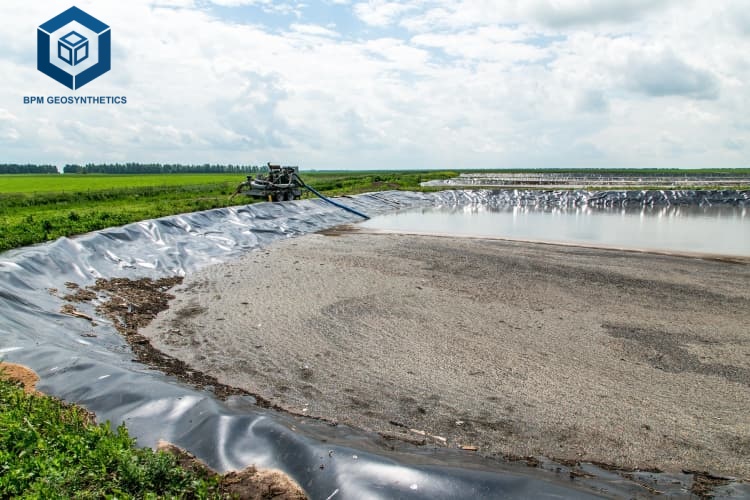
Detailed step-by-step comparison of the two manufacturing methods.
Raw material preparation (both): HDPE/LLDPE resin, carbon black masterbatch, antioxidants compounded. Same raw materials for both processes.
Blown film process:
Extruder melts resin → annular die (vertical or horizontal)
Air injected through die center inflates bubble (blow-up ratio 2:1 to 4:1)
Bubble cooled by air ring (external) and internal air
Collapsing frames flatten bubble → nip rollers
Slitting to produce one or two sheets (up to 4–8 m total width)
Winding onto rolls
Flat die (calendered) process:
Extruder melts resin → coat-hanger flat die (width up to 10 m)
Melt exits die vertically downward onto three-roll calendering stack
Rolls set thickness and surface texture (polished or embossed)
Cooling rolls solidify sheet
Edge trimming and scrap reclaim
Winding onto rolls (up to 10 m width)
Critical process difference: In blown film vs flat die geomembrane manufacturing, blown film has biaxial orientation from bubble expansion; flat die has minimal TD orientation. This drives property differences.
Performance Comparison: Blown Film vs Flat Die Geomembrane
Comparing key mechanical properties and field performance.
| Property | Blown Film | Flat Die | Better For |
|---|---|---|---|
| Tear Resistance (MD & TD balance) | Excellent (balanced) | Good MD, Poor TD | Blown film — critical for slope stability and puncture resistance}, |
| Puncture Resistance | Higher (isotropic strength) | Moderate | Blown film — subgrade with stones}, |
| Tensile Strength (absolute) | Good | High (MD), Moderate (TD) | Flat die if MD strength is primary concern}, |
| Thickness Uniformity | Good (±8–12%) | Excellent (±5–8%) | Flat die — critical for GRI GM13 compliance}, |
| Stress Crack Resistance (PENT) | Comparable (resin-dependent) | Comparable | Equal — depends on resin, not process}, |
| Width Capability | 4–8 m | 6–10 m | Flat die — fewer field seams}, |
| Production Cost per m² | Higher (lower output) | Lower (higher output) | Flat die for large-volume, price-sensitive projects}, |
| Suitability for Texturing | Fair (post-embossing required) | Excellent (calendering rolls create texture directly) | Flat die — textured geomembrane production}, |
Conclusion: The blown film vs flat die geomembrane manufacturing difference means blown film is preferred for tear/puncture-critical applications; flat die for wide sheets, textured surfaces, and high-volume production.
Industrial Applications: Blown Film vs Flat Die Geomembrane Selection
Application-specific recommendations based on blown film vs flat die geomembrane manufacturing difference.
Landfill bottom liners (puncture risk from subgrade stones): Blown film preferred for superior tear and puncture resistance. Flat die acceptable with thicker geotextile cushion.
Landfill final covers (low puncture risk): Flat die acceptable — cost advantage outweighs property differences.
Mining heap leach pads (sharp ore, high tear risk): Blown film recommended. Tear resistance critical.
Wastewater treatment lagoons (large area, low tear risk): Flat die preferred for width (fewer seams) and lower cost.
Slope applications (> 3H:1V, textured required): Flat die with calender-embossed texture — blown film texturing is post-extrusion and less consistent.
Potable water reservoirs (smooth, wide sheets): Flat die for width and surface quality.
Common Industry Problems Related to Blown Film vs Flat Die Geomembrane Manufacturing Difference
Real-world failures and issues from each process.
Problem 1: TD tear failure in flat die geomembrane on slope
Root cause: Flat die's uniaxial orientation creates weak transverse direction. Tear propagates across sheet under tensile load on slope.
Engineering solution: For slope applications with high tensile stress in TD, specify blown film (balanced tear resistance). This is a critical blown film vs flat die geomembrane manufacturing difference for slope stability.
Problem 2: Thickness variation in blown film geomembrane
Root cause: Bubble instability (cooling air fluctuation, melt temperature variation). Thickness tolerance ±12% exceeds GRI GM13 limit of ±10%.
Solution: Flat die offers tighter tolerance (±5–8%). For GRI GM13 compliance, flat die is safer.
Problem 3: Higher cost of blown film for large projects
Root cause: Blown film output 300–800 kg/h vs. flat die 1,000–4,000 kg/h. Higher manufacturing cost per kg.
Solution: For large, low-risk projects (e.g., final covers), specify flat die for cost savings. Reserve blown film for high-risk applications.
Problem 4: Inconsistent textured surface on blown film
Root cause: Post-extrusion embossing of blown film is less precise than calender texturing. Texture depth varies.
Solution: For textured geomembrane requiring consistent friction angle (ASTM D5321), specify flat die with calender-embossed texture.
Risk Factors and Prevention Strategies in Blown Film vs Flat Die Geomembrane Selection
Risk: Specifying flat die for puncture-critical application: Flat die's lower tear and puncture resistance may lead to field failures. Mitigation: For subgrade with stones > 12 mm, specify blown film or increase geotextile cushion mass (≥ 500 g/m²).
Risk: Blown film's thickness variation causing non-compliance: GRI GM13 requires thickness tolerance ±10%. Blown film may exceed this. Mitigation: Specify flat die if tight thickness tolerance is critical. Request gauge profile data from manufacturer.
Risk: Higher cost of blown film for large projects: Using blown film where flat die would suffice increases project cost 15–30%. Mitigation: Evaluate blown film vs flat die geomembrane manufacturing difference early in design. Use flat die for low-risk, large-area applications.
Risk: TD weakness in flat die causing seam edge tear: Seam edges in flat die geomembrane are oriented in weak TD direction. Mitigation: For flat die, orient seams parallel to MD (strong direction) where possible.
Procurement Guide: How to Choose Between Blown Film vs Flat Die Geomembrane
Follow this 8-step checklist for B2B purchasing decisions.
Assess puncture and tear risk: Sharp subgrade, high tensile stress on slopes → blown film. Low-risk, flat terrain → flat die acceptable.
Determine width requirement: Need > 6 m wide sheets to reduce field seams? Flat die only (blown film max 8 m, but typically 5 m).
Check thickness tolerance requirement: GRI GM13 requires ±10%. Blown film can be borderline; flat die is safer. Specify flat die if tolerance is critical.
Evaluate texturing needs: Consistent texture depth for friction? Flat die with calender embossing is superior to post-extrusion blown film texturing.
Calculate volume and cost: Large volume (> 1,000 tonnes/year) → flat die has lower per-unit cost. Small volume → blown film capital investment lower.
Request property data from suppliers: For blown film vs flat die geomembrane comparison, request MD and TD tear resistance (ASTM D1004), puncture (ASTM D4833), and thickness gauge profiles.
Order samples and perform testing: Test both types on representative subgrade. Measure tear propagation under load.
Consider manufacturer capability: Not all suppliers offer both processes. Verify which method your supplier uses. Some claim "blown film properties" from flat die lines — request process documentation.
Engineering Case Study: Blown Film vs Flat Die Geomembrane in Landfill Liner
Project type: Municipal solid waste landfill bottom liner.
Location: Midwest USA.
Project size: 120,000 m², 1.5 mm HDPE geomembrane.
Subgrade: Compacted clay with occasional stones up to 19 mm. Geotextile cushion: 400 g/m².
Blown film vs flat die geomembrane manufacturing difference evaluation: Blown film offered superior tear resistance (TD tear 180 N vs. flat die 95 N) but higher cost (+€2/m²). Flat die offered wider sheet (7 m vs. 5 m) — fewer field seams (1,400 m of seams saved).
Decision: Selected flat die for width advantage and lower material cost. Added 500 g/m² geotextile cushion to mitigate lower tear resistance.
Results after 5 years: No punctures or seam failures. Cost savings: €240,000 vs. blown film option. Blown film would have been unnecessary overkill for this subgrade. Correct blown film vs flat die geomembrane selection saved project cost.
Frequently Asked Questions: Blown Film vs Flat Die Geomembrane
Q1: What is the main difference between blown film and flat die geomembrane?
The blown film vs flat die geomembrane manufacturing difference is process geometry: blown film uses annular die and air bubble (biaxial orientation); flat die uses coat-hanger die and calendering rolls (uniaxial orientation). This affects tear resistance, width capability, and cost.
Q2: Which has better tear resistance — blown film or flat die?
Blown film has significantly better tear resistance, especially in the transverse direction (TD). Blown film tear strength is balanced (MD ≈ TD); flat die has strong MD but weak TD (often 40–60% lower). This is the most critical blown film vs flat die geomembrane manufacturing difference for slope applications.
Q3: Which process produces wider geomembrane sheets?
Flat die produces wider sheets (up to 10 m) compared to blown film (4–8 m, typically 5 m). Wider sheets reduce the number of field seams, lowering installation cost.
Q4: Is blown film or flat die more expensive?
Blown film has higher manufacturing cost per kg (15–30% more) due to lower output rates (300–800 kg/h vs. 1,000–4,000 kg/h). However, blown film lines have lower capital investment (€1M–2.5M vs. €2M–5M).
Q5: Which process is better for textured geomembrane?
Flat die with calender-embossing rolls produces more consistent texture depth and pattern. Blown film texturing is post-extrusion embossing, which is less precise. For friction angle requirements (ASTM D5321), flat die is preferred.
Q6: Can both processes produce GRI GM13 compliant geomembrane?
Yes, both can meet GRI GM13 if properly controlled. However, blown film's thickness tolerance (±8–12%) can be borderline for the ±10% requirement. Flat die typically has tighter tolerance (±5–8%).
Q7: Which process is better for LLDPE geomembrane (more flexible)?
Both can produce LLDPE. Blown film's balanced orientation is beneficial for LLDPE's lower modulus. Flat die LLDPE may have more pronounced MD/TD property differences.
Q8: How does the blown film vs flat die geomembrane manufacturing difference affect field seams?
Flat die's uniaxial orientation means seam edges in the TD direction (cross-slope) have lower tear resistance. Blown film's isotropic properties mean seams perform equally in all directions. For slopes, orient flat die seams parallel to MD.
Q9: Which process has better thickness uniformity?
Flat die has better thickness uniformity (±5–8%) due to precise die lip adjustment and calendering. Blown film (±8–12%) has circumferential variation from bubble instability.
Q10: How do I decide between blown film vs flat die geomembrane for my project?
Use blown film for: puncture/tear-critical applications, sharp subgrade, slopes, small-to-medium volume. Use flat die for: wide sheets (reducing seams), textured requirements, high-volume projects, low-risk subgrade, cost-sensitive applications. The blown film vs flat die geomembrane manufacturing difference should be evaluated by a geotechnical engineer based on site-specific conditions.
Request Technical Support or Quotation for Blown Film vs Flat Die Geomembrane Selection
For project-specific process selection, property testing, or procurement, our technical team is available.
Request a quotation – Provide thickness, width, application type, and tear/puncture requirements.
Request engineering samples – Receive both blown film and flat die geomembrane samples with MD/TD tear and puncture test reports.
Download technical specifications – Process comparison guide, tear resistance testing protocol, and selection flowchart.
Contact technical support – Process selection consulting, property testing coordination, and supplier verification.
About the Author
This guide was written by Dipl.-Ing. Hendrik Voss, a polymer processing engineer with 19 years of experience in geomembrane manufacturing and specification. He has designed and commissioned both blown film and flat die production lines across Europe, Asia, and the Americas, and has advised on over 300 projects on blown film vs flat die geomembrane manufacturing difference for landfill, mining, and water containment applications. His work is referenced in GRI and ISO TC 221 committee discussions on geomembrane manufacturing standards.