Stress Crack Resistance Testing of HDPE Geomembranes | Engineering Guide
Stress crack resistance testing of HDPE geomembranes is a critical quality assurance procedure that evaluates a liner's ability to resist slow crack growth under sustained stress. This engineering guide covers test methods, standards, and procurement — essential for QA/QC engineers, geotechnical professionals, and procurement managers.
What is Stress Crack Resistance Testing of HDPE Geomembranes
Stress crack resistance testing of HDPE geomembranes is a standardized test method (ASTM D5397) used to assess the susceptibility of HDPE geomembranes to brittle failure under long-term stress. The test, known as the Notched Constant Tensile Load (NCTL) test, measures the time to failure of a notched specimen under a constant tensile load in a surfactant solution. For engineering teams, this test is essential for predicting long-term performance and preventing premature failures. Procurement managers use stress crack resistance testing to verify material quality and compliance with GRI-GM13 requirements.
Technical Specifications of Stress Crack Resistance Testing of HDPE Geomembranes
The table below summarizes key parameters for stress crack resistance testing.
| Parameter | Typical Value / Requirement | Engineering Importance |
|---|---|---|
| Test Standard | ASTM D5397 | Standardized procedure |
| Test Method | Notched Constant Tensile Load (NCTL) | Measures slow crack growth |
| Specimen Type | Notched strip | Sample geometry |
| Test Environment | Surfactant solution (10% Igepal) | Accelerated testing |
| Minimum Failure Time | ≥ 500 hours (GRI-GM13) | Acceptance criterion |
| Test Temperature | 50 ± 1°C | Accelerated conditions |
| Load Level | 30% of yield strength | Constant stress |
| Number of Specimens | 10 (minimum) | Statistical significance |
Properly conducted stress crack resistance testing ensures long-term liner performance.
Material Structure and Composition
Stress crack resistance is influenced by the material composition. The table below describes the typical elements.
| Layer / Component | Material | ASTM Standard | Function |
|---|---|---|---|
| Base resin | Virgin HDPE (high-MW) | D5397 | Primary barrier |
| Carbon black | 2.0–3.0% | D1603 | UV protection |
| Antioxidants | Proprietary package | D3895 | Oxidation resistance |
High-molecular-weight HDPE provides better stress crack resistance.
Manufacturing Process of Stress Crack Resistance Testing of HDPE Geomembranes
Stress crack resistance testing is part of the quality control process. Key stages include:
Sampling – Specimens are cut from the finished roll.
Notching – A controlled notch is made in each specimen.
Conditioning – Samples are conditioned at 50°C.
Testing – Specimens are loaded in surfactant solution.
Monitoring – Time to failure is recorded.
Reporting – Test results are documented.
Each step is governed by ASTM D5397.
Performance Comparison with Alternative Materials
When evaluating stress crack resistance testing, engineers compare material performance. The table below provides a comparison.
| Material | Stress Crack Resistance (NCTL) | Durability | Cost Level | Typical Application |
|---|---|---|---|---|
| Virgin HDPE (high-MW) | ≥ 500 hours | 25–50 years | High | Critical containment |
| Standard HDPE | 300–500 hours | 20–35 years | Medium | General containment |
| Recycled HDPE | 200–400 hours | 15–25 years | Low | Low-risk applications |
| LLDPE | 200–400 hours | 15–30 years | Medium | Agricultural |
High-molecular-weight HDPE offers the best stress crack resistance.
Industrial Applications of Stress Crack Resistance Testing of HDPE Geomembranes
Stress crack resistance testing is used across various infrastructure sectors:
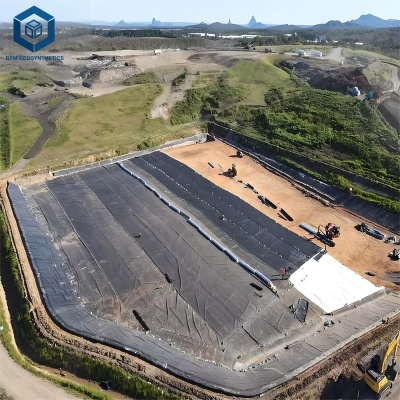
Landfills: Base liner quality assurance.
Mining: Heap leach pad liner testing.
Water containment: Reservoir liner verification.
Chemical containment: Secondary containment testing.
Environmental remediation: Capping and containment.
Stress crack resistance testing is required for most project specifications.
Common Industry Problems and Engineering Solutions
Below are four common problems and their engineering remedies for stress crack resistance testing.
Problem 1: Specimen preparation errors
Root cause: Improper notching.
Solution: Use calibrated notching tools; follow ASTM D5397.
Problem 2: Inconsistent test results
Root cause: Temperature variation.
Solution: Maintain 50 ± 1°C; calibrate equipment.
Problem 3: Low failure time
Root cause: Material quality.
Solution: Require high-MW HDPE; verify test reports.
Problem 4: Test interruption
Root cause: Power or equipment failure.
Solution: Use backup power; monitor regularly.
Risk Factors and Prevention Strategies
Engineering risk management for stress crack resistance testing includes five critical areas:
Specimen errors: Prevention: follow ASTM D5397.
Temperature variation: Prevention: control environment.
Material quality: Prevention: require high-MW HDPE.
Equipment failure: Prevention: maintain regularly.
Documentation: Prevention: use standardized reporting.
Procurement Guide: How to Choose the Right Stress Crack Resistance Testing of HDPE Geomembranes
Buyers should follow this step‑by‑step checklist when evaluating stress crack resistance testing:
Traffic load evaluation – Assess project requirements.
Specification verification – Confirm NCTL requirements.
Certifications – Require ASTM D5397 compliance.
Supplier capability – Audit testing procedures.
Quality control – Review test reports.
Sample testing – Request independent testing.
Warranty evaluation – Examine warranty covering stress crack resistance (≥5 years).
Engineering Case Study
Project: 25 ha landfill base liner
Location: United States
Size: 50,000 m² HDPE geomembrane
Product specification: ASTM D5397: NCTL ≥ 500 hours.
Results & benefits: All samples passed stress crack resistance testing. Material met project specifications.
FAQ Section
A test measuring the resistance of HDPE to slow crack growth.
ASTM D5397.
Notched Constant Tensile Load test.
≥ 500 hours per GRI-GM13.
50 ± 1°C.
10% Igepal surfactant solution.
30% of yield strength.
10 minimum.
Notched strip.
Typically 5–10 years.
Request Technical Support or Quotation
For project-specific engineering assistance, product samples, or technical datasheets for stress crack resistance testing, our technical advisory team is available. We provide:
Customized material selection and testing verification
Free sample panels for independent testing
Full technical specifications and quality assurance guidelines
Direct consultation with geotechnical and polymer engineers
Submit your project parameters through the contact form on our website to receive a detailed engineering proposal within 48 hours.
About the Author
This guide was prepared by senior industry engineers with over 15 years of experience in geomembrane manufacturing, quality assurance, and infrastructure projects across North America, Europe, and Asia. Our team has contributed to EPC projects for landfills, mining, and water containment, providing technical due diligence, factory audits, and post-installation verification. We are not affiliated with any specific brand or platform — our advice is independent and rooted in engineering principles and field failure analysis.