What is Geogrid for Roads?
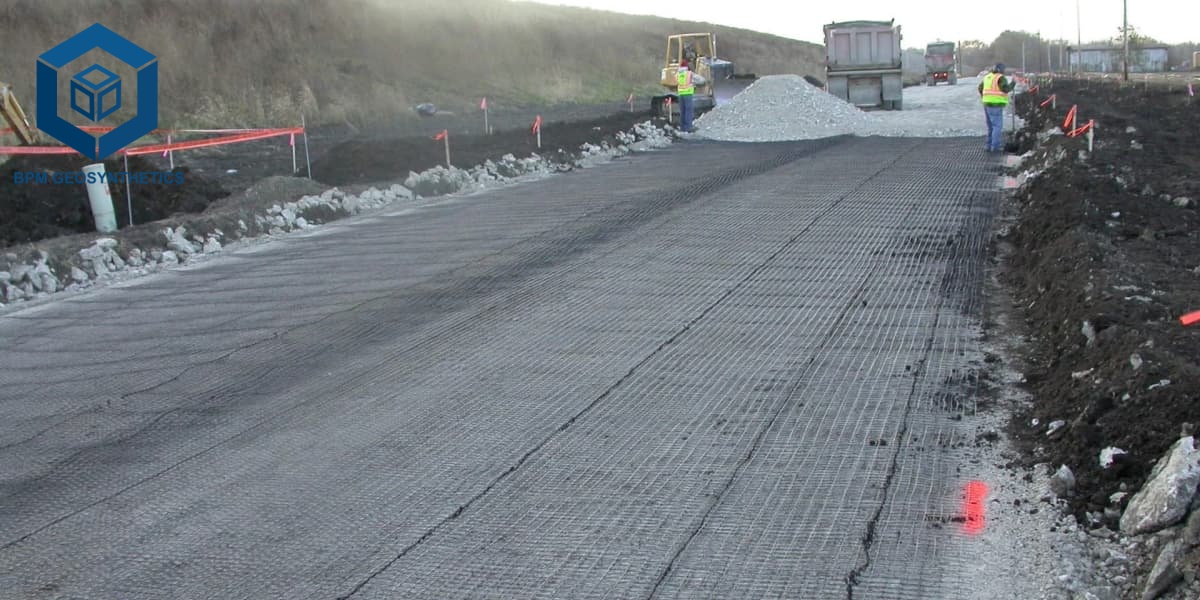
Geogrid for Roads are crucial geosynthetic components that play an important role in civil engineering, helping with soil stabilization, reinforcement, and erosion control. Besides these functions, geogrids are involved in facilitating structures like roads, retaining walls, and landfills.
1. What is Geogrid for Roads?
1.1 Definition and Purpose
Geogrids constitute polymeric structures with a grid-like pattern. Commonly these are made from high-density polyethylene (HDPE), polypropylene (PP), polyester (PET), or carbon fiber. The relatively large openings (10–100 mm) of geogrids interlock with soil or aggregate, thus increasing the tensile strength (20–400 kN/m, ASTM D6637) and the load-bearing capacity by 30–50%. Comparing to the conventional materials like concrete or aggregate, geogrids could lead to 15-25% savings in construction costs, and the predicted life span of these geogrids is from 20 to 120 years (bpmgeosynthetics.com, 2025). Geogrid reinforcement for roads are an integral part of the road construction process, retaining walls, slope stabilization, and landfills. Using them results in improved structural integrity and lower need for maintenance.
1.2 Key Specifications
- Types: Uniaxial (strength in one direction), biaxial (strength in two directions), triaxial (strength in multiple directions), composite (with drainage elements).
- Materials: HDPE (50% of market), PP (40%), PET (10%), carbon fiber (niche, high-strength).
- Tensile Strength (load that the geogrid can endure without breaking): 20–400 kN/m (ASTM D6637).
- Aperture Size (the size of the openings in the grid): 10–100 mm.
- Roll Dimensions: width 1–6 m, length 50–200 m.
- UV Resistance: retains 90% after exposure for 500 hours to ultraviolet light (ASTM D4355).
- Certifications: ISO 9001, ASTM D6637, GRI-GG standards.
- Durability: synthetic materials can last 50–100 years; coated geogrids have a life of 20–50 years.
- Manufacturing: Depending on the application, the product can be made using extrusion, weaving, knitting, or welding techniques.
1.3 Applications
- Road Construction: Helps in reducing the pavement thickness to 20–30%, translating to a cost saving of $50,000 per km.
- Retaining Walls: Increase the stability of soil by 40%, a factor crucial to prevent the failure of walls.
- Slope Stabilization: Through use of geogrids erosion on steep slopes can be reduced by 50-80%.
- Landfills: Geogrids are used for reinforcing liners, and therefore increase their lifespan effectively by 10-20 years.
- Railways: Enhance the stability of tracks so that the maintenance requirement is reduced by 30%.
2. Introduction to BPM Geogrid for Roads
Geogrids are the geosynthetic products commonly made with polymer materials. Due to the abilities of strength in tension and heavy load distribution across large area, BPM geogrid is widely used to reinforce soils and other materials in construction applications such retaining walls, foundation soil and pavement construction, etc. Typical geogrid products include biaxial geogrid, uniaxial geogrid and fiberglass geogrid. They have the features of strong tension, higher bearing load capacity, easy construction, land optimization, soil erosion protection, lower maintenance cost, etc.
2.1 Warp Knitting Polyester Geogrid
2.1.1 Description
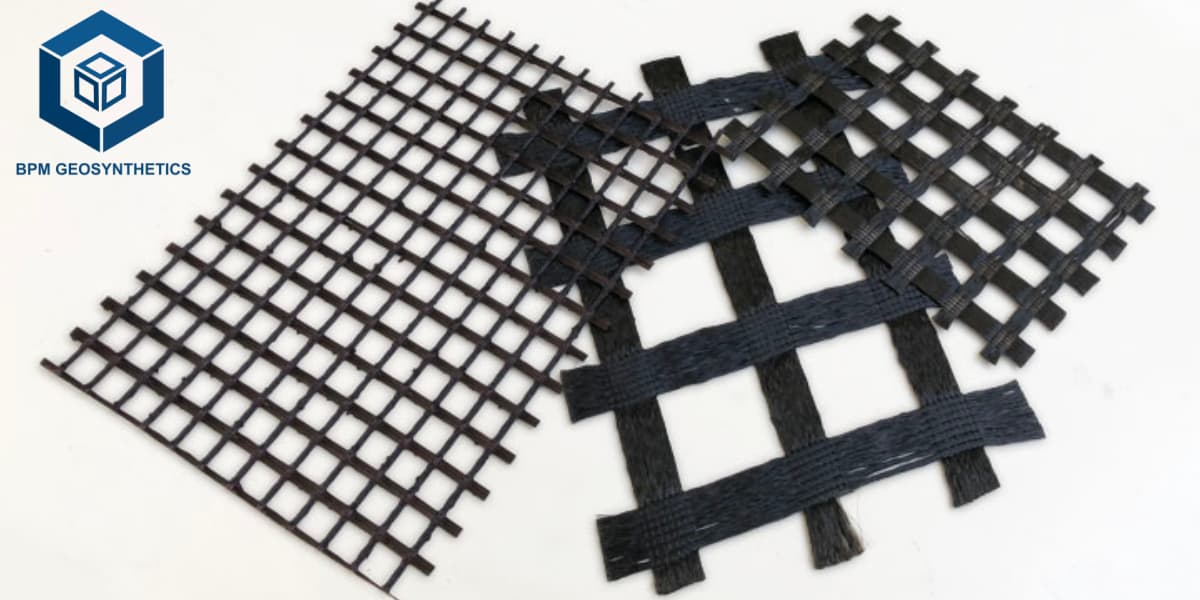
Polyester geogrid is fabricated by the complex knitting process using high tenacity, high oriented polyester filament to provide superior engineering and long term design strength properties. BPM warp knitting polyester geogrid is specifically designed for improved tensile reinforcement capacity in two principle directions. Our warp knitting polyester geogrid is engineered to be mechanically and chemically stable and biologically unaffected by soil micro-organisms. It is used for both harsh construction installation phase and in soil reinforcement application where strength develops uni-axially which can provide further chemical, mechanical and ultraviolet protection.
2.1.2 Warp Knitting Polyester Geogrid Specifications
Item | PET20-20 | PET30-30 | PET340-40 | PET50-50 | PET80-80 | PET100-100 | PET120-120 | |
Elongation(%) | 13% | |||||||
Intensity (kN/m) | Longitudinal | 20 | 30 | 40 | 50 | 80 | 100 | 120 |
Transverse | 20 | 30 | 40 | 50 | 80 | 100 | 120 | |
Grid (mm) | 12.7*12.7 25.4*25.4 | |||||||
Breadth (m) | 1-6 | |||||||
2.1.3 Warp Knitting Polyester Geogrid Features
Excellent mechanical properties and long-term stability.
High tensile strength.
High wear resistance.
Anti-corrosion resistance.
Balanced vertical and horizontal strength.
Strong tearing resistance.
Excellent soil surface adaptability, especially the tilted or curved surface.
High resistance to dynamic impact load and vibration activity.
Strong strengthening ability.
Excellent resistance to differential settlement.
Easy to install.
2.1.4 Warp Knitting Polyester Geogrid Application
Road or railway road sub-grade reinforcement
Walls retaining
Harbor, lake or dam stabilization
Tunnels and mining construction
Erosion prevention
Parking lots reinforcement
Anti-snow barriers
2.2 Fiberglass Geogrid
2.2.1 Description
Fiberglass geogrid is made of excellent reinforcement type non-alkali glass fiber yarn which is weaved into base material by using foreign advanced warp knitting directional structure. So the fiberglass geogrid can make full use of yarn textile strength to improve its chemical performance, high tension resistance, tearing resistance and creep resistance. BPM Geosynthetics fiberglass geogrid system is widely used to reinforce road surface, prevent highway harm such as crack and rut from occurring, solve the problem that asphalt road surface is difficult to reinforce. Our fiberglass geogrid is ideal for newer road construction or pavement rehabilitation.
2.2.2 Fiberglass Geogrid Specifications
Item | GSB30-30 | GSB40-40 | GSB50-50 | GSB80-80 | GSB100-100 | GSB125-125 | GSB150-150 | |
Size of mesh (mm) | 12.7*12.7~25.4*25.4 | |||||||
Tensile Strength (kN/m) | Longitudinal | ≥30 | ≥40 | ≥50 | ≥80 | ≥100 | ≥125 | ≥150 |
Transverse | ≥30 | ≥40 | ≥50 | ≥80 | ≥100 | ≥125 | ≥150 | |
Elongation Rate (%) | ≤4 | |||||||
Temperature Resistance (℃) | 100~280 | |||||||
2.2.3 Fiberglass Geogrid Features
Excellent reinforcement material in road construction.
Extending service life of road and prevent deflection cracks.
Fiberglass geogrid is polymer coated and includes a tack-film which is features high tensile strength in both warp and weft directions, low elongation, excellent temperature range, good anti-age and alkali-resistance.
Compared to traditional materials, the use of fiberglass geogrid can reduce construction costs,
Suitable for all types of asphalt mixes.
Minimizes both thermal and stress related reflective cracking.
Reduces pavement rutting under high ambient temperatures and intense wheel loads.
Increases the fatigue life of pavements with weak foundations.
Extends pavement life.
Easy installation.
2.2.4 Fiberglass Geogrid Application
Reinforcement of roads and crack prevention for airport runways, taxiways, roads, bridges, parking lots, jointed concrete highways to control reflective cracking.
New highway construction, and other road maintenance/repair jobs to improve pavement life.
Expanding thoroughfares and road lanes.
Asphalt reinforcement at locations subject to intensive vehicle braking or accelerating, important junctions, bus stops etc.
2.3 Steel Plastic Geogrid Reinforcement
2.3.1 Description
Geogrid reinforcement with steel and plastic is characterized by high corrosion resistance and excellent wear resistance. BPM Geosynthetics steel plastic geogrid reinforcement is made of high strength steel coated with virgin polyethylene or high density polyethylene by special ultrasonic welding technology.
2.3.2 Steel Plastic Geogrid Reinforcement Specifications
Item | GSZ30-30 | GSZ40-40 | GSZ50-50 | GSZ60-60 | GSZ80-80 | GSZ100-100 | GSZ150-150 | |
Tensile Strength (kN/m) | Longitudinal | ≥30 | ≥40 | ≥50 | ≥60 | ≥80 | ≥100 | ≥150 |
Transverse | ≥30 | ≥40 | ≥50 | ≥60 | ≥80 | ≥100 | ≥150 | |
Elongation Rate (%) | Longitudinal | ≤2 | ||||||
Transverse | ≤2 | |||||||
Strength at 1% elongation (KN/m) | Longitudinal | ≥20 | ≥32 | ≥40 | ≥48 | ≥63 | ≥81 | ≥125 |
Transverse | ≥20 | ≥32 | ≥40 | ≥48 | ≥63 | ≥81 | ≥125 | |
Limit peel force at welded bonded point N | ≥100 | ≥100 | ≥100 | ≥100 | ≥100 | ≥100 | ||
2.3.3 Steel Plastic Geogrid Reinforcement Features
High strength, small deformation.
Good performance for seismic waves
Excellent dimensional stability
Strong bearing capacity
High friction coefficient
Low elongation rate at break
Long service life
Easy to install
2.3.4 Steel Plastic Geogrid Reinforcement Applications
Soil stabilization for roads, airport, embankment
Railway ballast reinforcement over soft foundations
Base reinforcement and soil stabilization
Slope protection
Foundation support
Heavy duty pavements
2.4 Plastic Geogrid
2.4.1 Description
Plastic geogrid includes biaxial geogrid and uniaxial geogrid according to its structure. BPM biaxial polyethylene plastic geogrid is made of polyethylene or high density polyethylene as the main raw material through the processes of hot-melt extrusion, vertical and horizontal stretching to form a high strength reinforced square mesh structure. So the plastic geogrid material on the longitudinal and transverse has great mechancal strength which can provide a more effectively undertake and spread of the tensile strength thought system inside the soil.
2.4.2 Plastic Geogrid Specifications
Item | TGSG15-15 | TGSG15-15 | TGSG15-15 | TGSG15-15 | TGSG15-15 | TGSG15-15 | |
Tensile Strength (kN/m) | Longitudinal | ≥15 | ≥20 | ≥25 | ≥30 | ≥35 | ≥40 |
Transverse | ≥15 | ≥20 | ≥25 | ≥30 | ≥35 | ≥40 | |
Elongation Rate (%) | Longitudinal | ≤13 | ≤13 | ≤13 | ≤13 | ≤13 | ≤13 |
Transverse | ≤16 | ≤16 | ≤16 | ≤16 | ≤16 | ≤16 | |
Strength at 2% elongation (KN/m) | Longitudinal | ≥5 | ≥8 | ≥8 | ≥11 | ≥12 | ≥13 |
Transverse | ≥7 | ≥10 | ≥11 | ≥13 | ≥14 | ≥15 | |
Strength at 5% elongation (≥KN/m) | Longitudinal | ≤8 | ≤10 | ≤11 | ≤15 | ≤15 | ≤16 |
Transverse | ≤10 | ≤13 | ≤13 | ≤15 | ≤18 | ≤20 | |
2.4.3 Plastic Geogrid Features
Excellent soil stabilization
Good sub-base reinforcement
Heavy duty foundation support
High strength
Anti-corrosion
Erosion control
Good aperture stability
High junction efficiency
Long service life
Easy to install
2.4.4 Plastic Geogrid Application
High tensile strength and excellent mechanical properties.
Good aperture stability.
Excellent cold resistance and thermal stability.
High wear resistance.
Anticorrosion, low creep.
Excellent soil stability.
Good base reinforcement, effectively prevent pavement cracks, rutting.
Heavy foundation protection.
Long service life.
Easy to install.
3. How Does Geogrid for Roads Work?
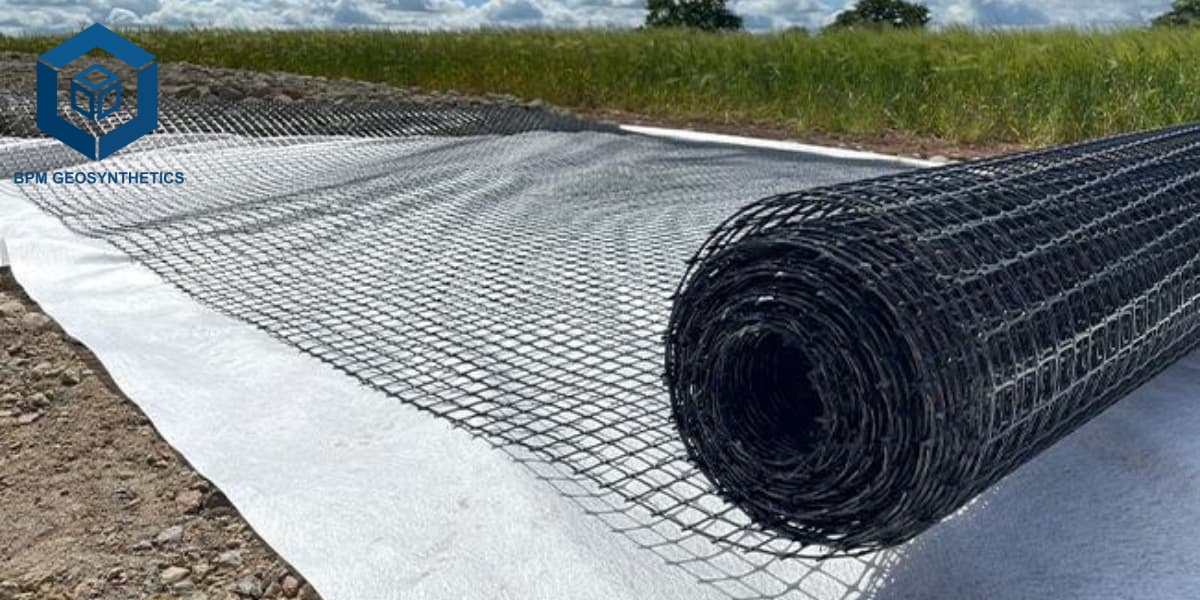
Geogrids for roads enhance the interaction between the materials used for the road base and the soil underneath, which is essential for the reinforcement. While traditional road construction methods depend mainly on thicker layers of aggregates, geogrid for gravel roads produce a mechanically stabilized system that, among other advantages, improves load distribution, increases the bearing capacity, and lessens the deformation of the pavement over time.
By combining geogrids with the road structure, engineers manage to construct stronger and more durable roads, at the same time cutting down on the costs of both construction materials and maintenance.
3.1 Working Principle of Load Distribution
Distributing the traffic loads more uniformly through the pavement structure is the major role of geogrids in road construction. The wheel loads from vehicles crossing over a road generate stress that is concentrated and transmitted via the pavement layers to the soil on which the pavement rests.
Such concentrated loads, if left unreinforced, may exert excessive pressure on weak soils and cause problems like settlement, rutting, cracking, etc. Usually, to counterbalance this, the thickness of aggregate layers has to be increased, which, in turn, results in higher construction expenses.
A geogrid for road construction placed in the road base serves as a tensile reinforcement layer that spreads vertical loads over an enlarged area. The force is not directed to the spot directly under the wheel path; instead, the geogrid laterally redistributes the load in the aggregate layer. Consequently, stress to the underlying subgrade is dramatically decreased and the structural capacity of the roadway is significantly boosted.
3.1.1 Major advantages obtained with load distribution include:
Pressure on the weak subgrade soils is minimized.
The load-bearing capacity of the road foundation is increased.
The pavement deformation resulting from heavy traffic is reduced.
The quantity of aggregates needed is lowered.
The lifespan of the pavement is prolonged.
Especially for roads overlying soft clay, silty soils, or other weak foundations, where traditional methods fail to achieve adequate stability, this load spreading mechanism is a big help.
3.2 Aggregate Interlock Phenomenon
The formation of aggregate interlock is among the principal reinforcement features of geogrids. Geogrids have a network of apertures, or slots, through which aggregate particles can pass and become physically locked within the grid structure.
Upon loading a geogrid with crushed stone or granular fill and compacting it, the particles penetrate the apertures and a strong interlock connection is formed. Such an interlock limits the particles' movement and a reinforced composite layer of both aggregate and geogrid evolves as a result.
The problem with no reinforcement is that the particles of the aggregate can be pushed to the sides because of continuous loading of traffic. That way the strength of the base is slowly lost; meanwhile, the formation of ruts and other damages lead to degradation. The aggregate interlock keeps the particles in position despite even the application of heavy loads, thereby preventing the displacement.
3.2.1 Here are stated some of the advantages of aggregate interlock:
Improved shear strength of the base layer.
More stable granular materials.
Decrease in the lateral spreading of aggregates.
Greater force resistance of pavement structure.
Improved transfer of loads through the road system.
Choosing the correct aperture size in relation to the aggregate gradation is key to the successful exploitation of aggregate interlock. When perfectly matched, geogrids are able to offer maximum confinement and the highest reinforcement results.
3.3 Confinement and Reinforcement
Geogrids also improve road performance through confinement and reinforcement mechanisms. Confinement occurs when the geogrid restricts the lateral movement of aggregate particles under load. This creates a stable and compacted base layer capable of supporting higher traffic loads without excessive deformation.
Under repeated vehicle loading, aggregate particles naturally tend to move outward from the wheel path. This lateral displacement weakens the road structure and contributes to rut formation. Geogrids act as a restraint system that limits this movement, maintaining the integrity of the aggregate layer.
As the aggregate attempts to move, tensile forces develop within the geogrid. These forces counteract the outward pressure and help stabilize the pavement structure. The reinforcement effect significantly improves the mechanical properties of the road base and reduces the risk of structural failure.
3.3.1 The confinement and reinforcement mechanisms provide several important benefits:
Reduced rutting and permanent deformation.
Increased pavement stiffness and strength.
Improved resistance to dynamic traffic loads.
Enhanced performance on soft or unstable soils.
Reduced differential settlement.
Greater long-term durability and reliability.
In applications such as highways, mining haul roads, airport pavements, and industrial access roads, geogrid confinement can significantly extend pavement life while minimizing maintenance requirements. By maintaining aggregate stability and improving load transfer efficiency, geogrids help roads withstand heavy traffic and challenging environmental conditions over many years.
Conclusion
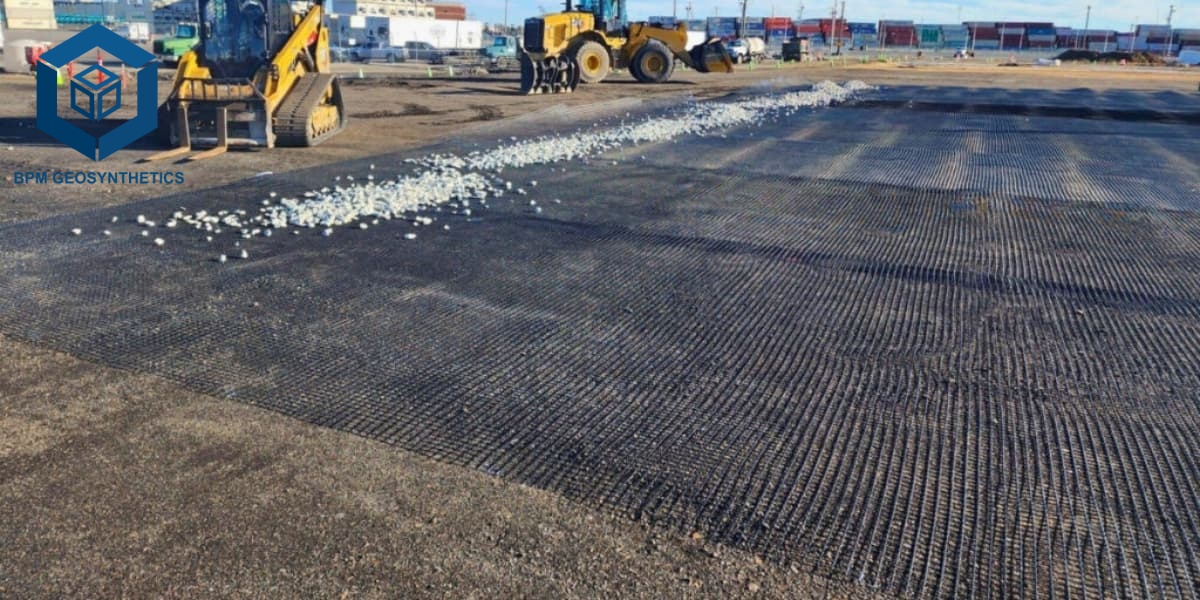
The effectiveness of geogrid for roads is based on three key engineering mechanisms: load distribution, aggregate interlock, and confinement reinforcement. Together, these functions improve soil stability, enhance pavement strength, reduce construction costs, and extend road service life. As a result, geogrids have become an essential solution for modern road construction projects where long-term performance and cost efficiency are critical.
The Best Project Material Co., Ltd.(BPM Geosynthetics) is not only fabricating best quality geogrids and geosythetics but also providing installation service. OEM, ODM, custom development and fabrication are also available. If you have any questions or inquiries, please contact us.