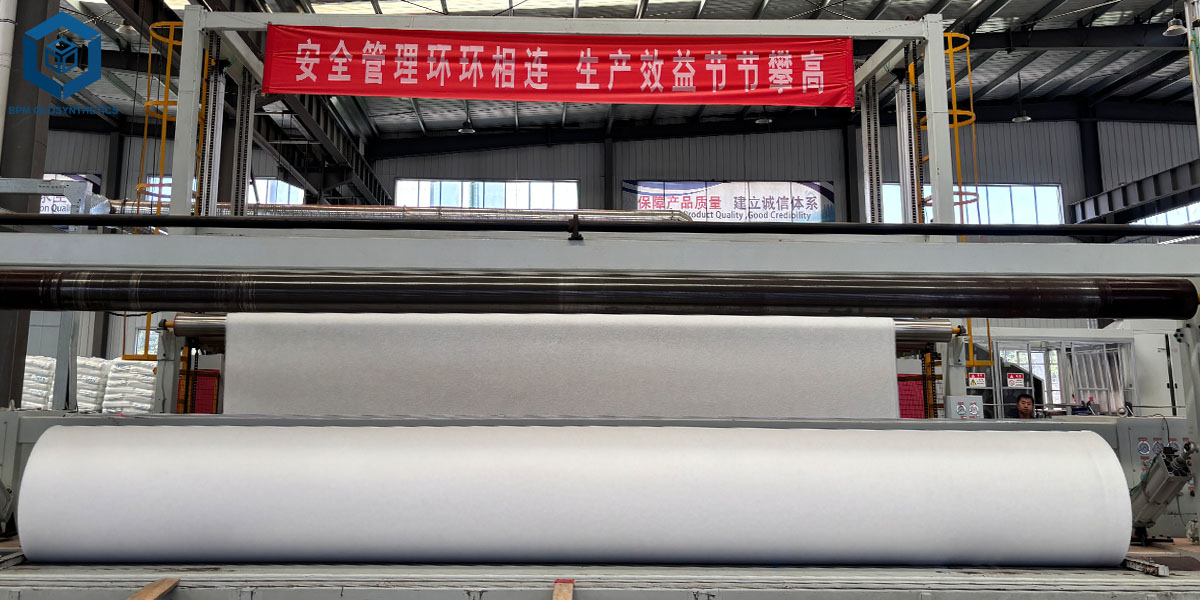
The 8 Best Geo Fabric for Roads Review
Introduction
Road construction demands durable materials. Engineers need reliable solutions. Geo fabric is one such solution. It strengthens road structures. It extends pavement life. It reduces maintenance costs.
This review covers the top 8 geo fabric for roads. We focus on performance and value. All products come from BPM Geosynthetics. BPM Geosynthetics is a trusted manufacturer. We provide detailed specifications. We explain key features. We help you choose the right fabric.
1. What is Geo Fabric for Roads?
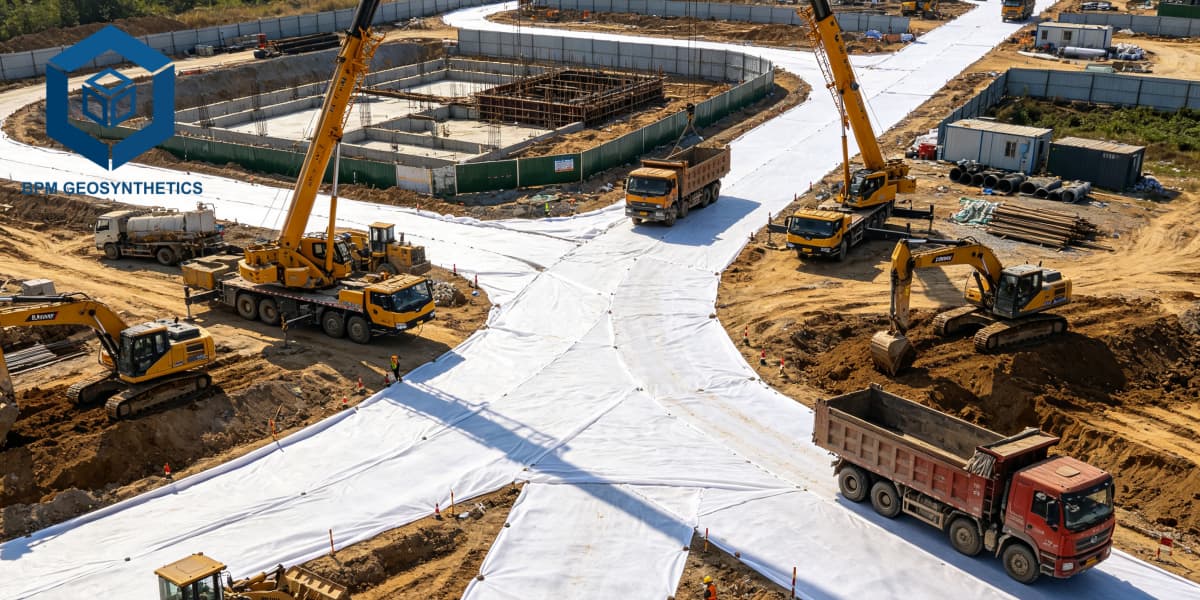
Geo fabric is a permeable synthetic material. It is made from polypropylene or polyester fibers. It performs multiple functions. It separates soil layers. It reinforces weak ground. It filters water. It aids drainage.
Roads face many stresses. Heavy loads cause deformation. Water weakens subgrades. Soil mixing reduces strength. Geo fabric solves these problems. It acts as a barrier. It distributes loads. It prevents fine particle loss.
Modern road design uses geotextile extensively. They are cost-effective. They improve sustainability. They reduce aggregate use. They lower carbon footprints. BPM Geosynthetics manufactures high-quality options. Each product meets strict standards.
2. Key Functions of Geo Fabric for Roads
Selecting the right geotextile requires understanding how it interacts with different soil layers and environmental conditions. BPM geotextiles perform five fundamental functions that directly extend pavement lifespan and reduce long-term maintenance costs.
2.1 Separation
2.1.1 Preventing Layer Intermixing:
Over time, heavy traffic loads force coarse base-course aggregates down into soft subgrade soils, while fine subgrade particles migrate upward. Geotextile for road construction act as an impermeable mechanical barrier between these two distinct soil zones.
2.1.2 Preserving Structural Thickness & Integrity:
By preventing intermixing, the base aggregate retains its design thickness, friction angle, and structural strength. Without a separator, up to 30–50% of base aggregate can be lost into the subgrade during construction and early service life.
2.1.3 Optimizing Load Distribution:
Maintaining a clean base layer ensures that traffic wheel loads are distributed over a wider area as designed, preventing localized shear failures.
2.2 Reinforcement
2.2.1 Tensile Load Absorption:
Soil possesses high compressive strength but virtually no tensile strength. Nonwoven and woven geotextiles absorb tensile stresses developed by traffic loads, transferring forces laterally across the fabric plane.
2.2.2 Subgrade Stabilization & Bearing Capacity:
On soft or weak soils (such as clay or saturated silt), geotextiles provide a "membrane effect." This increases the soil’s ultimate bearing capacity, allowing heavy equipment to operate safely during construction.
2.2.3 Rutting Mitigation:
By interlocking with or gripping adjacent soil particles, geotextile for roads restrict lateral movement of the aggregate base. Field research shows that geotextile reinforcement can reduce pavement rutting depth by up to 40–60% and extend pavement fatigue life significantly.
2.3 Filtration
2.3.1 Cross-Plane Water Passage:
Filtration occurs when water moves perpendicular to the fabric plane. Geotextiles allow groundwater to pass freely while retaining fine soil particles (sand, silt, and clay) on the upstream side.
2.3.2 Preventing Piping & Clogging:
Through precisely engineered Apparent Opening Size (AOS) and high permittivity, BPM Geosynthetics geo fabric for road prevent fine particle migration (piping) into drainage systems without becoming clogged by fine grains.
2.3.3 Filter Cake Formation:
Over time, larger soil particles form a natural "bridging network" against the geotextile surface. This creates a stable, self-filtering soil layer that ensures long-term hydraulic equilibrium.
2.4 Drainage
2.4.1 In-Plane Fluid Transmission:
Unlike filtration, drainage refers to the flow of water within the thickness of the geotextile itself (transmissivity or planar flow). Thick needle-punched nonwoven geotextiles excel at collecting and conveying water laterally away from the road structure.
2.4.2 Pore Water Pressure Relief:
Heavy rainfall or high water tables generate excess pore water pressure beneath the pavement, weakening subgrade support. Geotextile fabric rapidly dissipate this hydrostatic pressure, maintaining soil shear strength.
2.4.3 Protection Against Freeze-Thaw & Waterlogging:
Efficient lateral drainage prevents water accumulation in the road base, significantly reducing frost heave damage in cold climates and waterlogging-induced stripping in asphalt layers.
2.5 Protection (Cushioning)
2.5.1 Puncture & Impact Resistance:
During construction, placing sharp, angular aggregate directly over vulnerable surfaces (such as geomembranes, soft subgrades, or insulation panels) can cause tearing and puncture. Non woven geotextile fabric act as a protective cushion that absorbs high point-load shocks.
2.5.2 Stress Dispersion:
The geo textile fabric redistributes concentrated mechanical forces caused by heavy compaction equipment or coarse rocks, preventing localized damage to underlying layers.
2.5.3 Long-Term Soil Integrity:
By dampening dynamic impacts from continuous traffic loads, the protective layer minimizes soil disturbance and fatigue over the subgrade throughout the roadway's design life.
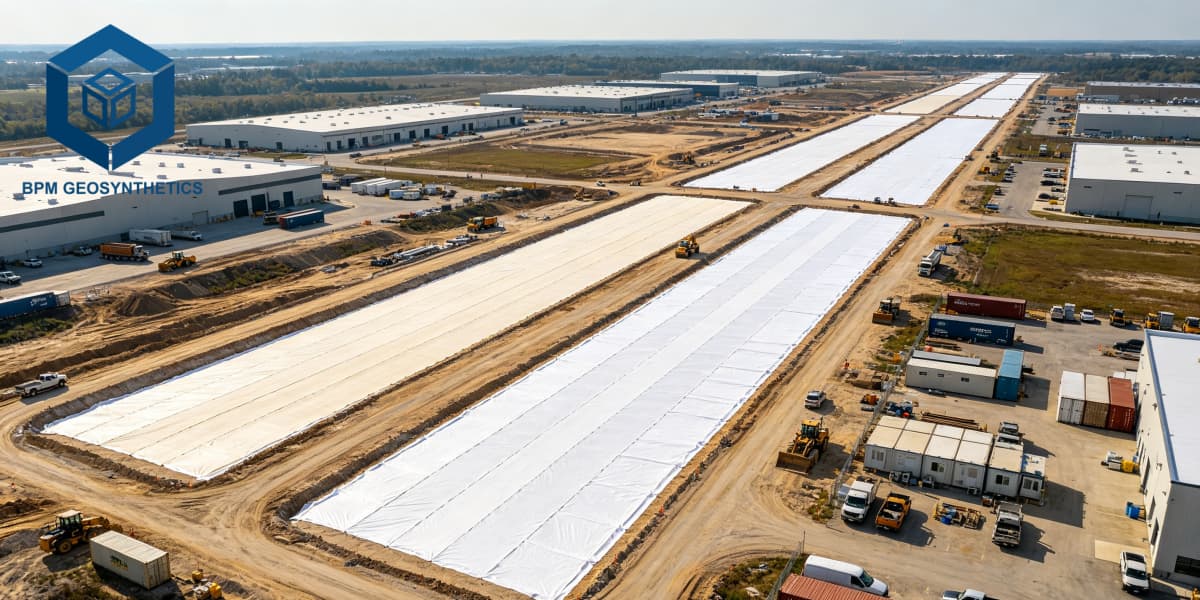
3. The 8 Best BPM Geosynthetics Geo Fabric for Roads
Here is our curated list. Each product suits specific road applications.
3.1 BPM Geosynthetics Woven Geo Fabric - High Strength
This geotextile fabric for driveway offers exceptional tensile strength. It is ideal for heavy-load roads. It reinforces base layers effectively. It handles high stress conditions. It prevents deformation.
- Best for: Highway base reinforcement.
3.2 BPM Geosynthetics Non-Woven Geo Fabric - Drainage
This fabric excels in drainage applications. Its porous structure allows rapid water flow. It filters fine particles efficiently. It prevents subgrade saturation. It suits areas with high water tables.
- Best for: Drainage and filtration systems.
3.3 BPM Geosynthetics Polyester Filament Geo Fabric
This product uses continuous filament yarn. It has excellent heat resistance. It resists UV degradation. It provides consistent performance. It is suitable for long-term projects .
Best for: Permanent road installations.
3.4 BPM Polypropylene Staple Fiber Geo Fabric
This nonwoven geotextile fabric is versatile and economical. It offers good strength. It provides reliable separation. It works well in standard road projects. It is easy to install.
- Best for: General road construction.
3.5 BPM Geosynthetics High-Strength Reinforced Geo Fabric
This fabric handles extreme loads. It has high CBR burst strength. It resists puncturing. It suits heavy traffic roads. It works on weak subgrades.
- Best for: Industrial and port roads.
3.6 BPM Geosynthetics Permeable Geo Fabric for Subgrade
This product prioritizes filtration. It has optimized aperture size. It prevents soil loss. It maintains drainage capacity. It protects subgrade integrity.
- Best for: Subgrade protection.
3.7 BPM Geosynthetics UV-Resistant Geo Fabric
This geotextile fabric near me withstands prolonged sun exposure. It has built-in UV stabilizers. It resists aging. It suits exposed applications. It maintains strength over time .
Best for: Slopes and embankments.
3.8 BPM Geosynthetics Multi-Functional Geo Fabric
This is a general-purpose product. It balances strength and permeability. It offers separation and reinforcement. It is cost-effective. It suits diverse projects.
- Best for: Small to medium road projects.
4. Geo Fabric for Roads Performance Data & Empirical Research
Extensive field trials and laboratory testing demonstrate that incorporating geotextiles into pavement structures delivers significant mechanical and economic performance gains.
4.1 Reduction in Surface Rutting
4.1.1 Empirical Performance:
Under cyclic wheel loads, placing high-stiffness geotextile filter fabric at the subgrade-base interface reduces surface rut depths by up to 96% compared to unreinforced control sections in soft-soil conditions.
4.1.2 Deformation Mechanism:
The geotextile acts as a tensioned membrane under wheel loading. As rutting starts to develop, the geotextile fabric under gravel stretches and develops upward support forces (tensile strain mobilization), locking base aggregate in place and suppressing vertical surface deformation.
4.1.3 Practical Impact:
Prevents early-stage channel rutting, pot-hole formation, and hydroplaning hazards on flexible pavements.
4.2 Traffic Benefit Ratio (TBR)
4.2.1 Traffic Capacity Extension:
The Traffic Benefit Ratio measures the increase in allowable load cycles (equivalent single-axle loads, or ESALs) before a pavement reaches a terminal serviceability limit.
4.2.2 Empirical Values:
Standard non woven geotextile drainage fabric typically achieve TBR values ranging from 1.5 to 10 (allowing 1.5× to 10× more vehicle passes). When using advanced composite or cement-treated geotextile layers, research indicates localized TBR values climbing dramatically up to 110 depending on subgrade stiffness and rutting targets.
4.2.3 Engineering Value:
Highly advantageous for heavy-haul corridors, industrial access roads, and port logistics areas that experience massive, repeated axle weights.
4.3 Reduced Permanent Subgrade Deformation
4.3.1 Mitigating Plastic Strain:
Experimental loading tests demonstrate that geotextile insertion cuts plastic (permanent) subgrade deformation by up to 82% under dynamic traffic cycles.
4.3.2 Preventing Base Contamination:
By isolating subgrade fines from migrating upward under cyclic pore-water pressure, the fabric maintains constant elastic modulus values in the crushed stone base.
4.3.3 Lifecycle Benefits:
Extends overall pavement fatigue life by 20 to 50 years, significantly lowering the frequency of costly deep-reclamation repairs and mill-and-overlay maintenance cycles.
4.4 Optimized Stress Distribution & Load Spreading
4.4.1 Broader Pressure Envelope:
Unreinforced subgrades experience sharp, concentrated vertical stress directly under wheel paths. Geotextile road fabric increase the stress distribution angle (load-spreading angle θ) from a typical 30°–35° up to 45°–55°.
4.4.2 Peak Stress Reduction:
Accelerated pavement testing shows that the inclusion of geo textile material lowers peak vertical subgrade stresses by 18% to 30%.
4.4.3 Subgrade Protection:
By spreading concentrated wheel loads over a much wider surface area, subgrade stresses remain well below critical plastic yield limits, preventing deep structural foundation failures.
4.5 Aggregate Volume & Cost Savings
4.5.1 Base Layer Thickness Reduction:
Because non woven geotextile filter fabric increase the effective bearing capacity and prevent structural loss into soft subgrades, required crushed aggregate base thickness can be safely reduced by 30% to 50% while maintaining equivalent pavement structural numbers (AASHTO design method).
4.5.2 Direct Economic ROI:
Reduces quarry aggregate purchasing, heavy haul trucking trips, and site grading times—yielding direct material cost savings of 20% to 40% per square meter.
4.5.3 Environmental Benefits:
Lowering aggregate extraction conserves natural rock resources and reduces site-directed carbon emissions from heavy machinery transport.
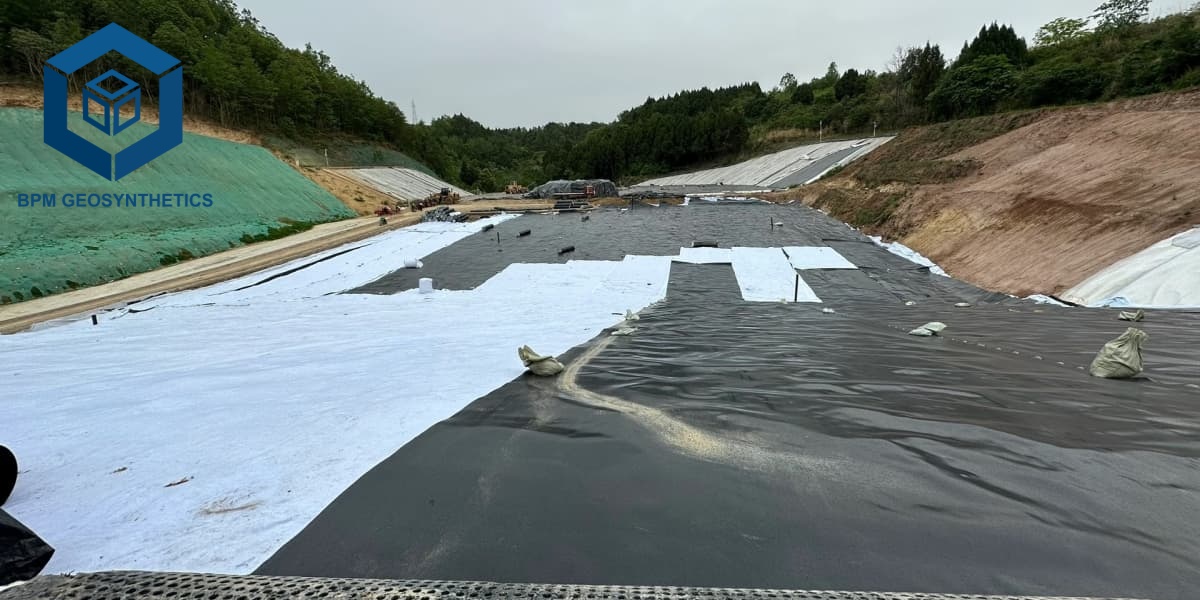
5. Comparison Table of BPM Geosynthetics Geo Fabric for Roads Specifications
This table helps you compare key parameters. Choose the right geotextile fabric for your project.
Property | BPM Woven | BPM Non-Woven | BPM Filament | BPM Staple | BPM Reinforced | BPM Permeable | BPM UV-Resistant | BPM Multi-Functional |
Material | PP/PET | PP/PET | PET | PP | PET | PP | PET | PP |
Weight (g/m²) | 200-800 | 100-600 | 100-800 | 100-500 | 300-800 | 150-400 | 200-600 | 100-400 |
Thickness (mm) | 1.5-5.0 | 1.0-4.0 | 0.8-5.5 | 0.8-3.5 | 2.0-5.0 | 1.0-3.0 | 1.5-4.5 | 0.8-3.0 |
Tensile Strength (kN/m) | 15-40 | 5-20 | 4.5-40 | 4.5-15 | 20-50 | 8-15 | 10-30 | 5-15 |
Elongation (%) | 15-30 | 50-80 | 40-80 | 40-80 | 15-25 | 50-70 | 30-50 | 50-80 |
CBR Burst (kN) | 2.0-5.0 | 1.0-3.5 | 0.8-7.0 | 0.8-2.5 | 3.0-7.0 | 1.5-3.0 | 2.0-4.5 | 1.0-2.5 |
Permeability (cm/s) | 0.01-0.1 | 0.1-0.5 | 0.001-0.1 | 0.1-0.3 | 0.01-0.05 | 0.2-0.5 | 0.05-0.2 | 0.1-0.3 |
Aperture (mm) | 0.15-0.3 | 0.07-0.2 | 0.07-0.2 | 0.07-0.2 | 0.15-0.3 | 0.07-0.15 | 0.1-0.2 | 0.07-0.2 |
UV Resistance | Moderate | Moderate | High | Low | Moderate | Low | High | Low |
Main Function | Reinforcement | Drainage | Strength | Separation | Heavy Load | Filtration | Protection | General |
Data derived from BPM Geosynthetics product specifications and industry standards.
6. How to Choose the Right Geo Fabric for Roads?
Selection depends on project conditions. Consider these factors.
6.1 Subgrade Soil Type
Weak soils need stronger fabrics. High-strength woven types work best. Stable soils may only need separation fabrics.
6.2 Traffic Load
Heavy traffic requires high tensile strength. Use reinforced or woven fabrics. Light traffic can use lighter options.
6.3 Drainage Requirements
Wet sites need permeable fabrics. Non-woven types excel here. They allow rapid water flow. They prevent pore pressure buildup.
6.4 Installation Conditions
Steep slopes need UV protection. Long-term projects need durable materials. Consider exposure duration.
6.5 Cost Considerations
Balance cost against performance. Higher strength costs more. But it saves aggregate. It reduces long-term maintenance. Consider lifecycle costs.
7. Geo Fabric for Roads Installation Best Practices
Proper installation ensures performance. Follow these guidelines.
7.1 Surface Preparation
Clear the site of debris. Remove sharp objects. Level the ground. Ensure proper compaction.
7.2 Roll Placement
Store rolls on flat surfaces. Protect from UV exposure. Cover with opaque material. Limit storage height.
7.3 Unrolling
Unroll fabric in the correct direction. Keep fabric taut. Avoid wrinkles. Allow slight deformation allowance.
7.4 Overlap and Seaming
Overlap adjacent rolls. Minimum overlap is 0.2 meters. Use stitching for seams. Seam width should exceed 0.1 meters .
7.5 Coverage
Cover fabric promptly. Place aggregate soon after laying. Prevent UV damage. Minimize construction traffic on exposed fabric.
8. Benefits of Using BPM Geosynthetics Geo Fabric for Roads
BPM Geosynthetics offers manufacturing excellence. Our products deliver proven advantages.
8.1 Quality Assurance
BPM Geosynthetics uses ISO-certified processes. We conduct batch testing. We verify tensile strength. We check permeability. Every roll meets standards.
8.2 Durability
Our fabrics resist environmental stress. They withstand UV exposure. They resist chemicals. They maintain structural integrity. They perform for years.
8.3 Cost Savings
BPM Geosynthetics geo fabrics reduce aggregate needs. Savings reach 40% in some cases. They lower maintenance costs. They extend road life. They deliver ROI.
8.4 Sustainability
Using geo fabric reduces quarrying. It lowers transport emissions. It enables recycled materials. It supports green construction.
8.5 Technical Support
BPM Geosynthetics provides expert guidance. We help with selection. We assist with installation. We answer technical questions. We ensure project success.
Conclusion
Geo fabric is essential for modern roads. It provides separation and reinforcement. It enables filtration and drainage. It protects subgrades. It extends pavement life.
The Best Project Material Co., Ltd. (BPM Geosynthetics) offers 8 top-performing options. Each suits specific applications. From woven high-strength fabrics to permeable drainage types. You can choose based on your project needs.
Use the specification table for comparison. Consider soil type and traffic load. Follow installation best practices. You will achieve durable road performance.
Choose BPM Geosynthetics for quality and reliability. Our geo fabrics meet international standards. They deliver cost-effective solutions. They support sustainable construction. Contact us for your road project needs.