Antioxidant Additive in Geomembrane Formulation: Engineering Guide
What is Antioxidant Additive in Geomembrane Formulation?
Antioxidant additive in geomembrane formulation refers to the chemical compounds (typically hindered phenols, phosphites, or hindered amine light stabilizers) blended into HDPE resin during extrusion to prevent thermo-oxidative degradation during processing and long-term service. For civil engineers, EPC contractors, and procurement managers, the antioxidant additive in geomembrane formulation is quantified by Oxidative Induction Time (OIT) per ASTM D3895 (Standard OIT) or ASTM D5885 (High Pressure OIT). Without adequate antioxidant protection, HDPE geomembranes undergo chain scission, embrittlement, and stress cracking within months at elevated temperatures or in aggressive chemical environments. This guide provides engineering analysis of antioxidant additive in geomembrane formulation: OIT depletion kinetics, antioxidant package types (primary vs. secondary), compatibility with carbon black, and procurement specifications for landfill liners, mining heap leach pads, and wastewater containment with design lives of 50–100+ years.
Technical Specifications of Antioxidant Additive in Geomembrane Formulation
The table below defines critical parameters related to antioxidant additives per GRI GM13 (Geosynthetic Research Institute) and ASTM standards.
| Parameter | Standard Value | Engineering Importance | |
|---|---|---|---|
| Standard Oxidative Induction Time (OIT, ASTM D3895) | ≥ 100 minutes | Measures antioxidant capacity at 200°C in oxygen. Lower values indicate insufficient antioxidant additive in geomembrane formulation or depletion.}, | |
| High Pressure OIT (HP-OIT, ASTM D5885) | ≥ 400 minutes | Measures antioxidant performance at 150°C under 3.5 MPa oxygen pressure. More representative of long-term aging.}, | |
| OIT Retention after Oven Aging (ASTM D5721) | ≥ 50% after 90 days at 85°C (or 30 days at 110°C) | Predicts long-term antioxidant depletion rate. Critical for design life > 50 years.}, | |
| Antioxidant Package Type | Primary (hindered phenol) + Secondary (phosphite) synergistic blend | Primary antioxidants terminate free radicals; secondary antioxidants decompose hydroperoxides. Both required for extended service life.}, | |
| Carbon Black Interaction | Antioxidants must be compatible with 2.0–3.0% carbon black | Some carbon black grades adsorb antioxidants, reducing effective concentration. Formulation must account for this.}, | |
| Melt Flow Index (MFI, ASTM D1238) | ≤ 1.0 g/10 min (190°C/2.16 kg) | Excessive antioxidants or incorrect type can affect MFI. High MFI indicates degradation.}, | |
| Service Temperature Range | -40°C to +80°C (continuous); up to 110°C (short-term) | Antioxidant additive in geomembrane formulation must be stable at maximum service temperature.}, | |
| Design Life (with adequate antioxidants) | 50 – 100+ years (depending on temperature and chemical exposure) | OIT retention modeling predicts long-term performance. Insufficient antioxidants reduce design life to < 10 years.}, |
Key takeaway: Antioxidant additive in geomembrane formulation is quantified by OIT (≥ 100 min) and HP-OIT (≥ 400 min). OIT retention after oven aging (≥ 50%) is equally critical for predicting long-term durability.
Material Structure and Composition: Role of Antioxidant Additive in Geomembrane Formulation
Antioxidants are functional additives, not fillers. This section explains their engineering role within the HDPE matrix.
| Component | Material | Typical Loading | Function & Engineering Impact |
|---|---|---|---|
| Base Resin | HDPE (virgin, 0.94–0.96 g/cm³) | 96.0–97.5% | Provides mechanical strength, chemical resistance, flexibility. Antioxidant additive in geomembrane formulation protects this base resin.}, |
| Primary Antioxidant | Hindered phenol (e.g., Irganox 1010, 1076) | 0.2–0.5% | Terminates free radicals (R• + ROO•) by donating hydrogen atoms. Prevents chain scission during processing and long-term service.}, |
| Secondary Antioxidant | Phosphite (e.g., Irgafos 168) or thioester | 0.1–0.3% | Decomposes hydroperoxides (ROOH) to non-radical products. Synergistic with primary antioxidants. Extends protection lifetime.}, |
| Carbon Black | Furnace black (2.0–3.0%) | 2.0–3.0% | UV stabilizer. Some grades adsorb antioxidants — formulation must account for this. Antioxidant additive in geomembrane formulation must be compatible.}, |
| Other Additives | Processing aids, acid scavengers | < 0.2% | Improve processability; acid scavengers protect antioxidants from catalyst residues.}, |
Engineering insight: Antioxidant additive in geomembrane formulation requires a synergistic blend of primary (hindered phenol) and secondary (phosphite) antioxidants. Single-component packages provide insufficient long-term protection.
Manufacturing Process: How Antioxidant Additive in Geomembrane Formulation Is Controlled
Production parameters directly affect antioxidant dispersion and retention.
Raw material compounding: Virgin HDPE resin, antioxidant masterbatch (10–20% antioxidants in HDPE carrier), carbon black masterbatch, and other additives are dry-blended. Antioxidant additive in geomembrane formulation target: 0.3–0.8% total antioxidants.
Extrusion: Flat die extrusion (200–220°C). Excessive temperature (> 230°C) degrades antioxidants prematurely. Screw design must minimize shear heating.
Calendering / polishing: Rolls set final thickness. Antioxidant distribution is not affected, but overheating during polishing can initiate oxidation.
Cooling: Three-roll cooling stack (40–60°C). Rapid cooling is acceptable — no effect on antioxidants.
Quality inspection (antioxidant specific): OIT per ASTM D3895; HP-OIT per ASTM D5885; OIT retention after oven aging per ASTM D5721. These tests directly measure antioxidant additive in geomembrane formulation effectiveness.
Rolling and packaging: Geomembrane rolled onto steel cores. Each roll must have OIT and HP-OIT certificate. UV exposure during storage can deplete antioxidants — rolls should be covered.
Procurement insight: Ask your supplier for OIT retention data after accelerated aging. Consistent antioxidant additive in geomembrane formulation across batches and high OIT retention (> 50% after 90 days at 85°C) indicate quality production.
Performance Comparison: Antioxidant Additive in Geomembrane Formulation vs. No Antioxidant
Comparing antioxidant-protected vs. unprotected HDPE geomembranes.
| Property | With Antioxidant (GRI GM13) | Without Antioxidant / Depleted | Engineering Impact |
|---|---|---|---|
| Initial OIT (ASTM D3895) | ≥ 100 minutes | < 20 minutes | Antioxidant additive in geomembrane formulation provides processing and short-term thermal stability.}, |
| OIT after 90 days at 85°C | ≥ 50 minutes (50% retention) | < 5 minutes | Without adequate antioxidant, geomembrane embrittles rapidly at elevated temperatures.}, |
| Tensile Elongation after Aging | ≥ 700% (unaged); ≥ 350% after aging | < 100% after aging | Loss of elongation indicates embrittlement — liner will crack under stress.}, |
| Stress Crack Resistance (ASTM D5397, SP-NCTL) | ≥ 500 hours (unaged); ≥ 250 hours after aging | < 50 hours | Antioxidant depletion leads to rapid stress crack failure, especially in notched or welded areas.}, |
| Design Life (50°C service) | 20 – 30 years (depending on antioxidant package) | < 2 years | Antioxidant additive in geomembrane formulation is essential for long-term applications.}, |
Conclusion: Antioxidant additive in geomembrane formulation is mandatory for any application with design life > 5 years or service temperature > 40°C. Without it, geomembrane fails within months to a few years.
Industrial Applications Requiring Specified Antioxidant Additive in Geomembrane Formulation
Proper antioxidant protection is critical for long-term exposed or high-temperature applications.
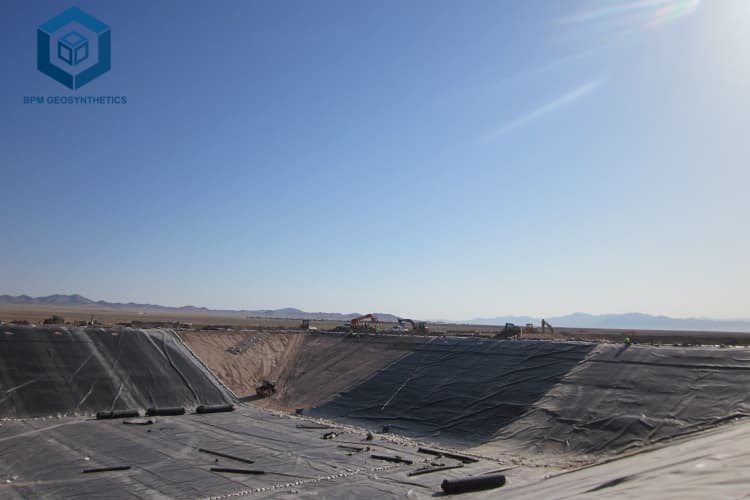
Landfill liners and covers (bottom liners): Elevated temperatures from waste decomposition (up to 60°C). Antioxidant additive in geomembrane formulation must provide OIT retention for 100+ year design life.
Mining heap leach pads (exposed): High UV exposure plus elevated temperatures in arid climates. Antioxidant depletion accelerated — specify HP-OIT ≥ 400 minutes.
Wastewater treatment lagoons (exposed, warm climates): Continuous UV and elevated water temperatures. Antioxidant additive in geomembrane formulation critical.
Secondary containment (tank farms, chemical plants): Contact with aggressive chemicals at elevated temperatures. Antioxidants must be compatible with chemical exposure.
Potable water reservoirs (floating covers): Long-term UV exposure. Antioxidant additive in geomembrane formulation must meet NSF/ANSI 61 for drinking water contact.
Oil and gas exploration (lined pits): Elevated temperatures from produced fluids (up to 80°C). High-temperature antioxidant packages required.
Common Industry Problems and Engineering Solutions Related to Antioxidant Additive in Geomembrane Formulation
Real-world failures from inadequate antioxidant protection.
Problem 1: Premature embrittlement in landfill bottom liner (after 8 years)
Root cause: Insufficient antioxidant additive in geomembrane formulation (initial OIT 45 minutes, below GRI GM13 minimum of 100 minutes). Accelerated depletion from waste heat (55–60°C).
Engineering solution: Specify initial OIT ≥ 100 minutes and HP-OIT ≥ 400 minutes. Require OIT retention ≥ 50% after 90 days at 85°C (ASTM D5721).
Problem 2: Stress cracking at field welds after 3 years (mining heap leach)
Root cause: Antioxidant depletion due to carbon black adsorption. Poor compatibility between carbon black and antioxidant package.
Solution: Request antioxidant additive in geomembrane formulation compatibility data. Use carbon black masterbatch specifically designed for antioxidant retention. Verify SP-NCTL stress crack resistance after aging.
Problem 3: Low HP-OIT (< 200 minutes) despite standard OIT > 100 minutes
Root cause: Antioxidant package lacks secondary (phosphite) antioxidants. HP-OIT is more sensitive to antioxidant depletion.
Solution: Specify both standard OIT (≥ 100 min) AND HP-OIT (≥ 400 min). HP-OIT is required per GRI GM13 for geomembrane ≥ 1.5 mm.
Problem 4: Inconsistent OIT across rolls from same supplier
Root cause: Poor compounding control — antioxidant masterbatch feeder drift or inconsistent mixing.
Solution: Audit supplier's compounding process. Request batch-to-batch OIT and HP-OIT data. Antioxidant additive in geomembrane formulation should be within ±15% of target across all rolls in an order.
Risk Factors and Prevention Strategies for Antioxidant Additive in Geomembrane Formulation
Risk: Counterfeit or recycled material with unknown antioxidant content: Recycled HDPE has depleted antioxidants. Mitigation: Specify virgin resin only. Require Certificate of Analysis (COA) with OIT and HP-OIT results for each batch.
Risk: Antioxidant depletion from high-temperature processing: Extrusion above 230°C degrades antioxidants before geomembrane is produced. Mitigation: Audit supplier's extrusion temperature logs. Request OIT before and after processing.
Risk: Incompatibility with carbon black: Some carbon black grades adsorb antioxidants, reducing effective concentration by 30–50%. Mitigation: Specify antioxidant additive in geomembrane formulation tested with specific carbon black grade. Request OIT after carbon black addition.
Risk: Accelerated depletion in high-temperature service (> 50°C): Arrhenius modeling predicts OIT half-life of 5–10 years at 50°C vs. 50+ years at 20°C. Mitigation: For high-temperature applications, specify HP-OIT ≥ 800 minutes (double GRI GM13).
Procurement Guide: How to Specify Antioxidant Additive in Geomembrane Formulation
Follow this 8-step checklist for B2B purchasing decisions.
Determine service temperature and design life: Higher temperatures require higher initial OIT and HP-OIT. For > 50°C service, specify HP-OIT ≥ 800 minutes.
Request ASTM D3895 (Standard OIT) report: Minimum 100 minutes. Reject below 100 minutes. This is the primary measure of antioxidant additive in geomembrane formulation.
Request ASTM D5885 (High Pressure OIT) report: Minimum 400 minutes (per GRI GM13 for ≥ 1.5 mm). Reject below 400 minutes.
Require OIT retention after oven aging (ASTM D5721): ≥ 50% after 90 days at 85°C (or 30 days at 110°C). This predicts long-term antioxidant depletion rate.
Verify antioxidant package type: Request formulation data — must include both primary (hindered phenol) and secondary (phosphite) antioxidants. Single-component packages are insufficient.
Order samples and perform independent OIT testing: Send to third-party lab (e.g., SGS, Intertek) for OIT and HP-OIT verification before full order acceptance.
Review supplier's compounding process: Ask about antioxidant masterbatch feeder calibration, in-line OIT monitoring, and batch records. Consistent antioxidant additive in geomembrane formulation across batches indicates quality.
Confirm warranty: Minimum 10–15 year warranty for exposed applications. Warranty must specifically cover antioxidant-related degradation (embrittlement, stress cracking).
Engineering Case Study: Antioxidant Depletion Failure in Landfill Liner
Project type: Municipal solid waste landfill, bottom liner.
Location: Central Europe (moderate climate, but waste temperature 55°C).
Project size: 120,000 m², 2.0 mm HDPE geomembrane.
Specification: GRI GM13 required OIT ≥ 100 min, HP-OIT ≥ 400 min. Supplier delivered material with OIT 112 min, HP-OIT 385 min (below spec).
Failure after 9 years: Leak detection system showed increased flow. Excavation revealed embrittled geomembrane with < 50% elongation. OIT measured 12 minutes (depleted). Root cause: insufficient HP-OIT (385 vs. required 400) and possible carbon black incompatibility.
Remediation: Replacement of 120,000 m² liner at €6M + regulatory fines. Subsequent procurement required HP-OIT ≥ 600 minutes and third-party verification of antioxidant additive in geomembrane formulation before acceptance.
Frequently Asked Questions: Antioxidant Additive in Geomembrane Formulation
Q1: What is the minimum OIT requirement for HDPE geomembrane per GRI GM13?
Standard OIT (ASTM D3895) ≥ 100 minutes. High Pressure OIT (ASTM D5885) ≥ 400 minutes for geomembrane ≥ 1.5 mm thickness. These are the key specifications for antioxidant additive in geomembrane formulation.
Q2: Why is High Pressure OIT (HP-OIT) required in addition to standard OIT?
HP-OIT is more sensitive to long-term antioxidant depletion and better correlates with field performance. Standard OIT can be high even if secondary antioxidants are depleted. GRI GM13 requires both for geomembrane ≥ 1.5 mm.
Q3: What is OIT retention and why does it matter?
OIT retention (ASTM D5721) measures antioxidant remaining after oven aging. ≥ 50% retention after 90 days at 85°C indicates good long-term stability. Low retention predicts premature embrittlement even with high initial OIT. Critical for evaluating antioxidant additive in geomembrane formulation.
Q4: How do primary and secondary antioxidants differ?
Primary antioxidants (hindered phenols) terminate free radicals. Secondary antioxidants (phosphites) decompose hydroperoxides. Both are required for synergistic protection. Single-component antioxidant additive in geomembrane formulation is insufficient for long-term applications.
Q5: Does carbon black affect antioxidant performance?
Yes. Some carbon black grades adsorb antioxidants, reducing effective concentration by 30–50%. Antioxidant additive in geomembrane formulation must be tested with the specific carbon black grade used. Request OIT after carbon black addition.
Q6: What is the expected OIT half-life in service?
At 20°C: 50–100+ years. At 50°C: 5–10 years. At 80°C: 1–2 years. Arrhenius modeling predicts depletion. For high-temperature applications, specify higher initial OIT (≥ 200 min) and HP-OIT (≥ 800 min).
Q7: Can recycled HDPE geomembrane meet OIT specifications?
No. Recycled HDPE has unknown antioxidant content and depletion history. Antioxidant additive in geomembrane formulation is not verifiable in recycled material. Specify virgin resin only for critical applications.
Q8: How is OIT tested?
Differential Scanning Calorimetry (DSC). Sample is heated in oxygen atmosphere at 200°C (standard OIT) or 150°C under 3.5 MPa oxygen (HP-OIT). Time to exothermic oxidation onset is measured in minutes.
Q9: What is the relationship between OIT and stress crack resistance?
Antioxidant depletion leads to chain scission and reduced molecular weight, which directly reduces stress crack resistance (ASTM D5397). Adequate antioxidant additive in geomembrane formulation maintains SP-NCTL ≥ 500 hours (unaged) and ≥ 250 hours after aging.
Q10: How can I verify antioxidant additive in geomembrane formulation on site?
On-site verification is not possible — requires DSC lab equipment. Take representative samples from each roll and send to third-party lab for OIT and HP-OIT testing. Do not accept COA alone for critical projects.
Request Technical Support or Quotation for HDPE Geomembrane with Specified Antioxidant Additive
For project-specific antioxidant specifications, OIT testing, or bulk procurement, our technical team is available.
Request a quotation – Provide thickness, area, service temperature, design life, and required OIT/HP-OIT values.
Request engineering samples – Receive 1.5 mm HDPE geomembrane samples with ASTM D3895 and D5885 test reports.
Download technical specifications – GRI GM13 compliance guide, OIT testing protocol, and antioxidant depletion modeling spreadsheet.
Contact technical support – Supplier audit support, third-party OIT testing coordination, and failure analysis for antioxidant-related issues.
About the Author
This guide was written by Dipl.-Ing. Hendrik Voss, a materials engineer with 19 years of experience in geosynthetics and HDPE geomembrane systems. He has consulted on over 250 projects across Europe, North America, and Asia, specializing in OIT depletion analysis, antioxidant formulation optimization, and long-term durability prediction for landfill, mining, and water containment applications. His work is referenced in GRI and ISO TC 221 committee discussions on geomembrane antioxidant standards.