Ultimate Guide to Geoweb Slope Stabilization
1. The Problem: Why Slopes Fail
Slope erosion is a serious problem. It affects highways, railways, dams, and mining sites. Water runoff is the main enemy. It cuts deep channels into the soil. These channels grow into rills and gullies. Over time, large sections of the slope can collapse. This is called sloughing. It destroys infrastructure and creates safety hazards.
Traditional solutions have limits. Rip rap is heavy and hard to install. Concrete is expensive. Vegetation alone is weak. A better solution is needed. That solution is the geoweb slope stabilization System.
2. How Geoweb Slope Stabilization Work?
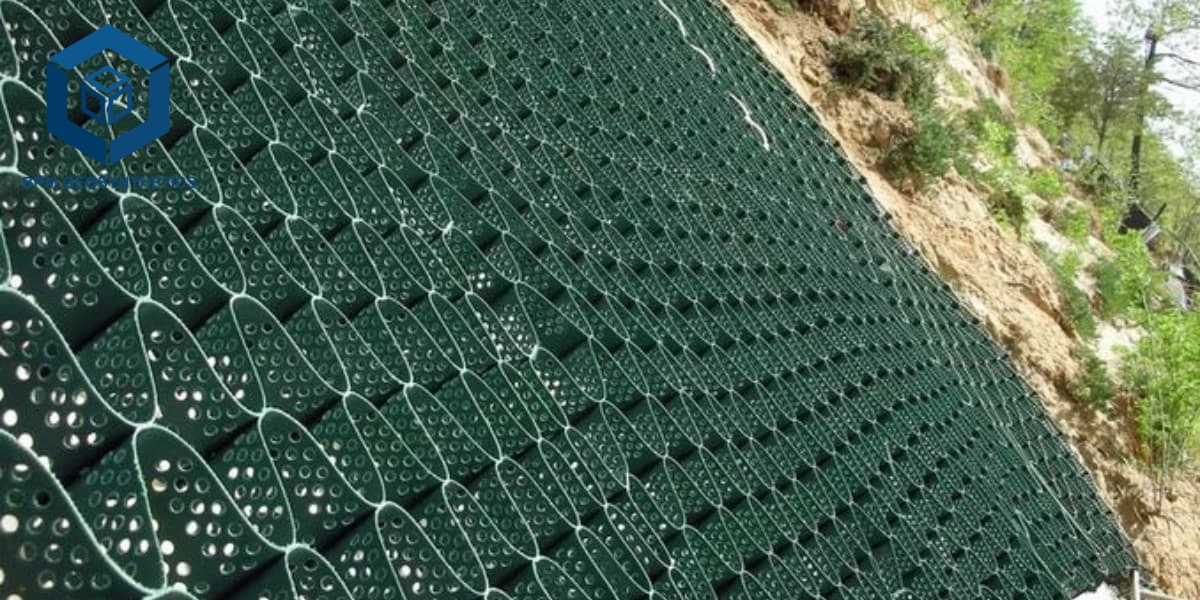
Geocells are three-dimensional honeycomb structures. They are made from high-density polyethylene (HDPE). The material is strong and durable. It resists chemicals and UV exposure.
2.1 The concept is simple.
The geocell is expanded over a slope. It creates a grid of small pockets. These pockets are filled with soil, gravel, or concrete. The cell walls confine the infill. This stops the material from moving. Even on steep slopes, the infill stays in place.
Think of it as a rigid mattress. It holds the soil together. Water can flow over the surface. It cannot dig deep channels. The system locks the soil in place. This prevents erosion from the start.
3. Key Elements of the Geoweb Slope Stabilization System
A simple plastic grid is nowhere near the Geoweb slope stabilization system- it is an entirely engineered erosion control and soil confinement solution. Besides, every component in the system contributes to overall slope stability, load distribution, and long-term performance.
3.1 Geocell Panels
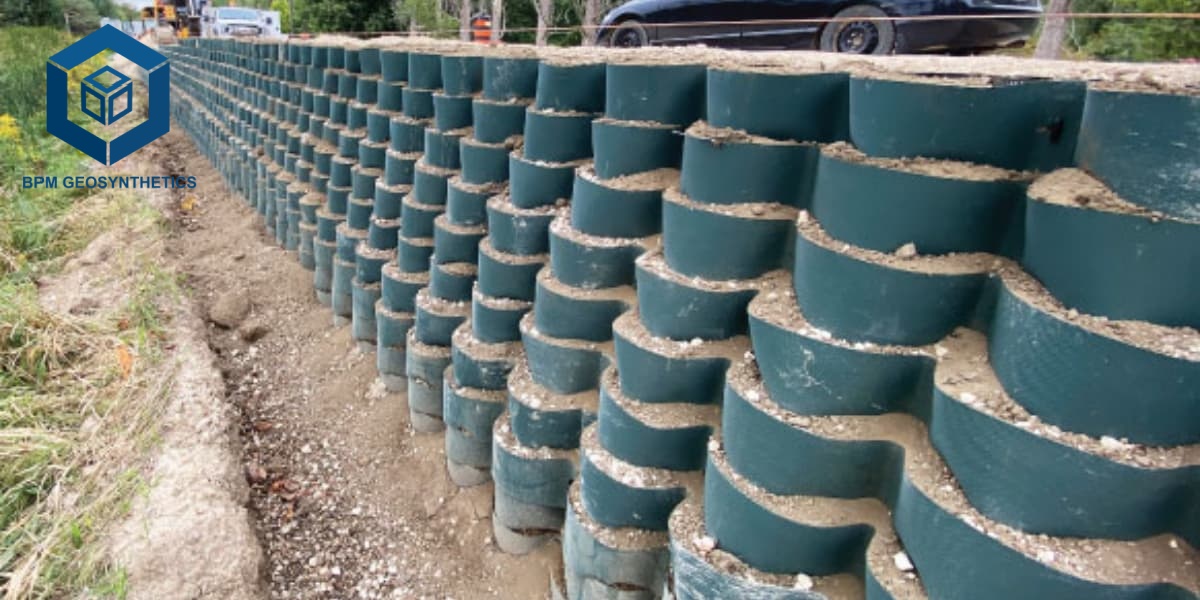
At the very heart of the GEOWEB system is the geocell panel. These panels, made of high-density polyethylene (HDPE) or polymer alloy, stretch out into a three-dimensional honeycomb form that holds soil and aggregate in place. There are several formats of cell depths and sizes to accommodate changing slope gradients and different loading conditions. Configurations of moderate-sized cells such as the GW30V model are quite popular, with typical cell depths ranging from 4 to 6 inches (approximately 10 to 15 cm) for effective slope reinforcement.
3.2 Tendon Clips
The tendon clips are a set of small devices that enable fastening of geocell panels to the tendons system. These clips have a high locking capacity, as they grip tightly to the cell walls and, in doing so, create a very secure attachment point for tendons. The designs of these clips accommodate quick pre-assembly operation in the field, providing dual benefits: time-saving and achieving higher structural integrity of steep slope constructions.
3.3 Keys and Panel Connectors
Keys are a type of dedicated connecting tools that allow two adjacent geocell panels to be joined together. They pass through special openings inside the cell walls and lock themselves by a small rotation. This is a very convenient connection way that offers fast, safe and reliable incorporation of panels with the goal of achieving continuity throughout the entire slope stabilization system.
3.4 Tendons
Strength and stability of the geocell framework are further increased by using polyester tendons as reinforcements and anchors. The tendons are fed through the tendon clips and run via the top anchor points or 'deadman' anchors on the slope. This setup is extremely useful for combating downslope movement and ensuring stability in the face of hydraulic or gravitational forces.
3.5 Anchors
Earth anchors, steel stakes or driven pins are largely utilized for fastening the whole geocell system tightly to the slope face. Anchors counteract soil lifting, sliding and soil dislocation as they are embedded deeply into the underlying soil or rock. Achieving long-term slope stability largely depends on proper selection of anchors and their correct spacing.
3.6 Geotextile Layer
A non-woven geotextile fabric are usually laid out under a geocell system as a separation and filtration medium. The geotextile acts as a barrier to the migration of fine soil particles while still permitting water to flow through the system. This not only enhances the erosion-resisting ability of the system but also keeps the stabilized slope structure intact over time.
4. Technical Specifications of Geoweb Slope Stabilization
Understanding the technical data is critical. The table below shows typical parameters for GEOWEB Geocells. These values ensure the system meets engineering standards.
Parameter | Typical Value / Range | Unit | Note |
Material | HDPE | -- | High-Density Polyethylene |
Cell Depth (Height) | 50, 75, 100, 150, 200 | mm | 4-inch (100mm) and 6-inch (150mm) are common for slopes |
Sheet Thickness | 1.0 - 1.5 (smooth), 1.4 - 1.5 (textured) | mm | Textured options provide better infill friction |
Welding Distance | 330 - 550 | mm | Defines the cell size |
Stretched Panel Size | ~5.7 x 6.2 (width x length) | m | Covers large areas quickly |
Tensile Yield Strength | ≥ 20.0 (sheet material) | MPa | Provides strong confinement |
Seam Peel Strength | ≥ 1000 | N/10cm | Ensures welds do not break under load |
Density | ~ 960 | kg/m³ | Lightweight for easy handling |
Temperature Range | -60 to +60 | ℃ | Works in extreme cold and hot climates |
Service Life | > 50 years | -- | Long-term durability |
Note: This table shows standard parameters. Custom specifications are available for specific project needs.
5. Geoweb Slope Stabilization Real-World Success
5.1 The Canadian Rockies Project
A coal mine in British Columbia had a failing shale slope. The slope was above a critical coal conveyor. The initial plan used only topsoil. It failed. Snow loads and erosion were too high. The project needed a permanent fix.
Engineers chose the GEOWEB system. They used the GW30V4 panel. It is a mid-size cell, 4 inches deep. The slope was steep. The team dug a trench at the top. They placed a deadman pipe inside. They laid a geotextile over the slope. Then they expanded the geocell down the face. Tendons connected the geocell to the deadman anchor. Tendon Clips locked the tendons. The cells were filled with topsoil. Finally, the area was seeded.
- The result: A stable slope. The HDPE geocell held the soil in place. Vegetation grew back. The solution was fast to install and cost-effective.
5.2 The Artistic Highway Slope
Sometimes, function must meet form. A slope protection project in Calgary was highly visible. It was next to a major road. The slope was a steep 1:1 angle. It had severe erosion problems. The solution needed to be strong. It also needed to look good.
The team used the GEOWEB GW30V4 system. They anchored it with 450 earth anchors. Each anchor was tested for strength. The really clever part was the infill. They used two different colors of stone. The stones were arranged in patterns. This created a design that looks like mountains. The slope is now a landmark. It stops erosion. It also blends with the natural environment.
- The result: A durable, maintenance-free slope. It showcases how geoweb geocell can be both functional and beautiful.
6. Geoweb Slope Stabilization Installation Process: Step-by-Step
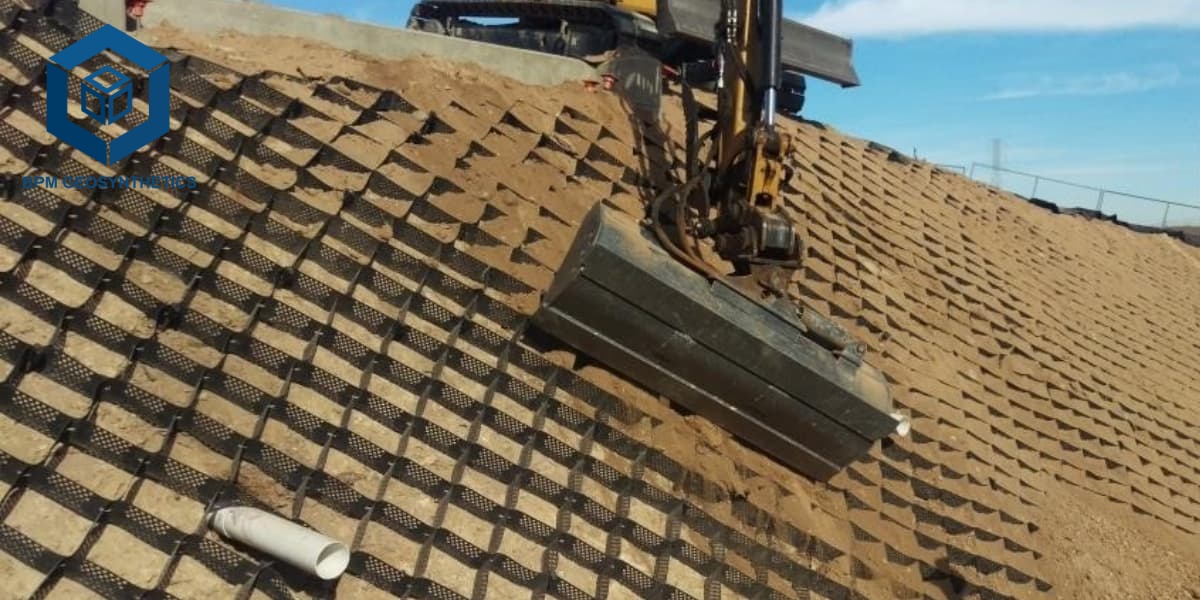
If the planning and site preparation are well done, installing a geocell slope stabilization system will turn out to be a quite efficient process. Every layer of installation contributes to the eventual stability and performance of the reinforced slope system.
6.1 Site Preparation
According to engineering design specification, clearing of the slope surface is the initial step to be undertaken. The slope needs to be reshaped at the desired angle and all remaining debris, vegetation, roots, and big rocks removed. At some sites, the soil might require compaction to make a firm foundation for the installation works.
6.2 Anchor Trench Construction
Generally, an anchor trench is dug at the top of the slope to fix the upper edge of the geocell system. This trench marks the spot of the deadman anchor which not only acts as a firm anchoring point for tendons but also aresists the downslope movement due to gravity or erosion forces.
6.3 Geotextile Placement
The first thing to do is to unroll the non-woven geotextile fabric on the slope surface. It is necessary to overlap adjacent fabric sections as per project specifications. Geotextile is a filtration and separation layer that completely prevents soil migration while the water is drained through the system.
6.4 Geocell Panel Expansion
Then, on the slope, the GEOWEB panels are spread out to create the three-dimensional cellular confinement structure. The neighboring panels are attached side-by-side by using Keys or connectors. Proper panel alignment is needed so there is even load distribution and slope coverage.
6.5 Tendon Installation
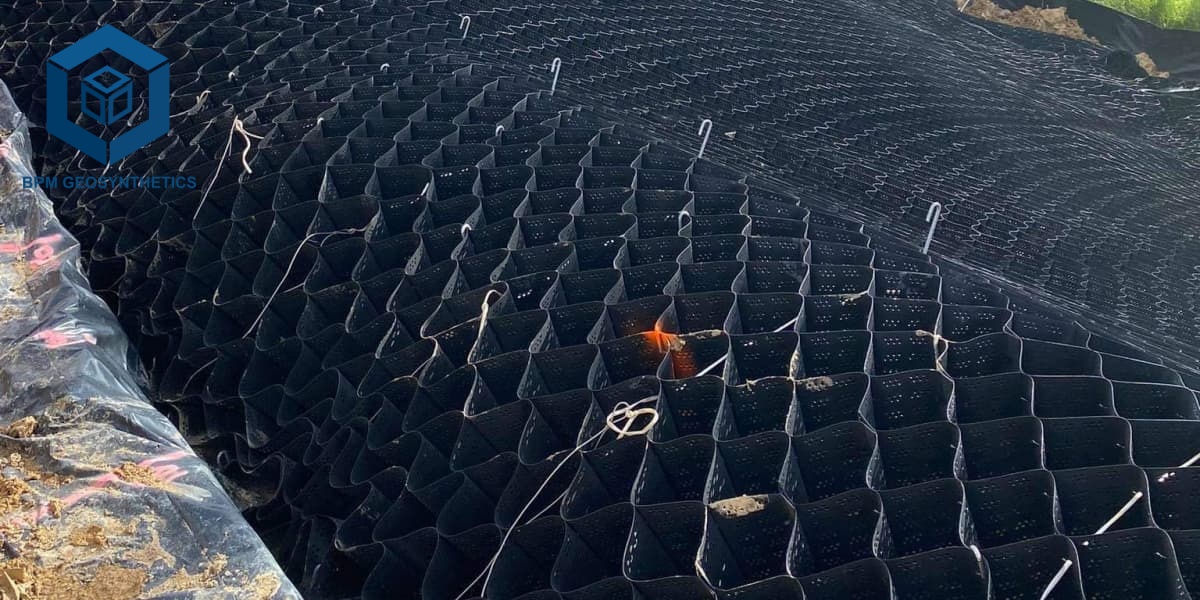
The tendon clips that are part of the geocell panels serve as guides for polyester tendons. These tendons, linked to the deadman anchor at the slope's top, are another way to reinforce the geocell system and increase its ability to resist sliding forces on steep slopes.
6.6 Anchoring the System
To provide stability, earth anchors, steel stakes, or driven pins are inserted through the geocell structure into the soil beneath it. The distance between anchors and the pattern depend on the steepness of the slope, soil conditions, and project requirements. More extensive anchoring patterns are usually necessary for steeper slopes and environments with high water flow.
6.7 Infill Placement
After the geocell system has been secured, the cells are filled with the chosen infill material, e.g. topsoil, aggregate, gravel or concrete. The filling is done top to the bottom of the slope which is a standard practice so as not to put stress on the expanded panels. It is often advisable to overfill slightly to allow for material settlement.
6.8 Compaction and Surface Finishing
When using soil or aggregate as the infill, it is a good idea to lightly compact it so as to improve stability and lessen the chance of settlement in the future. Vegetated applications (grass seed or hydroseeding) are done after installation. Wetting the fill material slightly can also aid in its settling and support the growth of vegetation.
7. Geoweb Slope Stabilization Benefits at a Glance
The geocell erosion control system offers many benefits from engineering and envirolmental perspectives. This has turned it into a dependable method for combating erosion, protecting slopes, and reinforcing ground over the long term.
7.1 Effective Erosion Control
Because of its 3D cellular architecture, the rate at which water travels across the surface is greatly reduced. Confining soil and aggregate within individual cells allows the system to prevent not only sheet erosion but also rill erosion and gully formation, even on steep slopes or in high rainfall conditions.
7.2 Enhanced Slope Stability
By containing the fill materials and spreading the loads more uniformly, the geocell system enhances the mechanical stability of the slope surfaces. As a result of this confinement, the surface layer is strengthened and the risk of soil displacement, shallow slope failures, and surface instability is reduced.
7.3 Excellent Flexibility and Terrain Adaptation
Unlike rigid concrete structures, GEOWEB panels can conform to irregular ground surfaces and uneven terrain. This flexibility allows the system to adapt to a wide range of slope geometries and makes it suitable for slopes as steep as 1:1, depending on project design requirements.
7.4 Long-Term Durability
Manufactured from high-density polyethylene (HDPE) or advanced polymer materials, the geocell system offers strong resistance to UV exposure, chemical attack, weathering, and biological degradation. Under proper installation conditions, the design service life can exceed 50 years.
7.5 Fast and Efficient Installation
The modular design of the GEOWEB system allows for relatively quick installation compared to traditional slope protection methods. Pre-assembled panels, tendon clips, and fast-connect Keys help reduce labor requirements and improve installation efficiency on large projects.
7.6 Environmentally Friendly Solution
The geocell cells can be filled with topsoil to support the growth of native vegetation. This creates a more natural and visually appealing slope surface while promoting environmental restoration, stormwater management, and ecological sustainability.
8. Choosing the Right Infill for Geoweb Slope Stabilization
Infill material is not simply a filler within the geocell structure. It is a critical design component that directly affects slope performance, durability, drainage capability, and visual appearance. The selection of infill depends on project requirements, environmental conditions, and desired long-term outcomes.
8.1 Topsoil Infill
Topsoil is commonly used for landscaping and environmentally sensitive slope stabilization projects. When combined with vegetation, the geocell system helps create a reinforced vegetated surface that blends naturally into the surrounding environment. The confined soil structure supports root development and reduces erosion during heavy rainfall. In many cases, an erosion control blanket or hydroseeding layer is applied during the initial germination period to improve vegetation establishment.
8.2 Aggregate Infill
Aggregate or crushed stone infill is preferred for applications requiring durable, low-maintenance surface protection. Clean angular stone provides excellent drainage performance and can withstand high water flow velocities, making it suitable for channels, embankments, and stormwater infrastructure. Aggregate-filled geocells also resist erosion effectively while allowing flexibility in design through the use of different stone sizes and colors.
8.3 Concrete Infill
Concrete infill is selected for projects requiring maximum structural strength and heavy-duty surface protection. In this configuration, the geocell system acts as a flexible formwork that confines the concrete and improves crack resistance. Concrete-filled geocells are commonly used in severe hydraulic environments, steep slope reinforcement, spillways, and areas exposed to heavy loading or continuous water flow.
9. Summary: A Complete Solution
Slope failure is a risk. The GEOWEB Geocell System removes that risk. It is a proven technology. From mining sites to city highways, it works. The system combines strong materials with smart design. Each component is engineered for performance. The result is a slope that lasts. It resists erosion. It stabilizes the surface. It protects valuable assets. For engineers and contractors looking for a reliable solution, The Best Project Material Co., Ltd.(BPM Geosynthetics) GEOWEB Geocells are the clear answer. They are the ultimate guide to slope protection.