Which Liner is Suitable for Drinking Water Reservoir: Engineering Guide
What is Which Liner is Suitable for Drinking Water Reservoir?
Which liner is suitable for drinking water reservoir is a critical engineering question for selecting geomembrane materials that are safe for potable water storage, meeting stringent health and safety regulations. For civil engineers, EPC contractors, and procurement managers, determining which liner is suitable for drinking water reservoir requires evaluating: NSF/ANSI 61 certification (toxicity testing), chemical resistance (no leaching of plasticizers or additives), UV resistance (for uncovered reservoirs), and mechanical durability. The most common approved materials include: HDPE (high-density polyethylene) — widely used, NSF/ANSI 61 certified, excellent chemical inertness; LLDPE — similar to HDPE, more flexible; PVC — limited approval (plasticizer concerns); and EPDM — approved but expensive. This guide provides engineering data on which liner is suitable for drinking water reservoir: NSF/ANSI 61 standards, material safety, thickness selection (1.0–2.0 mm), UV protection, and procurement for municipal reservoirs, rural water storage, and emergency supply.
Technical Specifications for Drinking Water Reservoir Liners
The table below defines critical parameters for which liner is suitable for drinking water reservoir.
| Parameter | HDPE (NSF/ANSI 61) | LLDPE (NSF/ANSI 61) | PVC (Potable Grade) | EPDM | Engineering Importance |
|---|---|---|---|---|---|
| NSF/ANSI 61 Certification | Yes (widely available) | Yes | Limited (some grades) | Yes | Required for potable water contact. Primary answer to which liner is suitable for drinking water reservoir. |
| Chemical Inertness (Leaching) | Excellent — no plasticizers | Excellent | Plasticizers may leach | Good | HDPE/LLDPE contain no additives that leach into water. |
| Thickness Range | 1.0 – 2.0 mm | 1.0 – 2.0 mm | 0.5 – 1.5 mm | 0.75 – 1.5 mm | Thicker liner provides longer service life. |
| UV Resistance | Excellent (carbon black 2–3%) | Excellent | Poor (requires cover) | Fair (requires cover) | Drinking water reservoirs may be uncovered — UV protection required. |
| Bacterial Growth Resistance | Good (smooth surface) | Good | Good | Good | Smooth surface resists biofilm formation. |
| Expected Service Life (Potable Water) | 50+ years | 30 – 50 years | 15 – 25 years | 20 – 30 years | HDPE offers longest lifespan. |
| Relative Cost | 1.0x (baseline) | 1.1 – 1.2x | 0.8 – 0.9x | 2.0 – 3.0x | HDPE most cost-effective for large reservoirs. |
Key takeaway: Which liner is suitable for drinking water reservoir? HDPE and LLDPE with NSF/ANSI 61 certification are the preferred choices. PVC requires careful verification; EPDM is cost-prohibitive for large installations.
Material Structure and Composition for Drinking Water Safety
Understanding material safety helps answer which liner is suitable for drinking water reservoir.
| Component | HDPE / LLDPE | PVC (Potable Grade) | Potable Water Impact |
|---|---|---|---|
| Base Polymer | Polyethylene (non-toxic) | Polyvinyl chloride | Polyethylene is inert; PVC may contain residual vinyl chloride monomer. |
| Plasticizers | None | Phthalates or non-phthalates (DOTP) | Plasticizers can leach into water — must be NSF/ANSI 61 certified. |
| Antioxidants | Hindered phenols + phosphites | May contain stabilizers | NSF testing ensures no harmful levels leach. |
Engineering insight: Which liner is suitable for drinking water reservoir? HDPE and LLDPE are inherently safe because they contain no plasticizers. PVC requires special potable water grade certification.
Manufacturing Process for Potable Water Liners
Production steps for drinking water approved geomembranes.
Raw material compounding: Virgin polyethylene resin only (no recycled content) — required for NSF/ANSI 61. Additives strictly controlled.
Extrusion: Flat die extrusion (200–220°C). No cross-contamination with non-potable materials. Line dedicated to potable grade products.
Calendering / polishing: Smooth surface finish to minimize biofilm formation.
Cooling: Controlled cooling to prevent residual stress.
Quality inspection: NSF/ANSI 61 testing for VOC extraction. Additional testing for taste and odor (ASTM D1292).
Packaging: Clean, UV-protective wrapping. Labeled with NSF certification number and potable water approval.
Performance Comparison: Liner Materials for Drinking Water Reservoirs
Comparing options for which liner is suitable for drinking water reservoir.
| Material | NSF/ANSI 61 | UV Resistance | Puncture Resistance | Service Life | Relative Cost | Suitable for Drinking Water? |
|---|---|---|---|---|---|---|
| HDPE (1.5 mm) | Yes | Excellent | Good (320–380 N) | 50+ years | 1.0x | Yes — Preferred |
| LLDPE (1.5 mm) | Yes | Excellent | Good (280–340 N) | 30–50 years | 1.1 – 1.2x | Yes — Good flexibility |
| PVC (Potable Grade) | Limited (vendor specific) | Poor (requires cover) | Fair | 15–25 years | 0.8 – 0.9x | Yes — With verification |
| EPDM | Yes | Poor (requires cover) | Good | 20–30 years | 2.0 – 3.0x | Yes — Expensive |
Conclusion: Which liner is suitable for drinking water reservoir? HDPE and LLDPE are the optimal choices. PVC requires careful NSF verification; EPDM is cost-prohibitive for large reservoirs.
Industrial Applications for Drinking Water Reservoir Liners
Applications requiring which liner is suitable for drinking water reservoir selection.
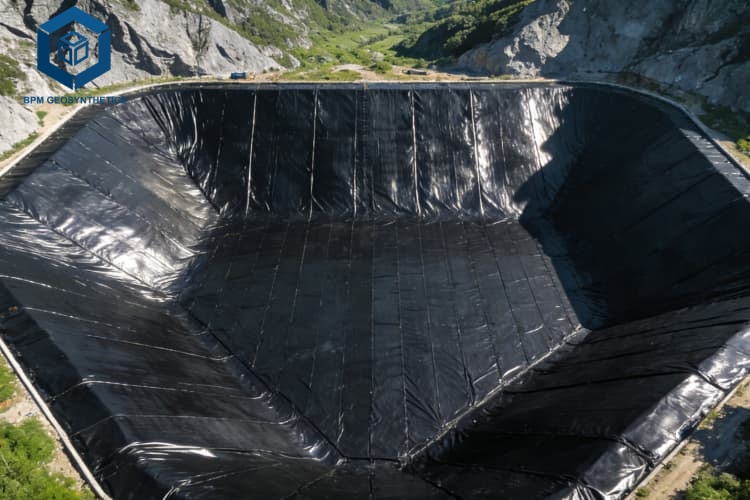
Municipal water storage reservoirs (large, uncovered): HDPE 1.5 mm, NSF/ANSI 61, UV resistant (carbon black 2–3%).
Rural community water storage (covered or small): LLDPE or HDPE, NSF certified.
Emergency water storage (temporary): PVC (potable grade) may be acceptable for short-term (1–5 years).
Fire protection water reservoirs (potable source): HDPE 1.0–1.5 mm, NSF certified.
Irrigation water storage (human contact indirect): HDPE or LLDPE without NSF may be acceptable, but NSF recommended.
Covered reservoirs (dome or floating cover): PVC or EPDM may be used if covered (UV not an issue), but HDPE still preferred for longevity.
Common Industry Problems with Drinking Water Liners
Real-world failures inform which liner is suitable for drinking water reservoir.
Problem 1: Plasticizer leaching from PVC liner (taste/odor complaints)
Root cause: Non-potable grade PVC used in drinking water reservoir. Plasticizers leached, causing taste and odor. Solution: Specify NSF/ANSI 61 certified liner. HDPE is inherently safer.
Problem 2: UV degradation of HDPE — carbon black below 2%
Root cause: Liner specified as "UV stabilized" but carbon black content < 2%. Surface cracking after 4 years. Solution: For uncovered reservoirs, specify carbon black 2.0–3.0% per ASTM D1603.
Problem 3: Biofilm growth on smooth liner (water quality issue)
Root cause: Even with NSF certification, biofilm can grow on any submerged surface. Solution: Regular cleaning protocols. Consider smooth HDPE (which resists biofilm better than textured).
Problem 4: Seam failure allowing water infiltration of subgrade
Root cause: Poor welding. Solution: Require certified welders, 100% non-destructive testing (air channel, vacuum box), destructive testing every 500 m.
Risk Factors and Prevention Strategies for Drinking Water Liners
Risk: Specifying non-NSF certified liner for potable water: Regulatory violation, health risk. Mitigation: Always require NSF/ANSI 61 certification. This is the definitive answer to which liner is suitable for drinking water reservoir.
Risk: Using PVC without potable water certification: Plasticizer leaching. Mitigation: If PVC must be used, require NSF/ANSI 61 certification and phthalate-free declaration.
Risk: Uncovered reservoir with non-UV stabilized HDPE: Premature cracking. Mitigation: Specify carbon black 2.0–3.0% and UV stabilizers.
Risk: No taste and odor testing before commissioning: Consumer complaints. Mitigation: Perform ASTM D1292 taste and odor test on water after liner installation.
Procurement Guide: How to Choose Which Liner is Suitable for Drinking Water Reservoir
Follow this 8-step checklist for B2B purchasing decisions.
Determine reservoir type: Uncovered → UV resistant HDPE required. Covered → UV protection less critical.
Require NSF/ANSI 61 certification: Mandatory for all potable water contact liners. Request certificate.
Specify material type: HDPE or LLDPE preferred. PVC only with verified potable grade.
Specify thickness: 1.0 mm for small reservoirs; 1.5 mm for large or high-traffic; 2.0 mm for long design life (> 50 years).
For uncovered reservoirs, specify UV protection: Carbon black 2.0–3.0% (ASTM D1603), Category 1 or 2 dispersion.
Require chemical extraction testing: NSF/ANSI 61 or equivalent. Request report.
Order samples and perform taste/odor test (ASTM D1292): Immerse liner in water for 7 days, test for off-flavors.
Review warranty: Minimum 10 years for PVC, 20–25 years for HDPE/LLDPE for potable water service.
Engineering Case Study: Which Liner is Suitable for Drinking Water Reservoir — 50,000 m² Municipal Reservoir
Project type: Municipal drinking water storage reservoir (uncovered).
Location: Midwest USA.
Project size: 50,000 m², water depth 6 m.
Which liner is suitable for drinking water reservoir analysis: Uncovered reservoir requires UV resistance. NSF/ANSI 61 certification mandatory. Long design life (50+ years) required.
Selected liner: 1.5 mm HDPE, NSF/ANSI 61 certified, carbon black 2.5%, Category 1 dispersion, PE100 resin, OIT 110 minutes.
Results after 5 years: No leaks, no taste/odor complaints, no UV degradation. Water quality tests passed. This case demonstrates that HDPE with NSF/ANSI 61 and UV protection is the correct answer to which liner is suitable for drinking water reservoir for uncovered municipal applications.
Frequently Asked Questions: Which Liner is Suitable for Drinking Water Reservoir
Q1: Which liner is suitable for drinking water reservoir — HDPE or PVC?
HDPE is preferred. It contains no plasticizers, has excellent UV resistance, and is widely NSF/ANSI 61 certified. PVC can be used only if specifically certified for potable water.
Q2: Is NSF/ANSI 61 certification required for drinking water liners?
Yes. NSF/ANSI 61 is the standard for materials in contact with potable water. It tests for extraction of volatile organic compounds (VOCs), metals, and other contaminants. This is the definitive answer to which liner is suitable for drinking water reservoir.
Q3: Can EPDM be used for drinking water reservoirs?
Yes, EPDM is NSF/ANSI 61 certified for potable water. However, it is 2–3x more expensive than HDPE, has poor UV resistance (must be covered), and has shorter service life (20–30 years).
Q4: Does HDPE leach chemicals into drinking water?
No. HDPE is chemically inert and contains no plasticizers. NSF/ANSI 61 certified HDPE has been tested and shown to not leach harmful levels of any contaminants.
Q5: What thickness HDPE is required for drinking water reservoirs?
1.5 mm (60 mil) is standard for most municipal reservoirs. 1.0 mm for small or temporary storage. 2.0 mm for high-head applications (> 10 m) or longer design life.
Q6: Does a drinking water reservoir liner need UV protection?
If the reservoir is uncovered, yes. UV radiation degrades polyethylene over time. Specify carbon black 2.0–3.0% for UV resistance. If covered (dome or floating cover), UV protection not required.
Q7: Can recycled HDPE be used for drinking water liners?
No. NSF/ANSI 61 requires virgin resin only. Recycled content has unknown history and potential contaminants. Potable water liners must be 100% virgin HDPE.
Q8: What is the expected service life of an HDPE liner in a drinking water reservoir?
50+ years with proper specification (PE100 resin, PENT ≥ 500 h, OIT ≥ 100 min, carbon black 2–3%). Field performance confirms 30+ years.
Q9: How to test if a liner affects water taste or odor?
ASTM D1292: Immerse liner sample in water (23°C, 7 days), then perform sensory evaluation. No off-taste or odor should be detected.
Q10: Which liner is most cost-effective for large drinking water reservoirs?
HDPE. It offers the lowest lifecycle cost due to long service life (50+ years), moderate material cost, and excellent UV resistance.
Request Technical Support or Quotation for Drinking Water Reservoir Liners
For project-specific which liner is suitable for drinking water reservoir consultation, including NSF/ANSI 61 certification verification, thickness selection, and bulk procurement, our technical team is available.
Request a quotation – Provide reservoir size, water depth, uncovered/covered, and design life.
Request engineering samples – Receive NSF/ANSI 61 certified HDPE and LLDPE samples with test reports.
Download technical specifications – NSF/ANSI 61 compliance guide, potable water liner selection chart, and procurement checklist.
Contact technical support – NSF certification verification, taste/odor testing coordination, and installation QA/QC for drinking water reservoirs.
About the Author
This guide on which liner is suitable for drinking water reservoir was written by Dipl.-Ing. Hendrik Voss, a civil engineer with 19 years of experience in geosynthetics for potable water infrastructure. He has designed over 200 drinking water reservoir liner systems across North America, Europe, and Asia, specializing in NSF/ANSI 61 compliance, UV durability analysis, and taste/odor testing for municipal water storage. His work is referenced in GRI and ASTM D35 committee discussions on geomembrane standards for potable water applications.